{domain:"www.qualitydigest.com",server:"169.47.211.87"} Skip to main content

        
User account menu
Main navigation
  • Topics
    • Customer Care
    • Regulated Industries
    • Research & Tech
    • Quality Improvement Tools
    • People Management
    • Metrology
    • Manufacturing
    • Roadshow
    • QMS & Standards
    • Statistical Methods
    • Resource Management
  • Videos/Webinars
    • All videos
    • Product Demos
    • Webinars
  • Advertise
    • Advertise
    • Submit B2B Press Release
    • Write for us
  • Metrology Hub
  • Training
  • Subscribe
  • Log in
Mobile Menu
  • Home
  • Topics
    • Customer Care
    • Regulated Industries
    • Research & Tech
    • Quality Improvement Tools
    • People Management
    • Metrology
    • Manufacturing
    • Roadshow
    • QMS & Standards
    • Statistical Methods
    • Supply Chain
    • Resource Management
  • Login / Subscribe
  • More...
    • All Features
    • All News
    • All Videos
    • Contact
    • Training

Streamlined Transition From Scan-to-CAD

Creaform’s scan-to-CAD solution eliminates guesswork in reverse engineering

Creaform

Creaform
Thu, 07/03/2025 - 12:02
  • Comment
  • RSS

Social Sharing block

  • Print
Body

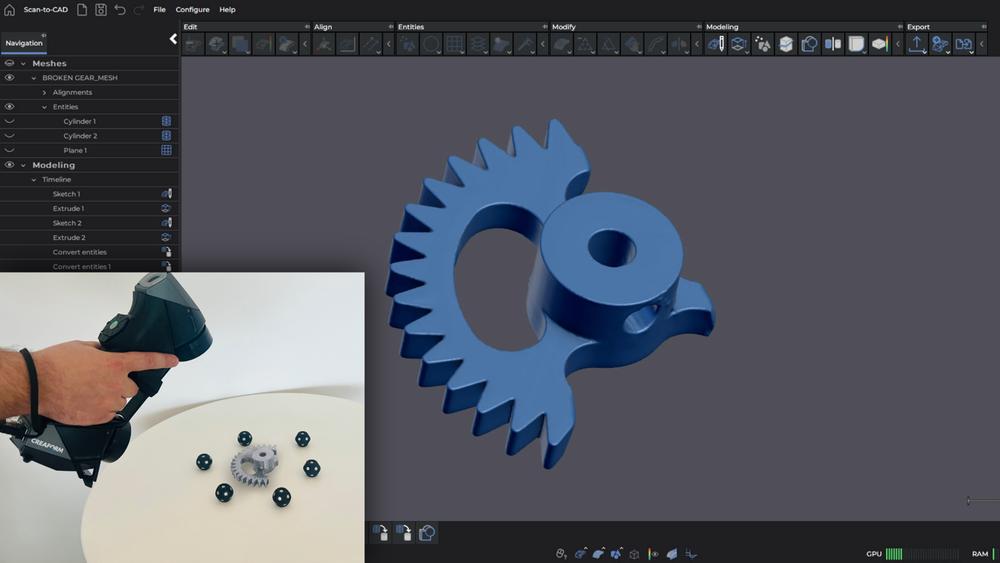
Streamlining the transition from scan-to-CAD involves selecting the right tool set for reverse engineering. However, many software platforms force product designers to switch between multiple tools, disrupting their workflow and increasing the risk of errors. Furthermore, some advanced scan-to-CAD tools come with a steep learning curve, which can slow adoption and make reverse engineering less accessible to general users.

ADVERTISEMENT

What happens when a reverse-engineering process starts with noisy or incomplete data?

Raw scan data (e.g., point clouds or triangular meshes) often contain noise or gaps that must be cleaned or interpolated. Otherwise, poorly processed data can lead to inaccuracies in the CAD model or add unnecessary complexity to the design. When scan data have excessive noise and low resolution, extracting key features—such as planes, cylinders, or holes—becomes more difficult. Product designers must manually re-create these features in CAD software, a process that’s time-consuming and prone to guesswork, approximations, and errors.

 …

Want to continue?
Log in or create a FREE account.
Enter your username or email address
Enter the password that accompanies your username.
By logging in you agree to receive communication from Quality Digest. Privacy Policy.
Create a FREE account
Forgot My Password
Top Stories
What FDA Warning Letters Reveal About Records, Spreadsheets, and AI
ISO 9001:2026 Ethics and Quality Culture
The Art of Forecasting: Part 1
Avoiding the 7 Deadly Killers of Projects
ISO 9001:2026 Is Here

Add new comment

Please login to comment.

© 2026 Quality Digest. Copyright on content held by Quality Digest or by individual authors. Contact Quality Digest for reprint information.
“Quality Digest" is a trademark owned by Quality Circle Institute Inc.

footer
  • Home
  • Print QD: 1995-2008
  • Print QD: 2008-2009
  • Videos
  • Privacy Policy
  • Write for us
footer second menu
  • Subscribe to Quality Digest
  • About Us
  • Contact Us