
Photo by Vitaly Gariev on Unsplash
Social Sharing block

According to Shigeo Shingo, a subtle but important distinction exists between problem-solving and continuous improvement.
|
ADVERTISEMENT |
I grew up in manufacturing with the idea that problem solving was standardization kaizen: a means to return flagging process performance to an established standard. For example, when a machine suddenly began producing defects, a team gathered, progressively asked why five times, and uncovered the root cause: a worn locator pin. The pin was replaced, and the defect eliminated. An abnormal condition was identified, and the established standard was restored.
I think I first learned this approach from Taiichi Ohno’s Toyota Production System: Beyond Large-Scale Production (Productivity Press, 1988). Years later, 5 Whys became a standard component of A3 thinking.
But from Shingo’s perspective, nothing was actually improved by asking why five times. The result of 5 Whys was to restore the process to an existing standard. Shingo saw more possibilities. Ever the antagonist of the status quo, he explained that why was not itself a phenomenon, but rather a means to interrogate the actual phenomena in a process:
• What—the object of the work
• Who—the people and machines (subjects) who did the work
• How—the method used
• Where—the physical space and location where the work was performed
• When—the time frame for the work
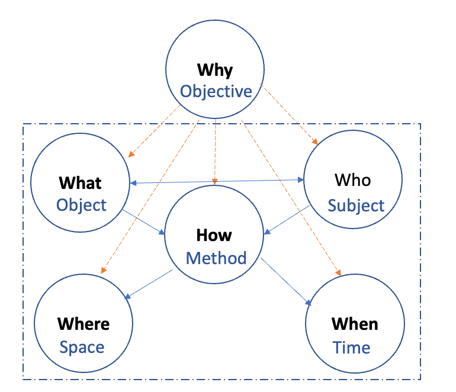
Improvement kaizen inquired why of each of these production phenomena in order to raise performance to a higher level than before. Shingo encouraged us to ask a deeper question than “What is the cause of the problem?” He challenged: “Why do we do it this way at all?” Could the locator be redesigned so it can’t wear into the wrong position? Could the part be self-locating? Could mistake-proofing make incorrect positioning impossible? Better still, could the entire operation be simplified or eliminated? Those questions sought a new standard, not a return to the old one. Shingo’s 5W1H was more than direct observation. It was directed observation to make sure no stone was unturned.
This distinction appears repeatedly throughout Shingo’s writing. He admired disciplined root-cause analysis, but he also warned against becoming too comfortable fixing yesterday’s problems. A factory can become exceptionally good at extinguishing fires while making little progress toward eliminating the conditions that create them. In other words, organizations can become complacent with maintaining the status quo. Shingo’s philosophy challenged us to seek perfection. Inspection shouldn’t become just better; defects should become impossible. Setup shouldn’t merely become more consistent; it should become dramatically shorter. Scheduling shouldn’t become increasingly sophisticated if better flow can reduce the need for scheduling altogether. In each case, the objective is not simply to solve a problem but to redesign the process so that the problem no longer exists—or never has the opportunity to recur.
Perhaps this is why Shingo devoted so much of his career to not merely teaching techniques, but to changing the way people think. The real opportunity isn’t becoming faster at solving problems. It’s designing processes that make yesterday’s problems increasingly irrelevant.
That’s the essence of improvement kaizen. As I think back on the excitement surrounding improvement kaizen in my former factory, it was the exhaustive frontline investigation and creativity that defined our culture.
So, the next time your team celebrates solving a problem, pause for one more question:
Have you simply restored the process, or have you actually improved it?
Published Aug. 10, 2026, in the GBMP Old Lean Dude blog.
Comments
Easy confuse
The article is inspiring as we always confused the two without knowing. We always want our life to be easy ,not to make mistake rather than risking and take steps to go forward. That is sometimes the wish of our management, the culture was created and encouraged. The change should come from management rather than start from bottom level workers or engineers.
The improvement need support from management and capability to take risk and accept possible mistakes. Unfortunately, they are not always a necessary character for operation managers.
Add new comment