{domain:"www.qualitydigest.com",server:"169.47.211.87"} Skip to main content

        
User account menu
Main navigation
  • Topics
    • Customer Care
    • Regulated Industries
    • Research & Tech
    • Quality Improvement Tools
    • People Management
    • Metrology
    • Manufacturing
    • Roadshow
    • QMS & Standards
    • Statistical Methods
    • Resource Management
  • Videos/Webinars
    • All videos
    • Product Demos
    • Webinars
  • Advertise
    • Advertise
    • Submit B2B Press Release
    • Write for us
  • Metrology Hub
  • Training
  • Subscribe
  • Log in
Mobile Menu
  • Home
  • Topics
    • Customer Care
    • Regulated Industries
    • Research & Tech
    • Quality Improvement Tools
    • People Management
    • Metrology
    • Manufacturing
    • Roadshow
    • QMS & Standards
    • Statistical Methods
    • Supply Chain
    • Resource Management
  • Login / Subscribe
  • More...
    • All Features
    • All News
    • All Videos
    • Contact
    • Training

Watching Subsurface Defects As They Move

A new class of bulk measurements is now accessible with time-resolved dark-field X-ray microscopy

Lawrence Livermore National Laboratory
Wed, 08/04/2021 - 12:02
  • Comment
  • RSS

Social Sharing block

  • Print
Body

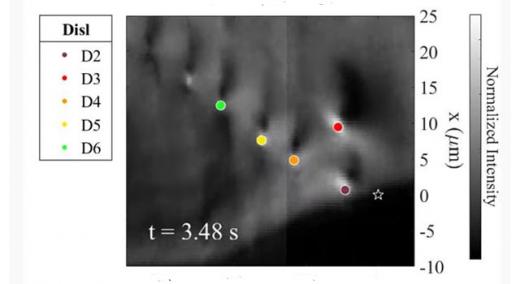
A Lawrence Livermore National Laboratory (LLNL) scientist and collaborators have demonstrated the first-ever “defect microscope” that can track how populations of defects deep inside macroscopic materials move collectively.

ADVERTISEMENT

The research, which appeared last month in Science Advances, shows a classic example of a dislocation (line defect) boundary, then demonstrates how these same defects move exotically just at the edge of melting temperatures.

“This work presents a large step forward for materials science, physics, and related fields, as it offers a unique new way to view the ‘intermediate scales’ that connect microscopic defects to the bulk properties they cause,” says Leora Dresselhaus-Marais, a former Lawrence fellow and now assistant professor of materials science and engineering at Stanford University.

 …

Want to continue?
Log in or create a FREE account.
Enter your username or email address
Enter the password that accompanies your username.
By logging in you agree to receive communication from Quality Digest. Privacy Policy.
Create a FREE account
Forgot My Password
Top Stories
AI May Be Making Your Quality Problem Worse
The 6 Best Quality Management Software Features That Simplify Your QMS
What I Discovered About Quality Concepts by Watching My Newborn Granddaughter
Why Products Still Fail RoHS, REACH, and POPs Compliance
The Hidden Cost of Poor Quality in Regulated Manufacturing

Add new comment

Please login to comment.

© 2026 Quality Digest. Copyright on content held by Quality Digest or by individual authors. Contact Quality Digest for reprint information.
“Quality Digest" is a trademark owned by Quality Circle Institute Inc.

footer
  • Home
  • Print QD: 1995-2008
  • Print QD: 2008-2009
  • Videos
  • Privacy Policy
  • Write for us
footer second menu
  • Subscribe to Quality Digest
  • About Us
  • Contact Us