{domain:"www.qualitydigest.com",server:"169.47.211.87"} Skip to main content

        
User account menu
Main navigation
  • Topics
    • Customer Care
    • Regulated Industries
    • Research & Tech
    • Quality Improvement Tools
    • People Management
    • Metrology
    • Manufacturing
    • Roadshow
    • QMS & Standards
    • Statistical Methods
    • Resource Management
  • Videos/Webinars
    • All videos
    • Product Demos
    • Webinars
  • Advertise
    • Advertise
    • Submit B2B Press Release
    • Write for us
  • Metrology Hub
  • Training
  • Subscribe
  • Log in
Mobile Menu
  • Home
  • Topics
    • Customer Care
    • Regulated Industries
    • Research & Tech
    • Quality Improvement Tools
    • People Management
    • Metrology
    • Manufacturing
    • Roadshow
    • QMS & Standards
    • Statistical Methods
    • Supply Chain
    • Resource Management
  • Login / Subscribe
  • More...
    • All Features
    • All News
    • All Videos
    • Contact
    • Training

A Look at Three Position Sensors for Hydraulic Cylinder Feedback

Which satisfies best when total installed cost vs. performance are compared?

Edward Herceg
Tue, 06/30/2015 - 14:59
  • Comment
  • RSS

Social Sharing block

  • Print
Body

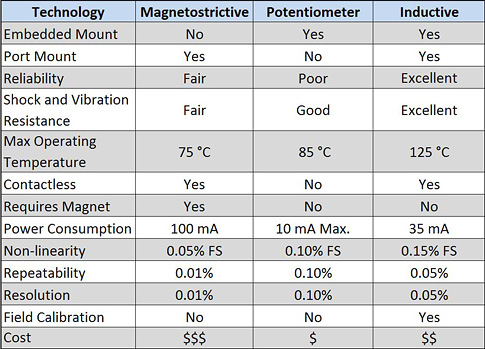
Position feedback sensors for hydraulic or pneumatic cylinders have used one of three traditional technologies: magnetostrictive, variable resistance, and variable inductance sensors. Occasionally other sensor technologies have  been used successfully in this application, but the focus of this article is to compare these three most commonly used technologies.

ADVERTISEMENT

As the demand for increased control and functionality has increassd, sensor-instrumented cylinders are becoming more important in the heavy industry, subsea, and mobile equipment arenas. Ultimately, a user or systems integrator must determine the requirements of the application and which technology best satisfies it on a total installed cost vs. performance basis. The strengths and weaknesses of magnetostrictive, variable resistance, and variable inductance sensors are discussed below, and a chart is included for feature-by-feature comparisons.
 …

Want to continue?
Log in or create a FREE account.
Enter your username or email address
Enter the password that accompanies your username.
By logging in you agree to receive communication from Quality Digest. Privacy Policy.
Create a FREE account
Forgot My Password
Top Stories
What FDA Warning Letters Reveal About Records, Spreadsheets, and AI
ISO 9001:2026 Ethics and Quality Culture
The Art of Forecasting: Part 1
Avoiding the 7 Deadly Killers of Projects
ISO 9001:2026 Is Here

Add new comment

Please login to comment.

© 2026 Quality Digest. Copyright on content held by Quality Digest or by individual authors. Contact Quality Digest for reprint information.
“Quality Digest" is a trademark owned by Quality Circle Institute Inc.

footer
  • Home
  • Print QD: 1995-2008
  • Print QD: 2008-2009
  • Videos
  • Privacy Policy
  • Write for us
footer second menu
  • Subscribe to Quality Digest
  • About Us
  • Contact Us