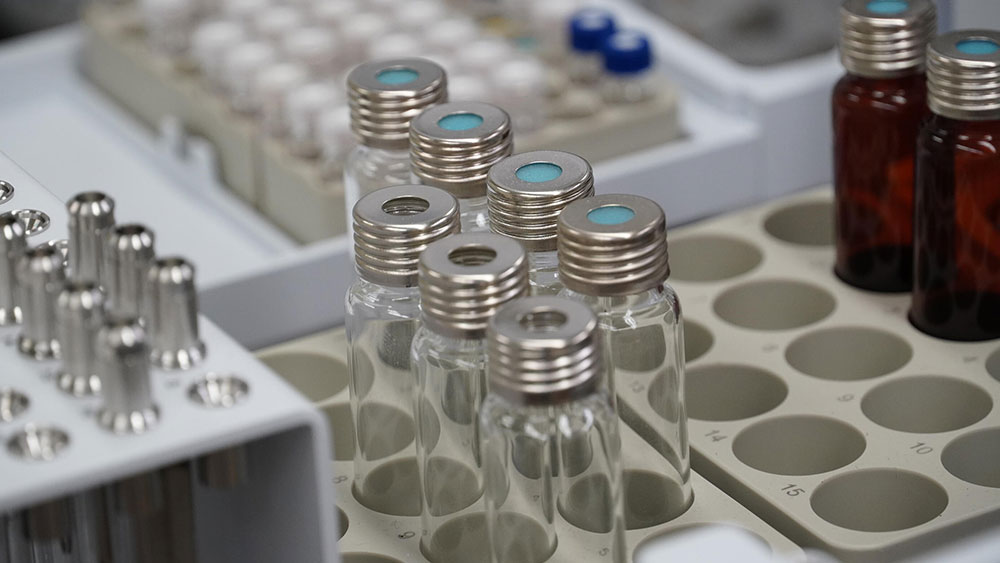
T. Mak/NIST
Vials of chemicals analyzed in the NIST mass spectral database
Social Sharing block

Whether you’re a researcher stumped by a mystery compound or a manufacturer perplexed by an unknown substance, there’s a major resource you can rely on: a library of chemical fingerprints, known as mass spectra, that the National Institute of Standards and Technology (NIST) has maintained for decades.
|
ADVERTISEMENT |
NIST has released the latest update to that library, which industry experts, forensic scientists, and others have used since 1988 to identify unknown substances in food, drugs, cosmetics, the environment, and even space rocks.
The expanded library, formally known as Standard Reference Database 1A, contains mass spectra measured from hundreds of thousands of compounds.
NIST scientists generate chemical fingerprints using a mass spectrometer, an instrument that ionizes and shatters a compound into charged fragments and then sorts those fragments by their mass-to-charge ratio. That gives researchers enough information to create a bar chart-like graph known as a mass spectrum that is unique to that particular chemical.
…
Add new comment