All Features

Harish Jose
I have been reading a lot these days about Western philosophy. The most recent book, All Life is Problem Solving (Routledge, 2001), is by Karl Popper, one of the great philosophers of the 20th century. This is a collection of Popper’s writings. One of the great teachings from Popper is the concept…

Christopher Martin
In 1996, former Microsoft employees Gabe Newell and Mike Harrington formed Washington-based video-game development studio Valve Corp. Two years later, they released a PC game called Half-Life to universal critical acclaim; it was a watershed moment in gaming history, and nearly 20 years later the…

Dirk Dusharme
In last week’s Quality Digest Live: design digital assistance instead of digital assistants, how to make better beer, and closed-loop manufacturing.
“How Digital Media Will Bring Out Our Best Selves in the Workplace”
To improve the workplace, maybe we need a fewer digital assistants and lot more…

Kevin Meyer
Mindful observation takes effort and practice, but it’s valuable if you want to be a leader. It allows you to watch processes in action and look for small nuances and opportunities for improvement. For example, the wait staff at top-tier hotels do this every day. One waiter is always watching,…

Matthew Barsalou
Although not a quality guru, the fictional detective Sherlock Holmes took a methodical approach to problem solving that can be useful when applied to root cause analysis (RCA) during the investigation of a product or process failure.
Sir Arthur Conan Doyle (1859–1930) was a British physician who…
William A. Levinson
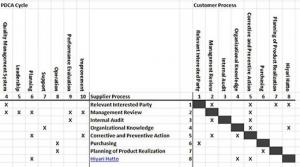
Among other requirements ISO 9001:2015, clause 4.4.1 requires an organization to identify the inputs and outputs of the processes of the quality management system; identify the sequence and interaction of these processes, noting that handoffs between processes often create risks; and identify the…

Greg Cresswell
Occasionally, my colleagues and I will take a step back from the day-to-day and have a more philosophical discussion about the field of ergonomics. Recently, the question was raised, “In the plan-do-check-act continuous improvement cycle, which step is the most important?” This sparked some…

Jason Furness
In a previous column based on our recent book, Manufacturing Money (Amazon Digital, 2015), we explained how to maximize ROI. Here we describe some changes that business owners and managers can make on their way toward becoming a Black Belt in a manufacturing and distribution business.
Before any…

Dawn Bailey
The message for audience members who attended the 29th Annual Quest for Excellence Conference held last week was, “Prepare for an inspiring journey.” This was the advice of keynote presenter Polly LaBarre, co-founder and director of Management Lab (MLab) and co-founder of Management Innovation…

Bruce Hamilton
I grew up in a small manufacturing company where nine different languages were spoken. English was the language of managers, office workers, and some of our production employees. Additionally, these languages were spoken in our factory: Armenian, Laotian, Vietnamese, Portuguese, Italian, Creole,…
Brian Maskell
The measurement of people’s efficiency has a long history in manufacturing industries. Design and production engineers calculate the time required to manufacture a product or batch of products. Each time the product is made, the “actual time” is measured and recorded. The efficiency of the…
Lars Fæste, Jim Hemerling
Digital disruption is reaching beyond technology to engulf a variety of industries, including manufacturing, transportation, energy, healthcare, and construction, that constitute a significant portion of the global economy. Manufacturing alone accounts for 12 percent of the U.S. GDP, according to…
Mike Micklewright
Fake news has fast become one of the most popular new phrases of 2017. We see it in Western politics, we listen to our news channels debate what is fake and what is not, and we hear our late-night comedians pan fake news with politically motivated jokes every chance they get.
The questions that…
Ryan E. Day
Sponsored Content
Brian Vinson may have one of the best jobs in the country. Vinson works as director of engineering with AWE Tuning, an automotive aftermarket company that provides award-winning, handcrafted performance exhausts, track-tested carbon-fiber intakes, and performance intercoolers.
“…
Bill Kalmar
Our universe seems to be in a state of flux, discombobulation, and transmutation. Every day a new issue surfaces that boggles the mind. It could be a debate on the number of people at the inauguration, a discussion of “alternative facts,” the Dakota pipeline access, severe snowstorms on the East…
Dirk Dusharme
In this week's Quality Digest Live: Lean Ben Franklin... who knew? Could the root cause of some manmade catastrophes simply be a lack of basics like humility, integrity, communication, and positivity? Connected spenders is what you want. And what’s the most important question to ask about your…
Kevin Meyer
To many people, lean manufacturing was invented in Japan and is synonymous with the Toyota Production System (TPS). They will tell you that the TPS is the manufacturing philosophy that enabled Toyota to effectively conquer the global automobile market by reducing waste and improving quality. While…
Joel Bradbury
One of the most important goals of lean manufacturing is the elimination of waste. Taiichi Ohno, father of the Toyota Production System (TPS), defined three categories of waste: mura, muri, and muda. While muda is the most widely known, muri and mura are equally important to understand.
Muda
Muda…
Gwendolyn Galsworth
One of my favorite sayings is, “Nothing changes if nothing changes.” The reverse is also true: If nothing changes, nothing changes. Perfect! So I was more than a little surprised recently when I visited a company that had made a sizeable investment in bringing continuous improvement into the…

Michael Causey
Former FDA Chairman Robert Califf, M.D., stepped down on Jan. 20, 2017, and it’s not always easy to predict what the Center for Drug Evaluation and Research (CDER), or any FDA agency, will accomplish under a new chairman. Efforts at quality management could be affected by what appears to be an…

Bruce Hamilton
Most often when we think of a wheel, it’s in the context of transportation, one of the more obvious and ever-present of the 7 wastes in lean. In fact, the first likely use of a wheel and axle was not for transport but for processing—actual work.
According to the Smithsonian, the potter’s wheel…
Roger Jensen
For several decades, manufacturers have been pursuing lean on their shop floors to reduce costs and improve lead times through waste elimination and process improvement. They have been less successful, however, in reaping lean’s potential benefits in their purchasing, planning, and supply chain…
Christopher Martin
Recently, during one of my many adventures across the internet, I stumbled across a photo that struck me. It depicts an aisle of a U.S. drugstore, where nearly every single product facing has a tag on it announcing a price and a limited-time promotion. The entire row is covered with bright yellow…
Bruce Hamilton
Here is an article I wrote 10 years ago, recently resurrected from the lost letter file. I can’t remember why I wrote it or for whom. Originally titled, “What is Kaizen?” the article still resonates with me as I hope it will with you.
My study of TPS has been guided by book learning, tacit…
Tim Lozier
When it comes to quality management, it’s not just about the requirements. As companies register to ISO 9001:2015, we see an additional shift. Not only are management system requirements changing to build an improved framework for the standard, but we also see an emphasis on an overall mindset…