{domain:"www.qualitydigest.com",server:"169.47.211.87"} Skip to main content

        
User account menu
Main navigation
  • Topics
    • Customer Care
    • Regulated Industries
    • Research & Tech
    • Quality Improvement Tools
    • People Management
    • Metrology
    • Manufacturing
    • Roadshow
    • QMS & Standards
    • Statistical Methods
    • Resource Management
  • Videos/Webinars
    • All videos
    • Product Demos
    • Webinars
  • Advertise
    • Advertise
    • Submit B2B Press Release
    • Write for us
  • Metrology Hub
  • Training
  • Subscribe
  • Log in
Mobile Menu
  • Home
  • Topics
    • Customer Care
    • Regulated Industries
    • Research & Tech
    • Quality Improvement Tools
    • People Management
    • Metrology
    • Manufacturing
    • Roadshow
    • QMS & Standards
    • Statistical Methods
    • Supply Chain
    • Resource Management
  • Login / Subscribe
  • More...
    • All Features
    • All News
    • All Videos
    • Contact
    • Training

Lasers and Math Can Help Doctors Deliver Just the Right Amount of Medicine

Specialized mathematical techniques help NIST team go with the flow

Henry Nonnemaker/NIST

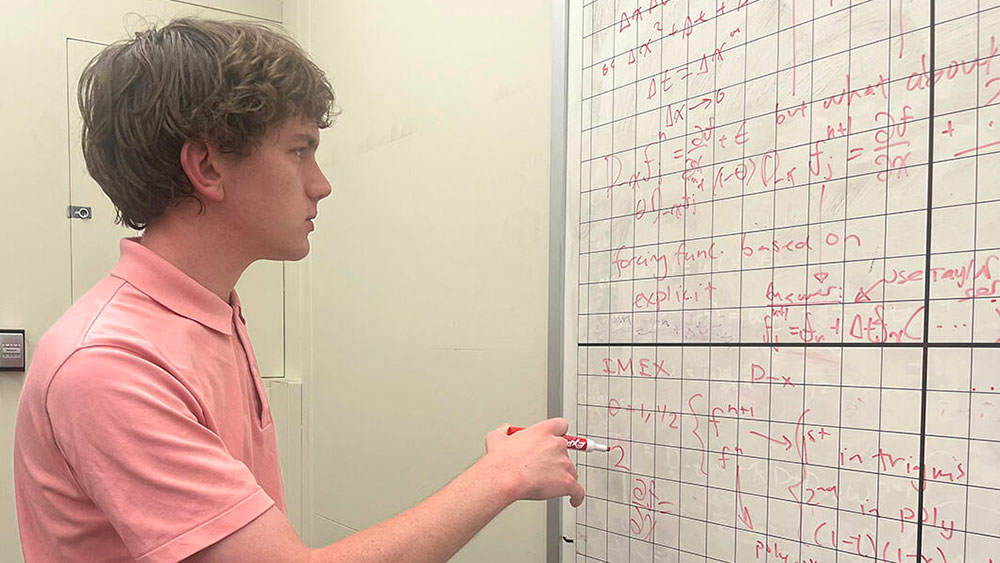
Knowing how fast medicine flows is crucial to delivering the right amount. Summer Undergraduate Research Fellow (SURF) intern Henry Nonnemaker used specialized math techniques to help better understand fluid flow.

Henry Nonnemaker

NIST

Wed, 09/16/2026 - 12:03
  • Comment
  • RSS

Social Sharing block

  • Print
Body

When doctors need to deliver precise doses of medicine on a strict schedule, they often administer it intravenously. Intravenous drug delivery methods need to carefully control the flow of medicine into a patient. Knowing the medicine’s flow rate—or the volume of fluid flowing into the patient each second or minute—is crucial to delivering the right amount of medicine at the right time.

ADVERTISEMENT

Surprisingly, the correct amount is sometimes not very much at all. Imagine a 1 L bottle divided up into a billion parts. One of those parts is a nanoliter.

Doctors may only need a handful of nanoliters of fluid to flow each minute.

Fluid flowing at the rate of one nanoliter per minute, in the words of NIST biomedical engineer and specialist in ultratiny technology Greg Cooksey, is like “draining a can of Coke through a hair if it were a straw, over about 700 years.”

Cooksey works to improve how we measure these super-slow flow rates. Currently, the devices we use to measure flow rate, called “flowmeters,” can be slow, fickle, or imprecise when used on nanoliter-per-minute flows.

In addition to more accurately measuring drug delivery, a better measurement technique for such slow flows would improve many other technologies. In medicine, emerging technologies manipulate individual biological cells, requiring precise control over the flow of nanoliters of fluid.

In chemistry, precise slow-flow measurements could improve widely used techniques for separating and identifying the components of unknown substances, such as those used to detect performance-enhancing drugs in athletes’ blood.

But how does Cooksey’s flowmeter break through the nanoliter-per-minute barrier? With lasers and clever mathematics. I worked to improve this math as an intern in the Summer Undergraduate Research Fellowship (SURF) program at NIST.

Measuring fluid flow with lasers

When fluorescent dye molecules absorb light, they re-emit that light. (The dye glows!) But it can’t keep that up forever. Once a molecule has absorbed and re-emitted light enough times, it stops and goes dark. Scientists call this process “photobleaching” and have a strong understanding of how long it takes.

Cooksey and his team’s flowmeter takes advantage of photobleaching’s predictability. They first add a dash of fluorescent dye to the fluid they’re measuring. Then they run the mix through a thin tube. As it creeps along, they fire a laser at it. This makes the dye glow until it goes dark. Then, they learn the flow rate by measuring the amount of light the dye re-emits. Here’s the trick: The amount of light the dye emits depends on how much it has photobleached. The extent of photobleaching depends on how long the dye has been in the laser beam. That varies based on how fast the fluid moves.

Slow flow means more dye molecules get fried and less glow. Faster flow means fewer dye molecules get fried and more glow. So, by measuring the amount of light the fluorescent particles re-emit, they can measure the flow rate.


The flowmeter in action: The tiny green dot in the middle is from the glow of the fluorescent dye. There’s an orange plastic box around the setup to filter out laser light. Credit: Henry Nonnemaker/NIST

Keeping up with the flow

A broad-strokes description of how glow relates to flow rate is useful, but Cooksey and his team needed to better understand their relationship to make this technology work.

That’s where I come in. As part of the SURF program, I worked with postdoctoral researcher Alli Carson to simulate the movement of dye through the flowmeter to better understand tiny changes in the movement of liquid.

I developed a simulation using specialized mathematical techniques. This work allowed the experimental team to better know what to expect when the flow rate has small variations. Hopefully, that’ll help them develop a flowmeter that makes measuring changes in super-slow flows feasible.

Making a difference with math

For me, working with NIST’s range of world-class researchers was its own reward. Most gratifying of all, however, was NIST’s willingness to work across research areas to accomplish the goal.

The experience also solidified my plans to pursue a graduate degree in applied math. Going into the SURF program, I wasn’t sure if that was for me. My exposure to a lively research environment at NIST has both prepared and excited me to pursue applied math at a high level.

What I liked best, however, was working so directly with the people who use applied math and seeing how my work would benefit others.

Published Aug. 26, 2026, in the NIST Taking Measure blog.

Top Stories
All Whys Are Not The Same
Flying Blind: What Your Quality Data Miss Every Shift
The 6 Best Quality Management Software Features That Simplify Your QMS
AI May Be Making Your Quality Problem Worse
Momentum Technologies Achieves Record Purity Milestones for Rare Earths

Add new comment

The content of this field is kept private and will not be shown publicly.
About text formats

© 2026 Quality Digest. Copyright on content held by Quality Digest or by individual authors. Contact Quality Digest for reprint information.
“Quality Digest" is a trademark owned by Quality Circle Institute Inc.

footer
  • Home
  • Print QD: 1995-2008
  • Print QD: 2008-2009
  • Videos
  • Privacy Policy
  • Write for us
footer second menu
  • Subscribe to Quality Digest
  • About Us
  • Contact Us