{domain:"www.qualitydigest.com",server:"169.47.211.87"} Skip to main content

        
User account menu
Main navigation
  • Topics
    • Customer Care
    • Regulated Industries
    • Research & Tech
    • Quality Improvement Tools
    • People Management
    • Metrology
    • Manufacturing
    • Roadshow
    • QMS & Standards
    • Statistical Methods
    • Resource Management
  • Videos/Webinars
    • All videos
    • Product Demos
    • Webinars
  • Advertise
    • Advertise
    • Submit B2B Press Release
    • Write for us
  • Metrology Hub
  • Training
  • Subscribe
  • Log in
Mobile Menu
  • Home
  • Topics
    • Customer Care
    • Regulated Industries
    • Research & Tech
    • Quality Improvement Tools
    • People Management
    • Metrology
    • Manufacturing
    • Roadshow
    • QMS & Standards
    • Statistical Methods
    • Supply Chain
    • Resource Management
  • Login / Subscribe
  • More...
    • All Features
    • All News
    • All Videos
    • Contact
    • Training

Corkscrewing Electrons: Like Rotini, But Smaller

Coiled electron beams poised to improve microscopes

NIST
Tue, 01/25/2011 - 05:00
  • Comment
  • RSS

Social Sharing block

  • Print
Body

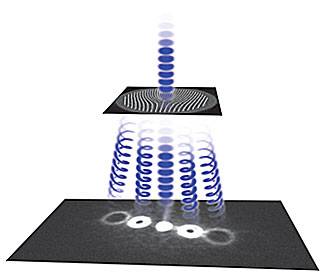
Electron microscopes are among the most widely used scientific and medical tools for studying and understanding a wide range of materials, from biological tissue to miniature magnetic devices, at tiny levels of detail. Now, researchers at the National Institute of Standards and Technology (NIST) have found a novel and potentially widely applicable method to expand the capabilities of conventional transmission electron microscopes (TEMs). Passing electrons through a nanometer-scale grating, the scientists imparted the resulting electron waves with so much orbital momentum that they maintained a corkscrew shape in free space.

View hi-res image

NIST researchers twisted the flat electron wave fronts into a fan of helices using a very thin film with a five-micron-diameter pattern of nanoscale slits, which combines the wave fronts to create spiral forms similar to a pasta maker extruding rotini.
--Credit: B. McMorran/NIST


 …

Want to continue?
Log in or create a FREE account.
Enter your username or email address
Enter the password that accompanies your username.
By logging in you agree to receive communication from Quality Digest. Privacy Policy.
Create a FREE account
Forgot My Password
Top Stories
AI May Be Making Your Quality Problem Worse
What I Discovered About Quality Concepts by Watching My Newborn Granddaughter
AI Layoffs Need Evidence, Not Executive Storytelling
Your AI Model Is Drifting Right Now. Would You Know?
Why Products Still Fail RoHS, REACH, and POPs Compliance

Add new comment

Please login to comment.

© 2026 Quality Digest. Copyright on content held by Quality Digest or by individual authors. Contact Quality Digest for reprint information.
“Quality Digest" is a trademark owned by Quality Circle Institute Inc.

footer
  • Home
  • Print QD: 1995-2008
  • Print QD: 2008-2009
  • Videos
  • Privacy Policy
  • Write for us
footer second menu
  • Subscribe to Quality Digest
  • About Us
  • Contact Us