{domain:"www.qualitydigest.com",server:"169.47.211.87"} Skip to main content

        
User account menu
Main navigation
  • Topics
    • Customer Care
    • Regulated Industries
    • Research & Tech
    • Quality Improvement Tools
    • People Management
    • Metrology
    • Manufacturing
    • Roadshow
    • QMS & Standards
    • Statistical Methods
    • Resource Management
  • Videos/Webinars
    • All videos
    • Product Demos
    • Webinars
  • Advertise
    • Advertise
    • Submit B2B Press Release
    • Write for us
  • Metrology Hub
  • Training
  • Subscribe
  • Log in
Mobile Menu
  • Home
  • Topics
    • Customer Care
    • Regulated Industries
    • Research & Tech
    • Quality Improvement Tools
    • People Management
    • Metrology
    • Manufacturing
    • Roadshow
    • QMS & Standards
    • Statistical Methods
    • Supply Chain
    • Resource Management
  • Login / Subscribe
  • More...
    • All Features
    • All News
    • All Videos
    • Contact
    • Training

ORNL Z-Contrast Microscope First to Resolve, Identify Individual Light Atoms

Researchers can design more accurate computational simulations to predict the behavior of advanced materials.

Oak Ridge National Laboratory
Wed, 03/31/2010 - 16:01
  • Comment
  • RSS

Social Sharing block

  • Print
Body
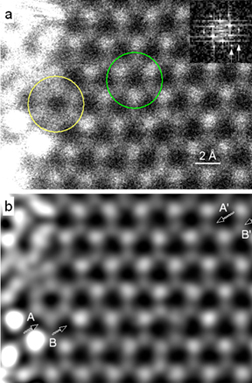
Individual boron and nitrogen atoms are clearly distinguished by their intensity in this Z-contrast scanning electron transmission microscope image from Oak Ridge National Laboratory. Each single hexagonal ring of the boron-nitrogen structure, for instance the one marked by the green circle in the figure a, consists of three brighter nitrogen atoms and three darker boron atoms. The lower (b) image is corrected for distortion.

(ORNL: Oak  Ridge, TN) -- Using the latest in aberration-corrected electron microscopy, researchers at the Department of Energy’s Oak Ridge National Laboratory and their colleagues have obtained the first images that distinguish individual light atoms such as boron, carbon, nitrogen, and oxygen.

The ORNL images were obtained with a Z-contrast scanning transmission electron microscope (STEM). Individual atoms of carbon, boron, nitrogen, and oxygen—all of which have low atomic numbers—were resolved on a single-layer boron nitride sample.

 …

Want to continue?
Log in or create a FREE account.
Enter your username or email address
Enter the password that accompanies your username.
By logging in you agree to receive communication from Quality Digest. Privacy Policy.
Create a FREE account
Forgot My Password
Top Stories
What FDA Warning Letters Reveal About Records, Spreadsheets, and AI
The Art of Forecasting: Part 1
Avoiding the 7 Deadly Killers of Projects
ISO 9001:2026 Ethics and Quality Culture
ISO 9001:2026 Is Here

Add new comment

Please login to comment.

© 2026 Quality Digest. Copyright on content held by Quality Digest or by individual authors. Contact Quality Digest for reprint information.
“Quality Digest" is a trademark owned by Quality Circle Institute Inc.

footer
  • Home
  • Print QD: 1995-2008
  • Print QD: 2008-2009
  • Videos
  • Privacy Policy
  • Write for us
footer second menu
  • Subscribe to Quality Digest
  • About Us
  • Contact Us