{domain:"www.qualitydigest.com",server:"169.47.211.87"} Skip to main content

        
User account menu
Main navigation
  • Topics
    • Customer Care
    • Regulated Industries
    • Research & Tech
    • Quality Improvement Tools
    • People Management
    • Metrology
    • Manufacturing
    • Roadshow
    • QMS & Standards
    • Statistical Methods
    • Resource Management
  • Videos/Webinars
    • All videos
    • Product Demos
    • Webinars
  • Advertise
    • Advertise
    • Submit B2B Press Release
    • Write for us
  • Metrology Hub
  • Training
  • Subscribe
  • Log in
Mobile Menu
  • Home
  • Topics
    • Customer Care
    • Regulated Industries
    • Research & Tech
    • Quality Improvement Tools
    • People Management
    • Metrology
    • Manufacturing
    • Roadshow
    • QMS & Standards
    • Statistical Methods
    • Supply Chain
    • Resource Management
  • Login / Subscribe
  • More...
    • All Features
    • All News
    • All Videos
    • Contact
    • Training

Lasers and Math Can Help Doctors Deliver Just the Right Amount of Medicine

Specialized mathematical techniques help NIST team go with the flow

Henry Nonnemaker/NIST

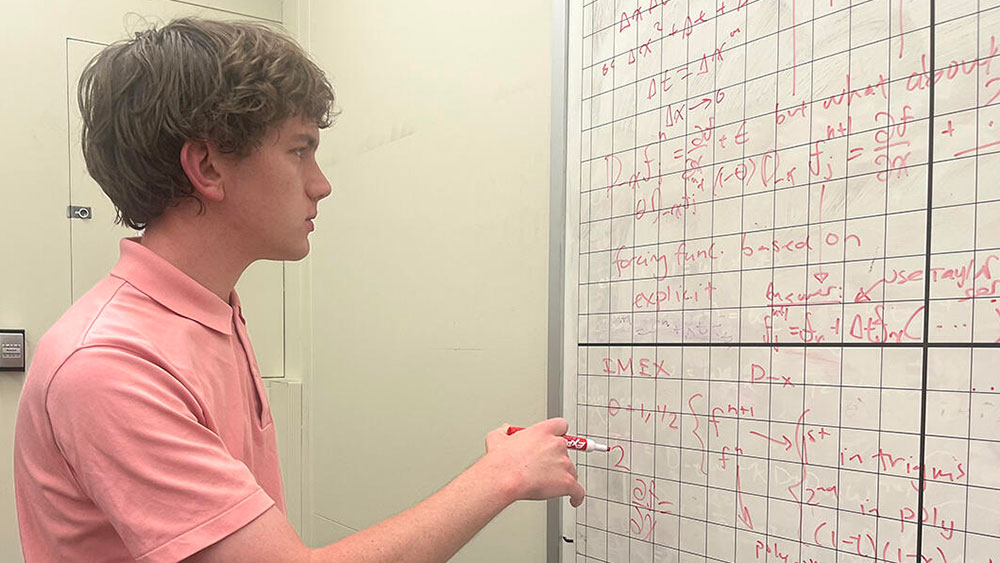
Knowing how fast medicine flows is crucial to delivering the right amount. Summer Undergraduate Research Fellow (SURF) intern Henry Nonnemaker used specialized math techniques to help better understand fluid flow.

Henry Nonnemaker

NIST

Wed, 09/16/2026 - 12:03
  • Comment
  • RSS

Social Sharing block

  • Print
Body

When doctors need to deliver precise doses of medicine on a strict schedule, they often administer it intravenously. Intravenous drug delivery methods need to carefully control the flow of medicine into a patient. Knowing the medicine’s flow rate—or the volume of fluid flowing into the patient each second or minute—is crucial to delivering the right amount of medicine at the right time.

ADVERTISEMENT

Surprisingly, the correct amount is sometimes not very much at all. Imagine a 1 L bottle divided up into a billion parts. One of those parts is a nanoliter.

Doctors may only need a handful of nanoliters of fluid to flow each minute.

Fluid flowing at the rate of one nanoliter per minute, in the words of NIST biomedical engineer and specialist in ultratiny technology Greg Cooksey, is like “draining a can of Coke through a hair if it were a straw, over about 700 years.”

Cooksey works to improve how we measure these super-slow flow rates. Currently, the devices we use to measure flow rate, called “flowmeters,” can be slow, fickle, or imprecise when used on nanoliter-per-minute flows.

 …

Want to continue?
Log in or create a FREE account.
Enter your username or email address
Enter the password that accompanies your username.
By logging in you agree to receive communication from Quality Digest. Privacy Policy.
Create a FREE account
Forgot My Password
Top Stories
ISO 9001:2026 Ethics and Quality Culture
Your First 12 Months of ISO 9001:2026 Transition: An Auditor’s Perspective
Why Remote Work Isn’t Working
A Blueprint for Keeping Humans in Control of AI
ISO 9001:2026 Is Here

Comments

Submitted by dangermoney on Wed, 09/16/2026 - 13:01

Where's the beef?

The author "developed a simulation using specialized mathematical techniques," but that's curiously all the detail we're allowed to have; I think the subheading of this article teases a little more than that. 

If it's a finite difference method to numerically integrate the partial differential equations describing multicomponent mass transfer in laminar flow, you can just say so. I won't tell anyone. 

  • Reply

Add new comment

Please login to comment.

© 2026 Quality Digest. Copyright on content held by Quality Digest or by individual authors. Contact Quality Digest for reprint information.
“Quality Digest" is a trademark owned by Quality Circle Institute Inc.

footer
  • Home
  • Print QD: 1995-2008
  • Print QD: 2008-2009
  • Videos
  • Privacy Policy
  • Write for us
footer second menu
  • Subscribe to Quality Digest
  • About Us
  • Contact Us