{domain:"www.qualitydigest.com",server:"169.47.211.87"} Skip to main content

        
User account menu
Main navigation
  • Topics
    • Customer Care
    • Regulated Industries
    • Research & Tech
    • Quality Improvement Tools
    • People Management
    • Metrology
    • Manufacturing
    • Roadshow
    • QMS & Standards
    • Statistical Methods
    • Resource Management
  • Videos/Webinars
    • All videos
    • Product Demos
    • Webinars
  • Advertise
    • Advertise
    • Submit B2B Press Release
    • Write for us
  • Metrology Hub
  • Training
  • Subscribe
  • Log in
Mobile Menu
  • Home
  • Topics
    • Customer Care
    • Regulated Industries
    • Research & Tech
    • Quality Improvement Tools
    • People Management
    • Metrology
    • Manufacturing
    • Roadshow
    • QMS & Standards
    • Statistical Methods
    • Supply Chain
    • Resource Management
  • Login / Subscribe
  • More...
    • All Features
    • All News
    • All Videos
    • Contact
    • Training

A Method to Assess Covid-19 Transmission Risks in Indoor Settings

MIT researchers have developed a publicly available model based on physics and data from past spreading events

David L. Chandler
Wed, 05/12/2021 - 12:02
  • Comment
  • RSS

Social Sharing block

  • Print
Body

This story was originally published by MIT News.

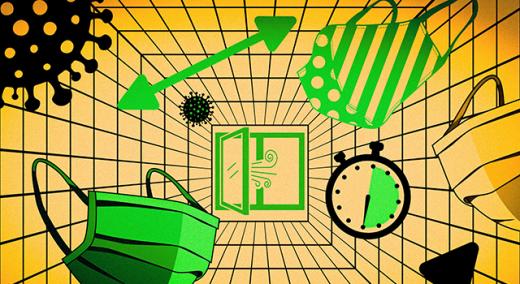
Two MIT professors have proposed a new approach to estimating the risks of exposure to Covid-19 under different indoor settings. The guideline they developed suggests a limit for exposure time, based on the number of people, the size of the space, the kinds of activity, whether masks are worn, and the ventilation and filtration rates. Their model offers a detailed, physics-based guideline for policymakers, businesses, schools, and individuals trying to gauge their own risks.

ADVERTISEMENT

The guideline, appearing in the journal PNAS, was developed by Martin Z. Bazant, professor of chemical engineering and applied mathematics; and John W. M. Bush, professor of applied mathematics. They stress that one key feature of their model, which has received less attention in existing public-health policies, is providing a specific limit for the amount of time a person spends in a given setting.

 …

Want to continue?
Log in or create a FREE account.
Enter your username or email address
Enter the password that accompanies your username.
By logging in you agree to receive communication from Quality Digest. Privacy Policy.
Create a FREE account
Forgot My Password
Top Stories
What FDA Warning Letters Reveal About Records, Spreadsheets, and AI
ISO 9001:2026 Ethics and Quality Culture
The Art of Forecasting: Part 1
Avoiding the 7 Deadly Killers of Projects
ISO 9001:2026 Is Here

Add new comment

Please login to comment.

© 2026 Quality Digest. Copyright on content held by Quality Digest or by individual authors. Contact Quality Digest for reprint information.
“Quality Digest" is a trademark owned by Quality Circle Institute Inc.

footer
  • Home
  • Print QD: 1995-2008
  • Print QD: 2008-2009
  • Videos
  • Privacy Policy
  • Write for us
footer second menu
  • Subscribe to Quality Digest
  • About Us
  • Contact Us