{domain:"www.qualitydigest.com",server:"169.47.211.87"} Skip to main content

        
User account menu
Main navigation
  • Topics
    • Customer Care
    • Regulated Industries
    • Research & Tech
    • Quality Improvement Tools
    • People Management
    • Metrology
    • Manufacturing
    • Roadshow
    • QMS & Standards
    • Statistical Methods
    • Resource Management
  • Videos/Webinars
    • All videos
    • Product Demos
    • Webinars
  • Advertise
    • Advertise
    • Submit B2B Press Release
    • Write for us
  • Metrology Hub
  • Training
  • Subscribe
  • Log in
Mobile Menu
  • Home
  • Topics
    • Customer Care
    • Regulated Industries
    • Research & Tech
    • Quality Improvement Tools
    • People Management
    • Metrology
    • Manufacturing
    • Roadshow
    • QMS & Standards
    • Statistical Methods
    • Supply Chain
    • Resource Management
  • Login / Subscribe
  • More...
    • All Features
    • All News
    • All Videos
    • Training

Give Your Workforce Permission to Fail... Virtually

Digital twins let operators, engineers rehearse messy, imperfect, even catastrophic conditions they’ll never practice on live equipment

Rockwell Automation

Michael Masser
Bio

Rockwell Automation

Mon, 08/24/2026 - 12:02
  • Comment
  • RSS

Social Sharing block

  • Print
Body

There’s a number that stopped me in my tracks recently. U.S. manufacturers spent about $32 billion training and upskilling their people—a 22% jump from 2019—and the average worker now logs close to five more training hours a year than they did back then, climbing from 42.9 hours to 47.6 (Manufacturing Institute survey).

ADVERTISEMENT

That’s a serious investment, and it’s the right instinct. But walk onto almost any plant floor and you’ll hear the same quiet worry from the people running the lines: “I’m not totally sure I trust this system to do what it’s supposed to—and I’m even less sure what I’m supposed to do when it doesn’t.”

That gap between the training we’re paying for and the confidence workers actually feel when the machine surprises them is the real skills gap in 2026. It’s no longer mainly about whether someone can read a schematic or find their way around a human machine interface (HMI). Automation is becoming software-defined, AI is moving into plant-floor workflows, and the systems our people operate are getting smarter and more autonomous by the quarter. So, the question isn’t just can your workforce operate the technology. It’s whether they can understand it, trust it, and do the right thing when it behaves in a way nobody expected.

Here’s the uncomfortable part: For most of manufacturing’s history, the only place to build that kind of confidence has been the live production line—the single most expensive and least forgiving classroom we own. Every mistake there costs material, downtime, sometimes a damaged machine, and occasionally a safety incident. We’ve been asking people to get good at handling the hard moments in the one environment where a hard moment is a genuine problem.

The problem isn’t knowledge. It’s reps.

Think about how any of us truly becomes good at handling a crisis. Not by reading about it but by living through it, and ideally somewhere the stakes are low enough that a mistake becomes a lesson instead of a disaster. Pilots don’t earn their composure flying passengers through their first engine failure. They earn it in a simulator, losing that engine a hundred times until the correct response is muscle memory. If and when it happens for real, they’ve already been there.

Manufacturing has never really had that simulator for the people on the floor. A new operator’s first jam, first fault cascade, first “why is the line doing that?” moment usually happens live, under pressure, with a supervisor watching and product piling up. No wonder confidence is thin. We’ve never given our workforce a safe place to be wrong.

What a digital twin actually is (and isn’t)

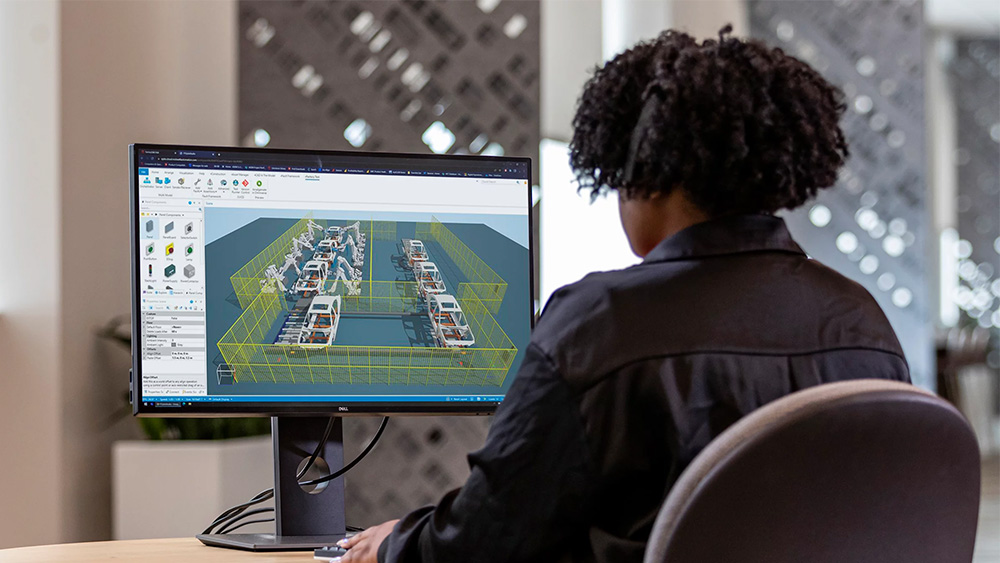
This is exactly where a digital twin earns its keep. To be precise, the terms digital twin and simulation get used interchangeably but they’re not the same thing. A simulation is best performed early in a project, when you’re predicting theoretical performance and making design choices. A digital twin, in the virtual-commissioning sense, goes further. It’s a dimensionally accurate, physics-based model of the machine that connects to the real control system. The controls command the virtual machine and get signals back exactly as if it were physical steel on the floor. Manufacturers can get a faithful, running copy of their line that they can poke, break, and rehearse against without touching the real one.

So, think of it as a flight simulator for the plant floor. Once you have one, the most valuable thing you can do with it for your workforce has nothing to do with proving the machine works. It’s proving what happens when it doesn’t.

Rehearse the imperfect conditions on purpose

Most testing and most training rehearse what I’d call the happy path. Everything works. Parts arrive on time. Sensors read true. Operators hit the right buttons in the right order. It’s a nice story, but it almost never survives contact with a real shift.

A digital twin lets you deliberately rehearse the imperfect conditions instead. I find it helps to think about three buckets worth practicing:

The fault you hope never happens. The emergency stop at the worst possible moment. The power blip. The communications drop midsequence. On a real line, you can’t manufacture these on demand without real risk, so people rarely practice them until the day it counts. In the twin, you can trigger them at will and let an operator work the recovery until it’s second nature.

The mess you know will happen. Jams, misfeeds, out-of-spec material, robots that index to the wrong position. This is the daily texture of real production. Let your workforce see it, diagnose it, and clear it in a virtual environment first, and their first live jam becomes routine instead of rattling.

The catastrophic scenario you’d never create for real. This is the one that changes the economics. You can run the sequence that would slam a linear motor into a hard stop and cost you a five-figure repair, or the fault that would burn out a drive. With a digital twin, a new engineer can make that exact mistake, watch the consequence play out, and learn from it without a scratch on the machine or their confidence. You can’t buy that lesson any other way, and you certainly don’t want to buy it with a real motor.

The mindset behind all of this is what software teams call “shifting left”—testing early and often instead of saving it for the end. Rather than throwing finished code over the wall for one big acceptance test right before startup, you validate the small building blocks as you build them, then the functions, then the whole system, against the twin. By the time real hardware shows up, there are no surprises for the machine or the people who have to run it. And the same discipline that safeguards commissioning happens to be the best workforce-readiness tool we’ve got, because every one of those tests is a rep your team banks before it matters.

This isn’t theoretical

A couple of examples make it concrete. When RidgeTech Automation commissioned automated storage and retrieval systems for a pair of 100,000 sq ft vertical farms, the units stood more than 40 ft tall and left no room for error at startup. The team virtually commissioned the whole thing ahead of the build, ran the operator interface alongside the twin, and worked through real client concerns before a single piece of equipment shipped to site. That shortened the commissioning window and got the line running sooner but, just as important, the people who’d run it had already “flown” it.

In another case, GA Pet Food Partners built a twin of a heavily automated new line and integrated it with their manufacturing execution system so they could tune and optimize the whole thing before going live. They estimated the project would have taken three to four months longer without it. And when Rockwell moved one of our own manufacturing lines from Switzerland to Milwaukee, we trained operators on the digital twin before the system went live—and their feedback revealed potential operator issues while they were still cheap to fix.

None of this is fringe technology anymore. In a recent State of Smart Manufacturing report, 95% of manufacturers said they’re planning to incorporate smart manufacturing technologies. The tools are arriving fast. The bottleneck is a workforce that trusts them.

Meet your people where they are

Two practical things can make a twin usable by more than a handful of specialists. First, the barrier to building and interrogating one keeps dropping. Instead of everyone hand-writing rigid code, engineers are starting to describe what they want a machine to do in plain language and let AI generate the logic—uploading a functional spec or a process diagram and getting a working starting point back. That lowers the ceiling on who can participate. Second, the industry is converging on a single, friendlier control surface that blends traditional automation with modern IT workloads, so operators aren’t forced to learn three disconnected tools to work the way the technology now works.

A word of caution, because I’d rather you succeed than be sold to: It’s easy to go too far down the rabbit hole and try to build a digital twin of everything. Don’t. A twin that’s more elaborate than its purpose gets expensive and brittle and still might not answer the question you have. Build the twin that lets your people practice the conditions that matter, and give them regular workouts. Digital-twin work pays off when it’s part of how a team operates, not an occasional science project.

Confidence is the deliverable

If you’re a manufacturing leader staring at a rising training bill and a workforce that still hesitates when the system does something unexpected, here’s the reframe I’d offer: You don’t primarily have a knowledge problem; you have a routines problem, in that your people haven’t been allowed to fail anywhere it’s safe.

Start small. Pick one line where mistakes are expensive or safety-sensitive. Stand up a twin of it. Then, deliberately break it—in front of your team, over and over, in every imperfect way you can dream up. Let them make the costly mistake in a place where it costs nothing. Because the goal was never a perfect model of a machine. The goal is to have a team member who walks onto the floor already knowing what to do when things go sideways, and does it without flinching. That’s confidence you can’t train into someone with a slide deck. But you can let them earn it, safely, one virtual failure at a time.

Add new comment

The content of this field is kept private and will not be shown publicly.
About text formats
Image CAPTCHA
Enter the characters shown in the image.

© 2026 Quality Digest. Copyright on content held by Quality Digest or by individual authors. Contact Quality Digest for reprint information.
“Quality Digest" is a trademark owned by Quality Circle Institute Inc.

footer
  • Home
  • Print QD: 1995-2008
  • Print QD: 2008-2009
  • Videos
  • Privacy Policy
  • Write for us
footer second menu
  • Subscribe to Quality Digest
  • About Us