All Features
Harish Jose
Today I’d like to take a look at a lesson from Taiichi Ohno regarding the pursuit of quality. His comment, “The pursuit of quantity cultivates waste, while the pursuit of quality yields value,” struck a chord with me. Among other things, he's referring to the importance of resisting mass-…
Eugene Daniell
Sponsored Content
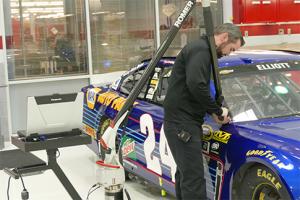
For more than 30 years, Hendrick Motorsports has consistently been one of NASCAR’s most successful teams. In the course of winning a record 11 Sprint Cup Series championships, Hendrick Motorsports has learned that it must innovate constantly to stay ahead of the competition.…
Heinz Schandl
The world is using its natural resources at an ever-increasing rate. Worldwide, annual extraction of primary materials—biomass, fossil fuels, metal ores, and minerals—tripled between 1970 and 2010. People in the richest countries now consume up to 10 times more resources than those in the poorest…
Bruce Hamilton
Early along, as a student of the Toyota Production System (TPS), now referred to as lean, I struggled with some of the concepts and systems. For example, Shigeo Shingo’s claim that a four-hour machine setup could be reduced to less than 10 minutes made me a skeptic.
“Perhaps, when Mr. Shingo…
Annette Franz
I recently came across the Japanese terms genchi genbutsu and gemba; they’re both key principles of the Toyota Production System, which comprises Toyota’s management philosophy and best practices. Although they’re (lean) management principles and concepts, they apply not only to the employee…
Jason Furness
For the sake of argument, let’s say you’re aware of an issue that’s holding your enterprise performance back, and you know what to do about it. At that point, there are seven key actions you can take to rapidly implement change, which in turn will allow you to respond to market changes with short…
Kevin Meyer
Few people realize how employee policy manuals, usually given to you on your first day and then mostly forgotten, shape an organization’s culture and thereby its fundamental performance.
To give you a reference point, one company I worked for had an employee manual of 40+ pages. Every section…
Gwendolyn Galsworth
Does lean have a clearly delineated limit? When a company starts out on that path, should it expect an endpoint, a completion, an arrival? Is it a forever commitment, or is it a bounded outcome that companies can achieve and then move on? In short, is lean a destination or a process?
These aren't…
William A. Levinson
Masaaki Imai, author of Gemba Kaizen (McGraw-Hill Education, 1997), introduced the concept of the value-adding “bang,” the exact moment at which a process adds value for the customer. He meant the moment at which an official stamped a document, but the same concept applies when a stamping or…
Mark Graban
Given all of the problems that exist in our American healthcare system, it’s encouraging that most healthcare organizations are endorsing or practicing some form of process improvement or operational excellence strategy. Under the banner of different labels and using different combinations of…
Harish Jose
There is a concept in lean known as a “monument.” It refers to a large machine, piece of equipment, or something similar that can’t be changed right away, and so you have to plan your processes around it. This generally impedes the flow and frequently becomes a hindrance to lean initiatives. A…
Davis Balestracci
Today I want to concentrate on the foundation of what is most commonly taught as design of experiments (DOE)—factorial designs.
Elsewhere I’ve mentioned three of C.M. Hendrix’s “ways to mess up an experiment.” After 35 years of teaching DOE, I’ve concluded that he pretty much captures the…
Bruce Hamilton
I wrote a piece a little more than five years ago about a variety reduction program (VRP), an amazing but little-known product-design optimization tool. At the time I referred to VRP as an idea whose “time had not yet come.” Last week, as I gave a short presentation on VRP, I realized that five…
Bruce Hamilton
Many moons ago, when I was just getting started on my lean journey, I visited a large automotive supplier to benchmark pull systems. My own factory had started a pilot kanban between two work centers and I was hoping to gain some insight from a more experienced source.
To my disappointment, when…
Ken Levine
How do you determine the “worst case” scenario for a process? Is it by assuming the worst case for each process task or step? No. The reason is that the probability of every step having its worst case at the same time is practically zero. What we’re looking for is a value that will occur a very…
Ken Voytek
In a recent post, I examined the differences in productivity across small and large manufacturing firms, and noted that there were differences across manufacturers in terms of size. But it’s also clear from the literature that productivity differs across companies even in the same industry.
Why…
Pacific Northwest National Laboratory
An improved titanium alloy—stronger than any commercial titanium alloy currently on the market—gets its strength from the novel way atoms are arranged to form a special nanostructure. For the first time, researchers have been able to see this alignment and then manipulate it to make the strongest…
Steve Melito
How competitive is American manufacturing? By the year 2020, the United States is projected to take the top spot in the Global Manufacturing Competitiveness Index (GMCI), a multiyear research platform from Deloitte and the Council on Competitiveness.
The 2016 GMCI surveyed more than 500 of the…
Fred Schenkelberg
A fault tree analysis (FTA) is a logical, graphical diagram that starts with an unwanted, undesirable, or anomalous state of a system. The diagram then lays out the many possible faults, and combinations of faults, within the subsystems, components, assemblies, software, and parts comprising the…
Howard Sklamberg
Globalization is posing challenges for public health. For the U.S. Food and Drug Administration (FDA), part of that challenge is the ever-increasing volume and complexity of FDA-regulated products coming to America’s shores.
In fiscal year 2015, there were more than 34 million shipments of FDA-…
Ryan E. Day
Sponsored Content
In the most basic terms of engine exhaust theory, more flow equates to more performance. The aim is to improve the efficiency of your vehicle’s engine, boost performance, and save money on fuel. Auto-jet Muffler Corp. has implemented that “improved flow = improved performance”…
Jason Furness
Here’s a “tales from the real world” extract from our book, Manufacturing Money (Amazon Digital, 2015). It offers an example of the “five focusing steps” to improvement, with a particular focus on step one, identify the constraint; and step two, maximize the constraints output.
This was a time…
Harish Jose
In this article I want to look at the concept of equifinality in relation to the plan-do-check-act (PDCA) cycle. In systems theory, equifinality is defined as reaching the same end, no matter what the starting point was. This is applicable only in an open system, one that interacts with its…
Bruce Hamilton
Twice in the last month I’ve heard the phrase “traditional lean” used in public presentations. In neither case did the presenter explain the expression, but one displayed a slide with a Venn diagram showing the overlap between lean and Six Sigma.
I suppose this means that he defined traditional…
Fred Schenkelberg
When products were crafted one at a time, the design and manufacturing processes were often done by the same person. For example, a craftsman would design and build a chest of drawers or a carriage. Some trades would employ apprentices to learn the craft, which also included design.
Larger…