Social Sharing block

(IDS: Obersulm, Germany) -- Strong reflections, changing light conditions, or large brightness differences complicate many applications of industrial image processing. High dynamic range (HDR) extends the measurable dynamic range and reveals details that may be lost in overexposed or underexposed areas of an image.
|
ADVERTISEMENT |
Different applications have different requirements, so choosing the appropriate HDR method is an important step. Depending on the application, the focus may be on dynamic range, resolution, or motion tolerance.
Accordingly, IDS Imaging Development Systems GmbH combines various HDR technologies within a single software environment. This enables users to compare, test, and integrate the respective features into their applications more easily. With Clear HDR, Quad HDR, and Sequence HDR, IDS supports three HDR modes for different requirements regarding dynamic range, resolution, and motion. HDR-capable IDS cameras can be configured, output data captured, and HDR results processed and visualized via “IDS peak.”
“Users want to use HDR and not develop HDR,” says Heiko Seitz, product marketing manager at IDS. “That is why we combine various HDR technologies as end-to-end software support from capture to the finished HDR result in IDS peak. This simplifies evaluation, reduces integration effort, and accelerates the path to the right solution.”
HDR is more than just a function of the image sensor. Only the interaction of the sensor and the camera firmware with the image processing on the PC makes the additional image information practically usable. That’s why IDS integrates central functions such as camera acquisition control, various image data formats, as well as the merging of HDR sensor data and tone mapping algorithms directly into the IDS peak SDK. Users thus gain access to individual HDR exposures as well as to calculated HDR and LDR results. The IDS peak cockpit allows users to explore and test the entire HDR tool chain and to visualize the resulting HDR images.
All of this is possible without prior programming. Source code samples further simplify integration into users’ own applications.
Numerous industrial image processing applications benefit from this approach. These include quality control of reflective components, logistics and OCR applications, robotics and automation, welding processes, as well as traffic and outdoor applications. In both medical technology and microscopy, HDR can be used to make more image information from high-contrast scenes usable.
Find more information here.
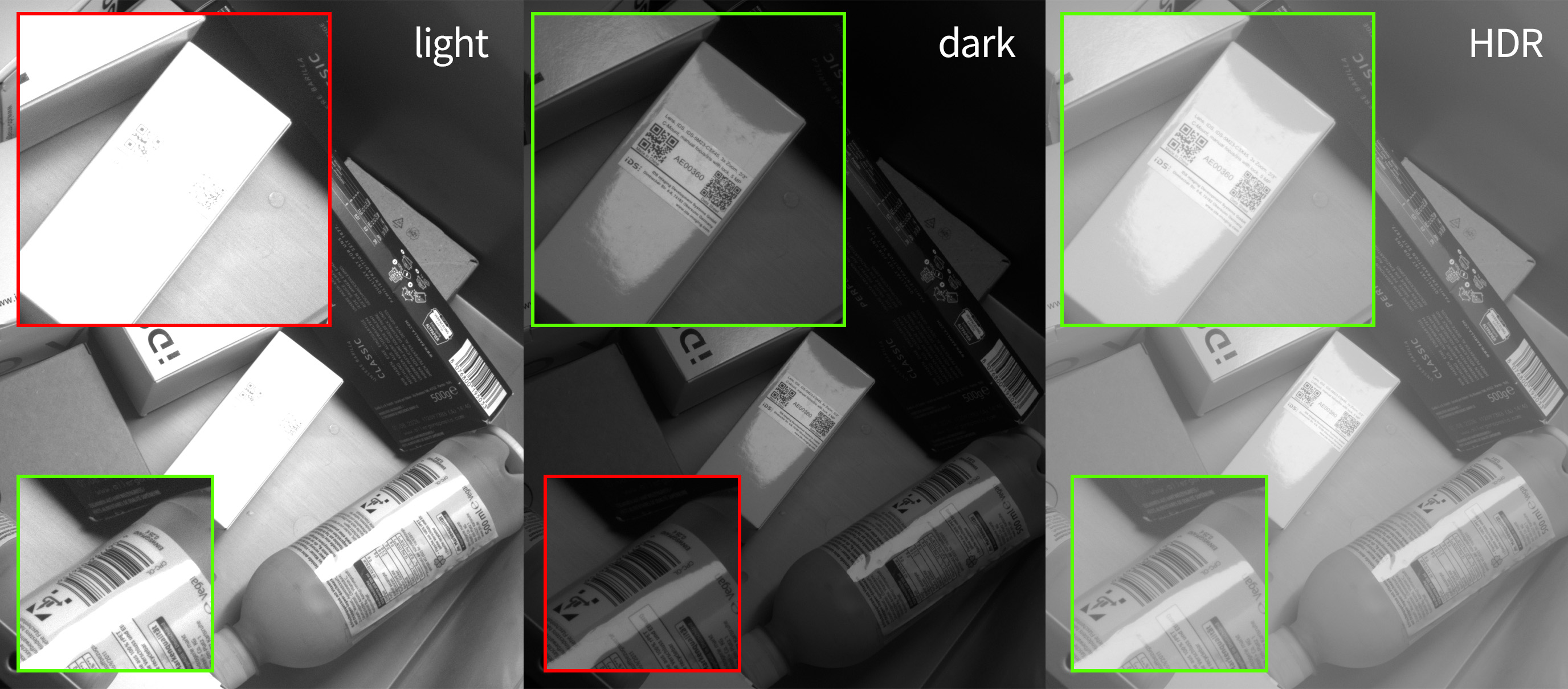
With IDS peak, users can directly compare, visualize, and evaluate HDR results for their own application.
Add new comment