Social Sharing block

(AIM3D: Rostock, Germany) -- AIM3D, a pioneer in pellet-based 3D printing since 2017, offers the ExAM 255 and ExAM 510 3D printing systems with high build speeds, high quality, and superior cost efficiency. AIM3D has now certified a new ExAM A 510 specifically for aerospace applications, with a focus on ULTEM 9085.
|
ADVERTISEMENT |
Together with AM-MRO GmbH, the ExAM 510 was extensively redesigned as the ExAM A 510. The “A” stands for aviation. At Formnext 2026 in Frankfurt, Germany, AIM3D is making 3D pellet printing for aviation applications the centerpiece of its exhibition, showcasing the ExAM A 510 system and aerospace components.
Compared with conventional filament-based 3D printing, 3D pellet printing offers major economic advantages through cost reduction. For ULTEM 9085, the unit cost of a ULTEM 9085 component is just under 60% of the cost of 3D printing with filaments. To meet the aerospace industry’s stringent requirements for process stability and mechanical properties, AIM3D’s established ExAM 510 has been modified specifically for aviation applications as the ExAM A 510.
A new benchmark for cost efficiency
Pellet-based 3D printing generally offers major advantages in unit costs. A 3D part made with commercially available pellets can achieve adequate mechanical properties comparable to injection molding. In addition to optimized unit costs and the highest quality, aerospace suppliers seek other benefits that only 3D printing can deliver: on-demand production and decentralized manufacturing to provide spare parts promptly for maintaining and servicing machinery and equipment while limiting inventory. 3D pellet printing now opens up new possibilities for cost efficiency by reducing the unit costs of 3D parts in an otherwise equivalent process.
Certification partner AM-MRO
AIM3D’s ExAM A 510 and its ULTEM printing process were modified through a certification process with expert Stefan Roeding of AM-MRO GmbH in Bleckede, Lower Saxony, Germany. AM-MRO provides consulting, training, and auditing services to aerospace manufacturers in connection with the use of additive and other innovative manufacturing technologies. The company supports customers in introducing, qualifying, and implementing these processes to ensure compliance with applicable aviation standards and approval requirements. As part of the certification process, AIM3D developed the ExAM A 510 and the printing process to meet the aerospace industry’s stringent requirements.
Key features of the ExAM A 510
The focus was on ULTEM 9085, the high-performance polymer widely used in the aerospace industry. The new ExAM A 510 system had to demonstrate consistent tensile strength in ULTEM 9085 tensile specimens regardless of the machine or build position. The certification process with AM-MRO combines high mechanical performance of the parts with maximum process stability of the 3D printing system. All process parameters are documented, standardized, and optimized during certification.
One result is a slightly higher density than that of filament-printed parts. The system modifications focused on highly uniform temperature distribution throughout the build chamber, as well as continuously controlled ULTEM 9085 material feeding in terms of temperature, dryness, and tamper protection. An important additional benefit was easier removal of support structures, reducing post-processing effort. The result is an ExAM A 510 with a build chamber actively heated on all sides. The large viewing window that is a distinctive feature of the standard ExAM 510 has been replaced by a camera for monitoring the build chamber—form follows function.
Potential and prospects for 3D pellet printing in aviation
The cost advantages over 3D filament printing are clear, but other opportunities are also attracting the aviation industry’s attention: Material use and post-processing can be optimized, and part properties can be improved. Stefan Roeding, CEO of AM-MRO, says, “Readiness for aviation with an ExAM A 510 combines substantial material cost advantages with part optimization. It also meets all requirements for decentralized, timely onsite manufacturing, from batches of one to medium-sized production runs, with high process stability and high part quality. For aviation users, a manufacturing strategy based on a pellet-fed 3D printing system is a key factor in improving value creation and part quality, while enabling the use of unmixed recycled aviation materials.”
More AIM3D highlights at Formnext 2026
AIM3D is also focusing on the high-performance material PEEK. Sample parts made from pure, medically certified PEEK and printed on an ExAM 510 will be on display, alongside other PEEK components. Another development of interest for PEEK is a smaller ExAM with a smaller but heated build chamber, positioned below the ExAM 255. This system will be exhibited as a prototype and is still under development in Rostock. Rounding out the company’s presentation is the printing of extra-soft TPE (Shore 0) on an ExAM 255. Other TPE parts with a Shore hardness of 0 complete the display.
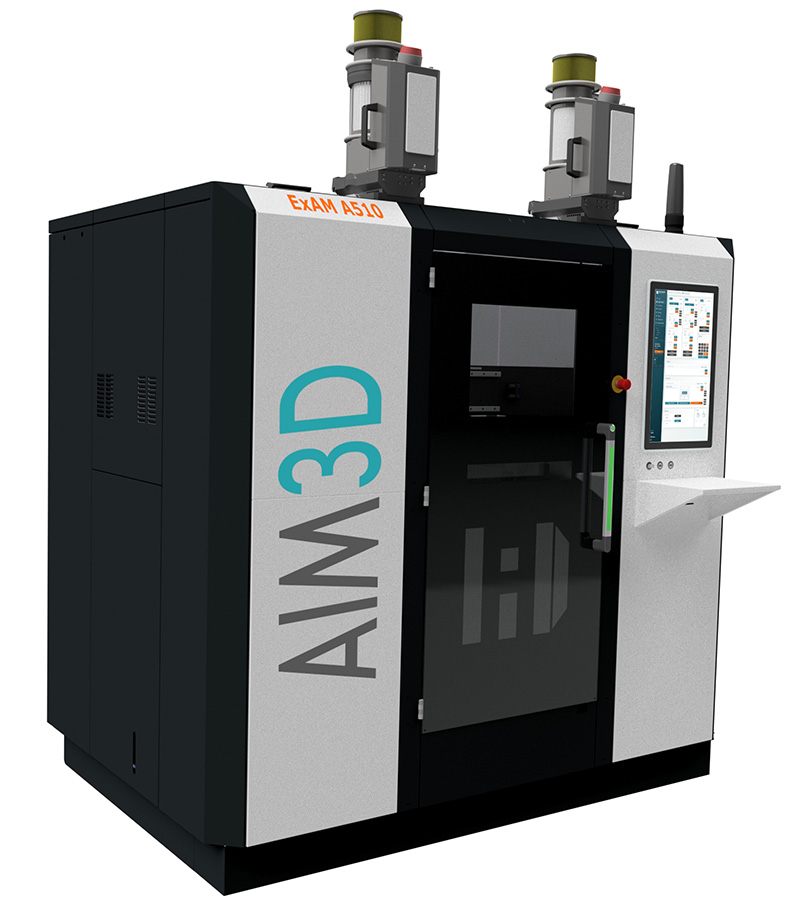
ExAM A 510 “aviation” modified for aviation applications
Add new comment