Natasha Hanacek/NIST
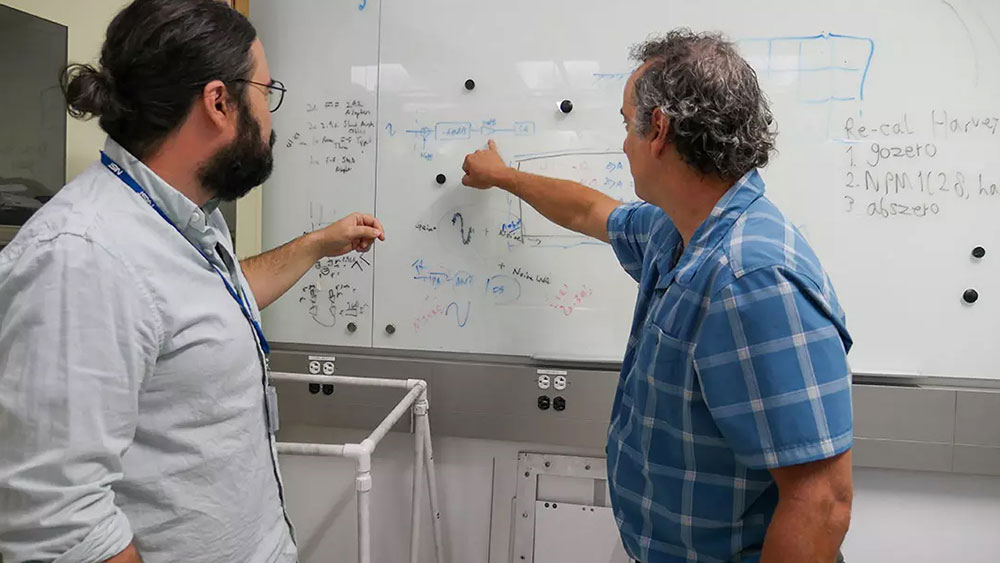
NIST researchers Jacob Rezac (left) and Robert Horansky (right) discuss the setup of an experiment.
Social Sharing block

If you hear a song you like and want to know its name, some apps will record a snippet and provide the title.
|
ADVERTISEMENT |
An app like that works by listening to the music’s notes, rhythm, and lyrics, and matching them to a vast musical database to help you understand what you’re listening to—much like matching a fingerprint to a person.
Whether they’re playing music or not, our phones are constantly emitting silent signals in the form of invisible electromagnetic waveforms that travel through the air. And while there is no app that can capture and translate those signals for you, there are trained professionals who can use them to learn important information about the device.
Tamper-proofing phones and other devices
You may be wondering why we’d want to listen to the silent signals a phone gives off, a practice we call radio-frequency fingerprinting.
Well, you might not be able to tell on your own phone or other device, but these signals can tell a trained professional if a device has been tampered with, among other things.
Why would you care? Someone could tamper with a phone by swapping out a new chip for an older, cheaper one, so an unsuspecting buyer could unknowingly buy a substandard device.
Radio-frequency fingerprinting could be especially useful for governments buying phones for diplomats, for example. They want to know for sure that no one is listening in on that device.
Companies conducting this testing are already measuring these signals to determine whether a phone has been tampered with. But they’re all using different methodologies.
Additionally, they don’t understand the chances or the possible amount that their results are off, which we call uncertainty. Without properly applied uncertainties, it’s impossible to validate the tests.
There’s also no way to trace the measurement back to a precisely calibrated standard, which we call traceability. That’s a job perfect for NIST.
Testing radio-frequency fingerprints
In our lab here at NIST in Boulder, Colorado, we built a test environment and an algorithm that allowed us to measure those radio-frequency fingerprints with more than 95% accuracy. We tested this with 16 different devices from a variety of manufacturers and models.
We used what we learned to create publicly available resources that can assist a company in testing devices.
Phones and other wireless devices emanate waveforms. They’re kind of like the carbon dioxide we emit when we exhale. We don’t have to force the device to do anything; it just happens.
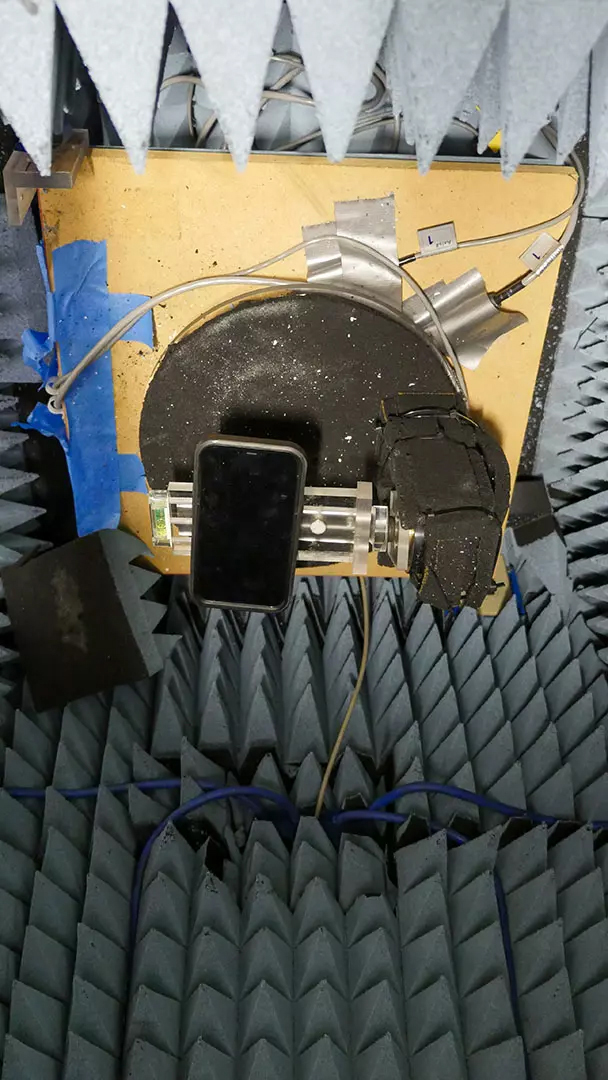
This test environment enables researchers to measure waveforms from mobile devices. Credit: Natasha Hanacek/NIST
For decades, Rob has been studying and working to understand these emanations thoroughly and to compare them to primary standards, such as the atomic clock (for the precise timing of the wireless signal) and a standard voltage (for the precise power of the signal).
Anytime someone measures how long something takes, they can trust their result if their clock is tied to NIST’s atomic clock. You know 5 seconds really means 5 seconds, up to some (very small) measurement uncertainty.
Similarly, if we can build up a full measurement uncertainty for the types of waveforms that cell phones emanate, we can trust that those waveforms are what the measurement equipment says they are. This current effort is just building on what we’ve learned and expanding the measurements in a new way.
Looking ahead
Our next steps are to continue refining our methodology and to develop best practices for taking measurements—such as how far from a wall the device should be, how to prevent interference in your working environment, and how best to understand factors that can alter the results in counterintuitive ways.
That’s what NIST does best—refining measurements and understanding the uncertainties. Private companies will likely continue to make products that do this type of testing. And we’ll give them the information they need to ensure that their measurements are as accurate and trustworthy as possible.
An organization or another government agency may choose to label a device that has passed these tests to help consumers. NIST’s measurement expertise and research would help make these tests more successful by providing clearer traceability and uncertainty estimates.
Some telecommunications companies have already discussed using the ideas behind our research to boost device security for everyone—even if it’s not applied exactly as we’re doing in our work.
Why Jake does this work
We hope to help people avoid being scammed or spied on via their cell phones and other wireless devices.
I see firsthand how people rely on phones but don’t necessarily understand the underlying technology—and the risks—associated with these devices. My grandmother and my parents, for example, rely on their devices for so many things. If I can make devices safer from tampering for people like my relatives, that’s very motivating for me.
Why Rob does this work
For years, I’ve studied device signals, and I’ve dug into the nitty-gritty details to understand the many factors that affect them. Every wireless device—from heart monitors to cell phones to vending machines—must be tested, and our research helps ensure that testing is accurate.
Of course, I’m hopeful this work will have an impact on people who rely on devices. But I’m mostly motivated by the measurement problem itself.
Every day in the lab, I’m excited to see what I can find out and brainstorm with my colleagues about how best to make measurements and understand any imperfections present. I don’t always set out to solve a specific problem on a given day, but when I learn something, it usually advances the overarching problem we are working on.
That’s the beauty of science. You never know quite where research will take you, and there’s always a new problem to go after.
Published Oct. 21, 2026, in the NIST Taking Measure blog.
Add new comment