Neeta Verma
Social Sharing block

Manufacturing Day fell on Oct. 2 this year. Manufacturers opened their doors and showed the public what modern manufacturing looks like, and, hopefully, built some interest in manufacturing careers.
|
ADVERTISEMENT |
Visitors saw robots, sensors, software, and connected production systems. What they may not have seen is the management system that determines whether those technologies, processes, and supply chains can consistently deliver what customers expect: quality.
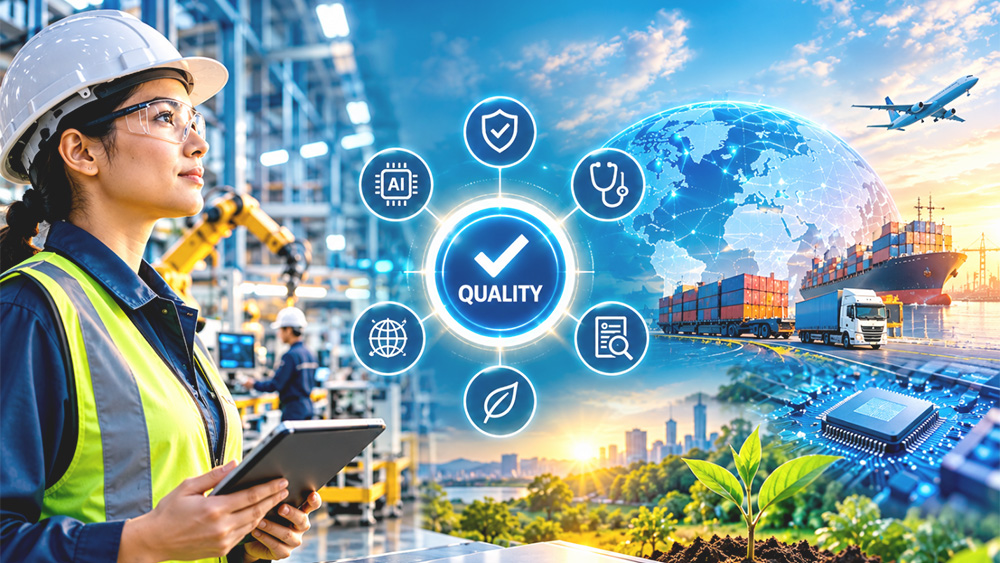
Quality management’s purview is expanding faster than many quality organizations have adapted. The quality function can no longer focus primarily on inspection, nonconformances, and corrective action inside the factory fence. It increasingly must look outward to suppliers and dependencies several tiers removed, to the data that feed digital and AI systems, to physical infrastructure and climate conditions, to the people who operate increasingly complex processes, and to the standards and regulatory requirements that define what good looks like.
That shift is visible in the changes manufacturers are confronting in 2026. ISO 9001:2026 places greater emphasis on leadership, quality culture, and ethical behavior, with clearer treatment of risks and opportunities. The U.S. Food and Drug Administration’s Quality Management System Regulation has brought ISO 13485:2016 into the U.S. medical-device regulatory framework. AI and advanced analytics are increasing the importance of reliable, traceable data. Geopolitical disruption is exposing dependencies outside the first tier of the supply chain, while climate and extreme weather are challenging assumptions about infrastructure and working conditions.
These aren’t separate quality stories. They point to the same conclusion: Quality management is becoming an enterprise discipline for understanding and controlling the conditions under which a product is made. Manufacturers that broaden that view can use quality systems not simply to detect problems, but to identify dependencies, test assumptions, and produce evidence that the business can remain in control when conditions change.
The first shift: The rulebook is expanding the quality conversation
The first signal is coming from the standards and regulatory environment. ISO published ISO 9001:2026 on Sept. 16, 2026, describing it as the new edition of the world’s leading quality management standard used by more than a million organizations. ISO says the update responds to a more complex operating environment in which organizations must balance resilience with innovation. It places greater emphasis on leadership, a culture of quality and ethical behavior, and provides greater clarity on risks and opportunities.
For quality leaders, the significance is broader than updating documented procedures. A standard that emphasizes leadership and quality culture, and speaks to resilience, creates an opportunity to connect the quality management system to decisions that traditionally sat elsewhere: supply-chain exposure, business continuity, technology investment, organizational culture, and the assumptions built into operational planning. Organizations certified to ISO 9001:2015 will transition within the time frame established through their certification cycle.
Medical-device manufacturers are already dealing with a binding example of this shift. The FDA’s Quality Management System Regulation took effect on Feb. 2, 2026. It amended 21 CFR Part 820 by incorporating ISO 13485:2016 by reference, and the FDA began using its updated inspection process the same day. The regulation applies to finished device manufacturers, including certain accessories and components that the FDA treats as finished devices. Here, quality-system alignment isn’t simply a certification exercise. It sits directly inside an active regulatory inspection framework.
The broader lesson is that quality organizations need to understand not only what a standard or regulation says, but also what organizational capabilities are required to demonstrate control. The quality system is increasingly a bridge between external expectations and how the enterprise actually operates.
The second shift: AI makes data quality a manufacturing capability
AI is moving deeper into manufacturing, and it raises the stakes for data. The World Economic Forum’s Global Lighthouse Network reached 238 factories in June 2026, highlighting the use of advanced manufacturing technologies to improve productivity, supply-chain resilience, sustainability, and talent development. Generative AI accounted for 23% of the network’s top solutions in 2025. At the same time, WEF notes that more than 70% of companies investing in advanced analytics, AI, or digital solutions fail to move beyond the pilot phase.
That gap should concern quality leaders, because technology doesn’t remove the need for trustworthy evidence; it increases it. An AI system can process large quantities of information, but it can’t turn incomplete, inconsistent, or poorly governed source data into dependable manufacturing knowledge.
Nucleus Research’s 2026 Quality Management System Technology Value Matrix describes organizations connecting quality data in engineering, manufacturing, suppliers, regulatory processes, and enterprise systems, which enables teams to trace events across suppliers, materials, processes, nonconformances, corrective actions, and complaints. NIST’s NISTIR 8536 likewise emphasizes verifiable supply-chain traceability, including provenance, interoperability, and selective disclosure. Its guidance recognizes that traceability depth should scale with risk, that audits can provide alternative evidence where digital information is unavailable, and that gaps should be recorded rather than hidden.
This changes the quality question from “Do we have the data?” to “Can we trust the data, understand its provenance, and identify the unknowns?” That distinction becomes critical as manufacturers use AI for inspection, predictive maintenance, process optimization, supplier analysis, and decision support.
The third shift: The supply chain is part of the quality system
Manufacturers are increasingly redesigning supply networks in response to geopolitical risk, trade restrictions, and concentration. For quality organizations, that means a supplier move, regional transfer, or new manufacturing source can’t be treated solely as a procurement or logistics decision.
The semiconductor sector illustrates why. On Sept. 17, 2026, Nexperia and Tata Electronics announced a partnership to manufacture and package Nexperia chips in India, with power-control chips planned for production at Tata’s $11 billion Dholera plant, and testing and assembly at Jagiroad. Reuters reported that an earlier dispute involving Nexperia and its Chinese parent had contributed to export restrictions on chips packaged at a Dongguan site and shortages affecting carmakers.
The important quality lesson isn’t the corporate dispute itself. It’s the dependency it exposed. A restriction affecting one packaging location can propagate through an automotive supply chain. A quality system that maps only first-tier suppliers might therefore miss the process, facility, or region on which a critical component ultimately depends.
When production moves to a new factory, supplier, or region, quality must move with it. Processes must be qualified, specifications and records must travel with the product, changes must be controlled, and customers must have confidence that the part they receive remains the part they approved.
The same principle applies to large-scale vertical integration. Boeing’s December 2025 acquisition of Spirit AeroSystems brought roughly 15,000 employees at five sites into Boeing and was described by Boeing as supporting aviation safety, airplane quality, and production and supply-chain stability. From a quality perspective, such a transaction also requires integration of procedures, records, controls, and accountability that previously operated across organizational boundaries.
The fourth shift: Physical risk belongs in quality risk management
Manufacturing systems depend on physical infrastructure and operating conditions that quality plans can’t take for granted.
In Europe, the European Commission’s Joint Research Centre reported this year that poor rainfall and recurrent severe heat waves pushed the Loire, Po, Rhine, and Danube rivers to record-low levels in August, affecting hydropower and nuclear generation as well as Danube navigation, water supply, and agriculture.
For a manufacturer, the quality implication is practical: A site can have a qualified process and still be unable to operate as designed if water, electricity, transportation, or another critical dependency fails. For quality leaders, that makes resilience a design-basis question. What assumptions about water, power, transport, and environmental conditions are built into site selection, supplier qualification, process validation, and business continuity?
The fifth shift: Resilience also depends on people
A broader quality system can’t stop at equipment and infrastructure. It must also account for the people doing the work. In April 2026, the International Labour Organization reported that more than 2.4 billion workers globally are exposed to excessive heat, affecting more than 70% of the working population. Workers also face risks from floods, droughts, wildfires, tropical cyclones, and other extreme events.
This matters to quality because procedures are executed by people, and increasingly complex technologies still depend on people who understand how to use, monitor, and challenge them. Safe and stable working conditions, training, competence, and the ability to respond when a process deviates are therefore not separate from quality performance. They’re part of the conditions that make consistent quality possible.
What quality leaders should do now
Manufacturing Day is a useful moment to look beyond the equipment on display and ask a different question: What does this organization need to know, control, and prove to keep making the right product when conditions change?
• Use ISO 9001:2026 as a business conversation, not just a document exercise. Start the transition with a gap assessment and involve top management so that resilience, leadership, culture, risks, and opportunities are connected to business decisions.
• Build the data foundation before scaling AI. Define ownership, provenance, and controls for critical quality data, and document important gaps instead of allowing incomplete information to create false confidence.
• Map critical dependencies beyond first-tier suppliers. Identify the facilities, processes, regions, and materials that could interrupt a product even when the direct supplier remains operational.
• Treat manufacturing transfers, supplier changes, and major organizational integrations as quality events. Qualify processes, maintain configuration and traceability, and confirm that customer requirements remain satisfied.
• Put physical and workforce resilience into quality risk reviews. Test assumptions about water, power, transport, heat, and other site conditions, and consider the people and capabilities required to operate through disruption.
The direction of travel is clear even though the individual pressures will continue to change. Standards will evolve, AI capabilities will expand, supply networks will be redesigned, climate conditions will test infrastructure, and workforces will face new operating challenges. Quality organizations that continue to define their responsibility inside the factory walls will see these as separate disruptions.
Quality organizations that widen their field of view can see the common thread: Quality is the discipline that connects product requirements to the people, processes, data, suppliers, infrastructure, and external conditions that determine whether those requirements can be met. That’s a much larger responsibility than inspection, but it’s also a much more strategic role for quality in modern manufacturing.
Add new comment