Social Sharing block

(ORNL: Oak Ridge, TN) -- As much as 15.2 terawatt-hours of electricity could be generated annually at nonpowered dams—enough to supply more than 1.4 million homes, according to an updated assessment of hydropower technical potential across the nation compiled by researchers at the U.S. Department of Energy’s Oak Ridge National Laboratory (ORNL) and Idaho National Laboratory (INL).
|
ADVERTISEMENT |
Historically, only 3% of the dams in the United States have been used for power generation, with most serving purposes such as water storage, navigation, and flood control. The remaining nonpowered dams (NPDs) present an opportunity for domestic energy production. The recent assessment identified a total potential capacity of 4 gigawatts across a subset of more than 2,600 NPDs, with individual facilities averaging 1.5 megawatts.
Analysis of the technical potential of these NPDs revealed that federally owned dams account for 86% of total capacity in the candidate sites. The assessment also pinpointed regions such as the upper Mississippi River and Great Lakes as particularly promising for hydropower development due to the large number of projects with high potential power capacity.
“The potential is heavily concentrated in large, federally owned dams, but we also see many opportunities for utilities and local or state agencies,” says ORNL’s Carly Hansen, the project’s principal investigator and lead author of the report. “This refined data will help decision makers focus their efforts on the sites with the greatest possible capacity.”
Previous national assessments of untapped hydropower resources had estimated the theoretical capacity of NPDs between 12 and 30 gigawatts. But these estimates were hindered by a lack of detailed data and an incomplete representation of technical factors relevant to hydropower retrofits. The recent assessment addresses this gap by incorporating more sophisticated methodologies and detailed datasets, offering a clearer and more actionable picture of potential hydroelectric yield.
“This project was really motivated by the need to improve confidence in what’s technically possible,” says Hansen.
Harnessing untapped infrastructure
The assessment was conducted using a computational tool developed by INL called HydroGenerate, along with newly integrated daily records of streamflow—the rate at which water moves through channels such as streams and rivers. The model relies on inputs from long-term streamflow records such as the USGS stream gage network and the ORNL Dayflow reanalysis dataset, a resource that simulates runoff and routing of water through river networks to provide consistent estimates of streamflow in U.S. rivers.
By analyzing this long-term hydrological data, HydroGenerate calculates the “design flow,” a metric used to determine the most efficient turbine size at a potential hydropower plant. The model also utilizes hydraulic head—a measure of gravitational potential energy from the water behind the dam—along with detailed information on turbine efficiency to calculate critical information such as expected plant capacity and daily electricity generation. These combined inputs enable researchers to capture long-term potential operational constraints as well as seasonal variations in water availability and movement more effectively than ever before.
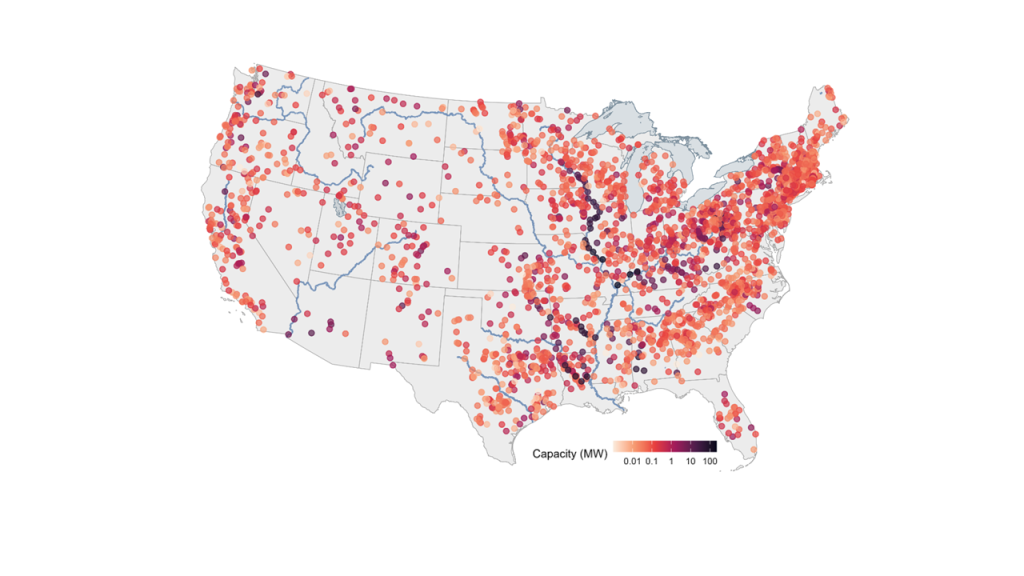
A map of technical potential for hydropower capacity at nonpowered U.S. dams. Credit: Oak Ridge National Laboratory, U.S. Department of Energy
“By using HydroGenerate, we are considering different types of turbines suitable to the conditions of the flow and hydraulic head at each site,” says INL researcher Juan Gallego-Calderon. “The tool is also offered as an open-source package so stakeholders such as researchers and project developers can use it to verify their own feasibility assessments.”
“This tool helps close the gap between theoretical possibilities and realistic potential,” says Hansen. “Many of these dams already serve other critical purposes, and their operational constraints—such as flood control or navigation—can significantly limit hydropower development. We’ve worked to reflect those limitations in a way that hadn’t been done before.”
The research delivers more than technical findings; it also supports resources, such as NPD Hydro, that help stakeholders evaluate nonpowered dam opportunities. NPD Hydro provides two new tools: NPD Insights, which captures the updated resource assessment and site rankings, and the NPD Toolkit, which helps users estimate payback periods and consider potential benefits to the environment, community, industry, and grid. Updated data are also available on the ORNL HydroSource website, enabling policymakers, dam owners, and hydropower researchers to visualize these dams alongside relevant existing energy infrastructure and water management data.
Empowering stakeholders with data and tools for the future
Looking forward, ORNL and INL researchers plan to incorporate future streamflow variability into the model to address the long-term effects of changing water availability on these potential hydropower resources. This next phase will also extend the assessment to regions like Alaska and Hawaii, ensuring consistent evaluations across the U.S. while coordinating with those who have already assessed feasibility. By accounting for evolving water systems, the project aims to deliver reliable, forward-looking insights for decades to come.
“Hydropower development takes time, often decades, so we need to consider what future water availability might look like,” Hansen says. “In some regions, increasing precipitation could even create greater potential for hydropower in the future.”
By refining the accuracy of NPD parameters, the dataset gives stakeholders foundational information that will lead to more effective and strategic detailed assessments. Ultimately, this will streamline development of new hydropower facilities, strengthen U.S. energy security, and expand domestically sourced energy production.
This research was conducted with support from the Hydropower and Hydrokinetic Office in the DOE’s Office of Critical Minerals and Energy Innovation.
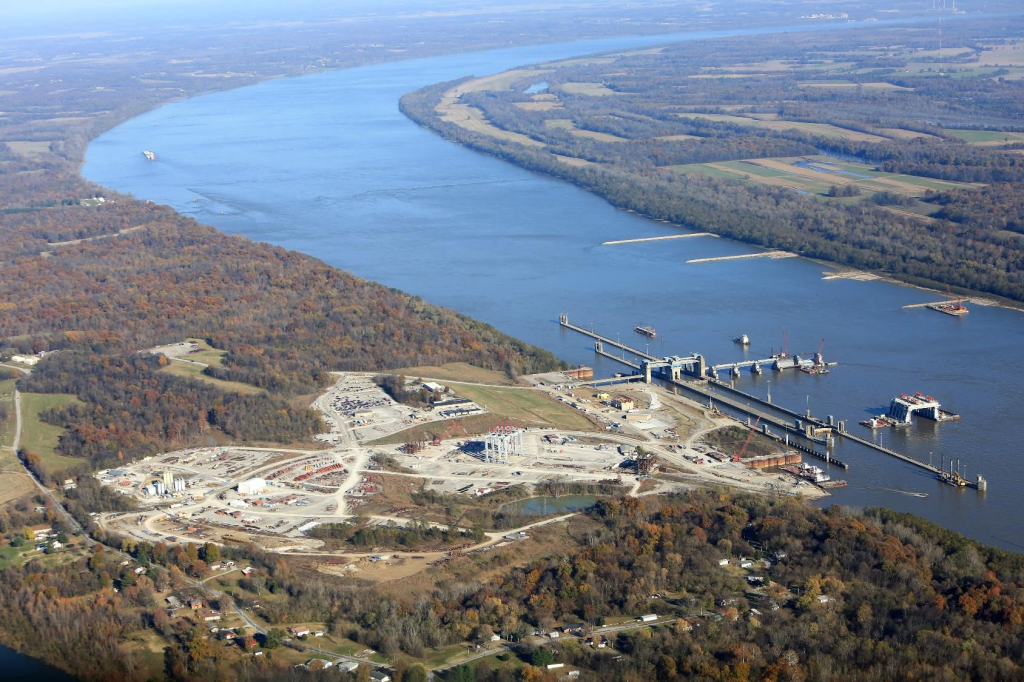
The Olmsted Locks and Dam in Illinois is a nonpowered dam identified as a candidate for hydropower generation in the NPD Hydro assessment. Credit: U.S. Army Corps of Engineers
Add new comment