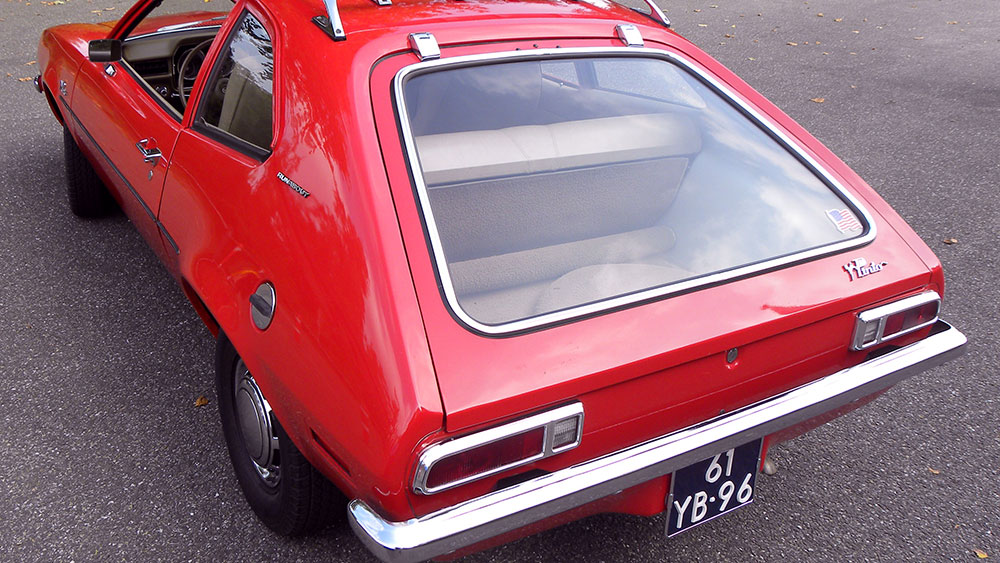
Making its debut in 1970, the Pinto was Ford Motor Co.’s first subcompact. In 1978, Ford was compelled to recall the car due to its propensity to burst into flame when struck from behind.
Social Sharing block

.jpg)
L eadership responsibility is included in ISO 9001:2026, Clause 5.1.1, to promote quality culture and ethical behavior. A strong argument could be made for adding safety as well.
|
ADVERTISEMENT |
Ethics has a very wide range of applications, including the need to avoid conflicts of interest (like recommending a product or service in which one has a personal financial interest) and not taking gifts that might influence purchasing decisions. This is obvious and common sense. In the context of ISO 9001, however, quality comes first in line.
This article will focus on helping organizations educate all stakeholders, including workers, managers, directors, suppliers, and customers, on the importance of an uncompromising quality culture.
I’ll also show why normalization of deviance, even without bad intentions (i.e., the decision maker doesn’t expect personal or organizational gain from it), must be avoided. Normalization of deviance could even constitute a crime in the U.S. armed forces. Article 92, failure to obey an order or regulation, says, “Duty: A duty may be imposed by treaty, statute, regulation, lawful order, standard operating procedure, or custom of the Service.” Willful or negligent noncompliance could constitute dereliction of duty. If this sounds extreme, the examples below will show the potentially devastating consequences of normalization of deviance.
Noncompliance with processes in civilian industries is cause for audit findings and, in industries regulated by the U.S. Food and Drug Administration, Form 483 notices, warning letters, and even worse. Nefarious intent isn’t required to cause any of these consequences. Therefore, I’ll address outright unethical conduct and normalization of deviance separately.
Consequences of unethical conduct
The need for a quality culture should and has usually gone without saying ever since humans began to practice trades upon which other humans relied. A cobbler who made shoes that fell apart, a blacksmith who made weapons or armor that failed in service, or a builder whose work couldn’t stand didn’t stay in business very long. When your name or trademark is on the item, you have a compelling interest to make sure it’s right before it goes out the door. “Proof armor,” for example, bore visible indentations from arrows and, later, bullets. The latter is the origin of the term bulletproof. These marks reassured the buyer that he could trust his life to the armor in battle.
Diffusion of responsibility in organized factories created opportunities and incentives to do poor work. These incentives included pressure to meet production schedules, e.g., “get it out the door at all costs,” and financial incentives to cut corners. The False Claims Act was created as a direct result of shoddy quality during the Civil War. I recall, however, that in A History of Managing for Quality (ASQC Quality Press, 1995), Joseph M. Juran cited Tsar Peter I’s threatened punishments, ranging from flogging to loss of vodka rations for selling nonconforming items to his army.
What does shoddy mean?
Many companies openly advertise shoddy products today, but only in the industry-specific context of fibers for soundproofing and insulation. As one textile glossary explains, “In the textile industry, ‘shoddy’ refers to a type of recycled or reclaimed textile material that is derived from discarded or worn-out garments and fabrics.” So shoddy and high quality aren’t contradictory terms in that industry.
Shoddy acquired a bad name during the Civil War when suppliers to the Union Army used this kind of material to make uniforms and shoes that fell apart in actual service. Ron Soodalter’s article “The Age of Shoddy” explains, “Facing a shortage of wool, Brooks Brothers glued together shredded, often decaying rags composed of various materials, pressed them into a semblance of cloth, and sewed them into uniforms. Far from protecting soldiers from inclement weather, these uniforms fell apart in the first rain.”
In that case, the unethical behavior came directly from top management. It’s also alleged that the French Army was issued boots with cardboard soles. “What would have been an annoyance in Spain turned into a frozen nightmare in Eastern Europe.”
One might have expected those quality scandals to have made this sort of behavior unacceptable. But they didn’t. All of the following examples can be used to train employees, managers, and suppliers to not cut corners when it comes to quality. They show that a dollar saved through unethical conduct might come back as thousands of dollars in liability, recalls, reputational harm, and even criminal liability.
The Union Stockyards: How to become a vegetarian in 2 minutes
Upton Sinclair’s The Jungle (Doubleday, Page & Co., 1906) described the meat-packing industry, and the Union Stockyards in particular: “These rats were nuisances, and the packers would put poisoned bread out for them; they would die, and then rats, bread, and meat would go into the hoppers together. This is no fairy story and no joke; the meat would be shoveled into carts, and the man who did the shoveling would not trouble to lift out a rat even when he saw one—there were things that went into the sausage in comparison with which a poisoned rat was a tidbit.”
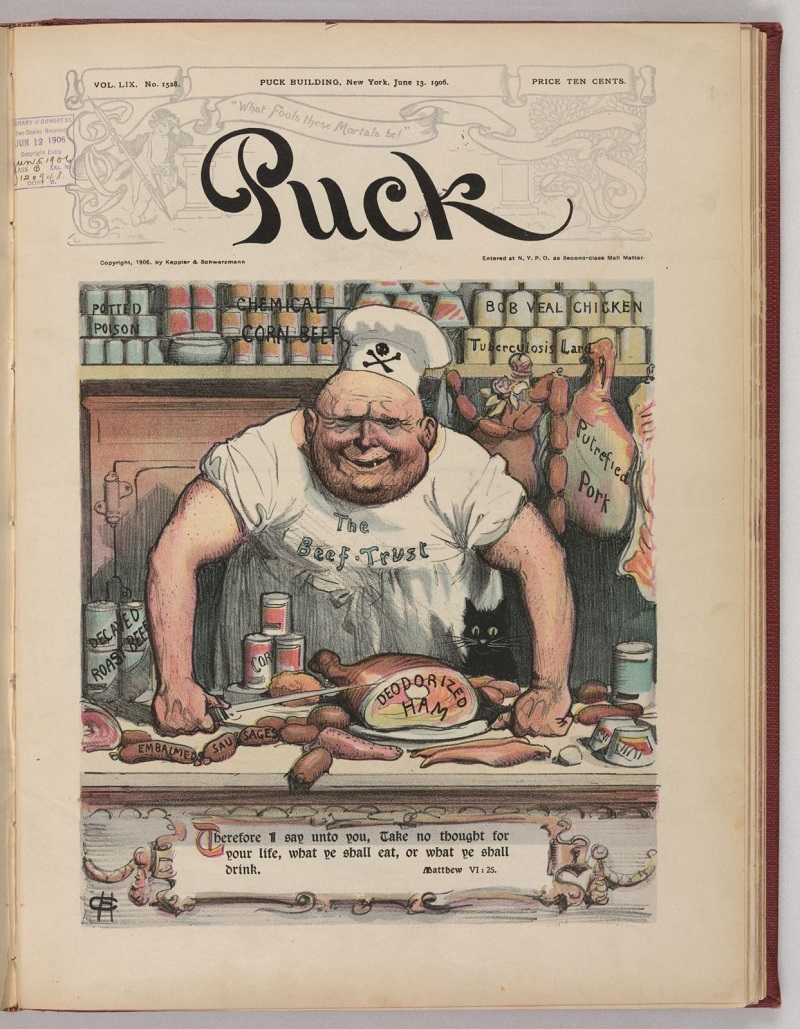
Now imagine your company on the cover of Puck in 1906.
Or in a cartoon such as this (also in Puck in 1906):
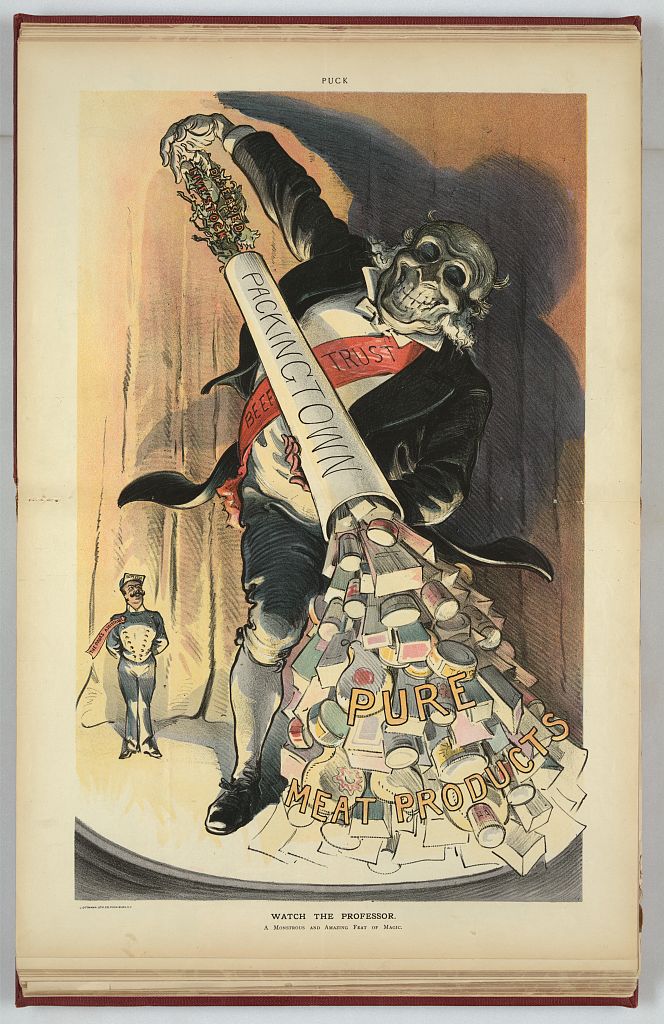
If you were a stockholder in the Union Stockyards, is this something you would want to see?
Now imagine what this would have looked like if they had had ChatGPT in 1903. Here is an AI rendition of Sinclair’s entire depiction of the meat packing operation. It takes about two minutes to read.
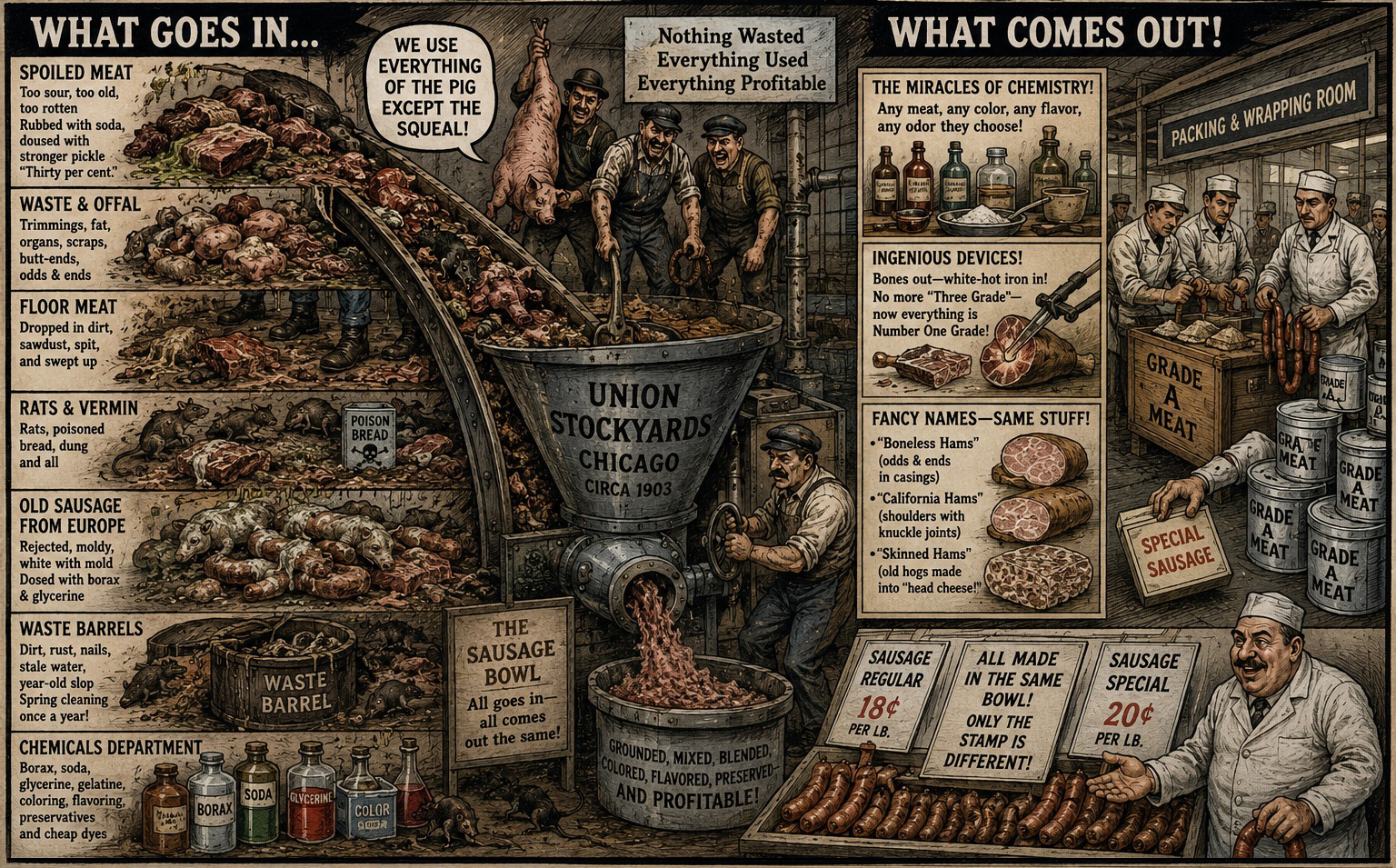
The Jungle, illustrated. Click here to enlarge.
This is an easily foreseeable consequence of unethical business practices at the expense of customers and, in the case of Union Stockyards, workers as well. Sinclair actually wanted his book to draw attention to the plight of immigrant workers such as Jurgis Rudkus, from Russian-ruled Lithuania, but it drew attention to people’s breakfast sausages instead. Sinclair complained, “I aimed at the public’s heart, and by accident I hit it in the stomach.”
Finley Peter Dunne wrote that President Theodore Roosevelt read the book. “Tiddy was toying with a light breakfast an’ idly turnin’ over th’ pages iv th’ new book with both hands. Suddenly he rose fr’m th’ table, an’ cryin’, ‘I’m pizened,’ began throwin’ sausages out iv th’ window.... Since thin th’ Prisideint, like th’ rest iv us, has become a viggytaryan....” A longer account adds that one of the sausages exploded when it hit the pavement outside.
This publicity resulted in the enactment of the original Pure Food and Drug Act in 1906. Christopher Klein’s “How Upton Sinclair’s ‘The Jungle’ Led to U.S. Food Safety Reforms” adds, “The chemical-laced ‘embalmed beef’ fed to soldiers during the Spanish-American War proved more lethal than combat.” Roosevelt had served in Cuba himself, and had eaten the canned meat in question. Klein adds, “Germany and France banned American meat products, and British imports of American canned meat ceased.”
The meat packers might have profited from their conduct in the short term, but lost entire markets as a result. The Chinese melamine scandal of 2008 is yet another example of adulteration of food products.
More quality scandals
Here are more spectacular examples of what happens when organizations subordinate quality to short-term profit. In most cases, they did profit in the short term. But the long-term downside was inevitable.
1. In 1937, Elixir of Sulfanilamide, which included diethylene glycol (a dimer of ethylene glycol, the ingredient in antifreeze), caused 107 deaths. This resulted in the Federal Food, Drug, and Cosmetic Act (FDCA) of 1938. The FDA’s Chamber of Horrors exhibit shows numerous other questionable, dangerous, and/or fraudulent products.
2. Arthur Miller’s All My Sons, a 1947 Broadway play that was made into a movie starring Edward G. Robinson, was based on the Curtiss-Wright scandal of World War II. HistoryNet explains, “…a culture had grown that encouraged Army inspectors to believe their primary duty was toward Wright rather than the AAF [U.S. Army Air Force], and that keeping their jobs depended on keeping the company happy. If an Army inspector refused to accept material that he knew was faulty, he got a reputation as a knucklehead who failed to ‘get along.’ Failing to get along meant you risked anything from an inconvenient job transfer to outright losing that job.” Note in particular the inference to a quality culture or, more precisely, lack of one.
3. During the late 1970s, Ford Motor Co. cut corners in manufacturing the Pinto, a subcompact which had a fuel tank that sometimes exploded in rear-end collisions. MotorTrend reports that the company had to pay out millions of dollars (in 1970s dollars) for the resulting deaths and injuries, and even faced a criminal indictment for reckless homicide (of which it was acquitted).
4. We would have expected the auto industry to have learned from the Pinto scandal. But, as Hershewe Law Firm wrote about the General Motors ignition switch scandal, “GM knew about this problem [which could allow a heavy key ring to turn off the ignition while the car was in motion] for years prior to the recall, perhaps as early as 2003 and certainly by 2005 and 2006 when engineers redesigned the key system due to safety concerns. But the idea was rejected because GM did not want to spend money on it.”
Instead of spending a little more money on each ignition switch, the company had to recall millions of vehicles and was liable for multiple deaths.
5. In March 2024 in Quality Magazine, Dale Norwood wrote that when he reported problems at the Ultrasonic Research and Testing Laboratory in 1991, he was variously told, “Why did you turn in URT? Everyone does it,” “Why didn’t you just quit?” and, “You know 98% of all the falsified parts would have passed inspection anyway.” To this he added, “And many of the falsified inspections were on fracture-critical components. It seemed that they were of the opinion that it was normal to expect some amount of falsification to take place.”
That last sentence indicates, again, lack of a quality culture. To this, Norwood adds, “In 2007 a Virginia man pled guilty to falsifying the inspections on over 9,000 welds he certified on submarines. In his plea deal, he was sentenced to 37 months in prison and required to pay the U.S. government $654,000.” A hospital technician, meanwhile, got 6 months in prison for falsifying mammography results. In some cases, though, there is not even a financial incentive to skip inspections or falsify their results. Norwood explains, “In many cases the individual is not benefiting monetarily, but [they] simply want to look good or just do not care anymore.”
6. Airbag manufacturer Takata wanted to save money by making substandard airbag inflators and ended up out of business instead. In the case United States vs. Takata et al, the U.S. Department of Justice writes, “As charged, from approximately 2000, Takata knew that certain ammonium nitrate-based airbag inflators were not performing to the specifications required by the auto manufacturers. Takata also knew that certain inflators had sustained failures, including ruptures, during testing. Nevertheless, Takata induced its customers to purchase these airbag systems by submitting false and fraudulent reports and other information that concealed the true condition of the inflators. This fraudulent data made the performance of the company’s airbag inflators appear better than it actually was, including by omitting that, in some instances, inflators ruptured during testing. Takata employees—including a number of key executives—routinely discussed the falsification of test reports being provided to Takata’s customers in email and in verbal communications.”
Even if poor quality doesn’t cause deaths or injuries, it can ruin a business’s reputation. Henry Ford told us in 1922 (in My Life and Work), “If the machine does not give service, then it is better for the manufacturer if he never had the introduction, for he will have the worst of all advertisements—a dissatisfied customer.”
That was when a dissatisfied customer might tell only his or her friends and neighbors. Now it takes but minutes to write the product a poor review all over the internet.
All of these case studies are compelling arguments for the need for ethics and quality culture, and can be cited in training for employees, supervisors, and supply chain stakeholders. They underscore the fact that cutting corners on something that might cost a few dollars to do right can result in millions of dollars in costs for product recalls or, even worse, fines and product liability costs.
Normalization of deviance
Normalization of deviance differs from willfully unethical conduct because there is no intention to cheat the customer or do bad work. It’s more of a mistaken “It doesn’t matter” attitude than “Let’s see what we can get away with.” However, its consequences can often be just as bad. That’s why it must be avoided.
“Flinching,” for example, means an inspector gives the benefit of the doubt to borderline nonconforming parts. Maybe the inspector thinks it would be a waste of money to scrap or rework the parts in question. If the inspector passes a shaft that is slightly wider than its upper specification limit, it will probably fit the corresponding hole 99% of the time or even more. Suppose, however, a shaft that is a little bigger than its specified diameter meets a hole that is exactly at its minimum specified diameter. Then it won’t fit, or the fit will be too tight. In addition, failure to reject the nonconforming shaft may allow the process conditions that are making the oversized shafts to continue.
What we have here is a poor judgment call rather than poor ethics, because the inspector gains nothing from the wrong decision and may even be trying to save the company money. Parts are inanimate objects, and we won’t hurt their feelings by rejecting them.
James Glover says in Quality Digest, “On the floor of almost any plant with a quality problem, operators can recite the standards and still skip them under pressure. The reasons vary, and the small lapses add up: the in-process verification that gets initialed but not performed; the deviation that gets rationalized under shift-change pressure; the calibration check that gets a shortcut when the line is behind.”
Again, there’s no intention to do the job wrong, and the person who deviates from the standard doesn’t expect to gain anything. But the outcome can be just as bad as if he or she did. If the calibration check isn’t performed, every measurement performed with the instrument in question is subject to doubt.
Another example might involve an ANSI/ASQ Z1.4 sampling plan with a sample size of 80 and an acceptance number of 2. The inspector finds no nonconforming items among the first 40 parts and decides to stop inspecting because he or she doesn’t expect to find more than two among the next 40 items.
Suppose, however, there are actually three nonconforming items, the de facto rejection number, in the sample. We can treat this like a bridge hand in which the defenders, East and West, have three missing trumps. If we use Pascal’s triangle, the relative probabilities are 1 for a 3–0 split, 3 for a 2–1 split, 3 for a 1–2 split, and 1 for an 0–3 split. Divide by 8 to get a 12.5% chance that they will all be in the uninspected group of 40. The inspector’s mistaken opinion of how to improve efficiency should be deployed instead as an ANSI/ASQ Z1.4 double sampling plan, which requires less inspection to pass a very good lot or reject a very bad one. Sequential sampling plans are even more efficient.
Now suppose an inspector or supervisor says, “We inspect every part, and we never find any bad ones, so why should we do the inspection?” Instead of just not doing the required inspection, find out if a continuous sampling plan will provide sufficient protection against unpleasant surprises. Then change the procedure or work instruction to reflect this (after proper review and approval).
Here’s a sample case study that can be used for training and discussion. A product is subject to ANSI/ASQ Z1.9 (inspection by variables) and requires measuring 10 parts. It’s late in the day, and the order has to get out the door, but the instrument is out of calibration. Somebody says, “The order has to go out, so let’s just simulate 10 measurements with the process’s known average and standard deviation. The customer will never know, and the measurements are, in fact, consistent with our process. We’re not simulating a standard deviation that is better than what we really have.”
If the process is capable and in control, this could easily work 99 out of 100 times. If, however, there are assignable cause problems the process’s control plan hasn’t caught yet, those could reach the customer, who will then wonder why it got an out-of-specification part when the inspection data are all in specification. The customer’s trust will be gone in a heartbeat.
Suppose instead that we tell the customer, “The instrument was found to be out of calibration, so we can’t ship the lot on time. We are calibrating the instrument and hope to send the shipment tomorrow (maybe by expedited freight, at our expense). We have also initiated corrective and preventive action for the calibration process.” The customer might not like it, but will also realize that they can count on us to do the job right rather than cut corners.
AI use: Ethics or judgment?
Using AI to do homework is a form of cheating unless permitted by the instructor. But what about using it to do a job? Keep two facts in mind:
1. The user is ultimately responsible for the AI’s output. At least one lawyer, for example, got into trouble with a judge for submitting precedent cases that the AI had not, as he thought, looked up; the AI made them up.
2. Online AIs don’t have confidentiality agreements with you and your client or employer. The AI might not deliberately give your trade secrets away, but it will learn from them and make the lessons learned available to others.
Here’s a good example of “the user is ultimately responsible for the AI’s output.” I asked ChatGPT, “What is the ANSI/ASQ Z1.4 tightened single sampling plan for a lot of 600 parts, general inspection level II, and acceptable quality level 1.0%?” It came back with code letter K, n = 125, accept on 5 nonconformances, reject on 6.
This is the tightened plan for AQL = 2.5%, and it uses the wrong sample size. I am admittedly using the 1981 version of the standard, but I doubt that the underlying statistics have changed since then. The code letter is J, which requires a sample of 80. For normal inspection, accept on 2 and reject on 3; for tightened inspection, accept on 1 and reject on 2.
When I told ChatGPT to use MIL-STD-105E, it came back with the correct code letter (J) but accept on 5, reject on 6—which is the tightened plan for AQL = 4%. However, it got the normal inspection level correct with n = 80, accept on 2, reject on 3.
How to promote ethics and quality culture
How can organizations promote ethics and quality/safety culture, and provide objective evidence of this to auditors? An ethics statement or policy by itself can, like a quality policy, be nothing more than a slogan. But training records are objective evidence. If, for example, people review case studies such as those depicted above, and understand the likely consequences of not performing required inspections, nonconformance to processes, and so on, this is objective evidence of training. Because leadership must set the example, it should be mandatory for even the CEO and the board of directors.
I worked for a company that sold products to the federal government, and we had a mandatory course on product substitution. Most of the content was common sense. It’s illegal to skip or falsify an inspection, or to use a material inferior to the one specified in a federal contract. Ethically, this is no different from selling short weight to customers, or “watering stock” in the context of making livestock drink as much water as possible before weighing it for sale.
One item was not common sense: You can’t use a material superior to the one specified in the contract. In this case, there is clearly no intention to cheat the customer. However, the supposedly harmless or even desirable change might have unforeseen and undesirable effects, and that’s why it’s not permitted. A chemical manufacturer, for example, substituted municipal water, literally clean enough to drink, for river water in a chemical process. The trace chlorine in the municipal water, however, damaged the process equipment under the harsh operating conditions.1 This suggests that ethics training needs to address actions that, while totally lacking in bad or dishonest intent, can still have undesirable results.
Don’t forget safety
A good quality policy, or subordinate document, will empower workers to stop production if necessary to prevent generating poor quality. Although Toyota is best known for this practice, it was Henry Ford’s policy long before. Although ISO 9001:2015 doesn’t mention this, IATF 16949:2016, Clause 5.3.2 (a) requires this explicitly. In addition—and this is mandatory under OSHA regulations—a job that can’t be done safely must not be done at all until it is made safe.
Summary
Basic ethics, such as not shipping known nonconforming work or covering up design flaws, should be a given. However, catastrophic product recalls and civil and criminal convictions have shown that some organizations, including some with well-known names, have engaged in this behavior. Ethics training must ensure that everybody understands the risks are easily foreseeable—and just not worth it.
Normalization of deviance can also have serious consequences, even though there is no intent to shortchange the customer or ship poor quality. Everybody needs to understand the importance of following procedures and processes to the letter. This is among the foundations of standard work. If somebody thinks of a better way to do a job, the change should go through the established review process to ensure that it works and doesn’t produce unintended consequences.
AI is an assistant for judgment, not a substitute for it. The user is ultimately responsible for the result.
Safety is nonnegotiable. Per OSHA regulations, nobody can be directed to work in an unsafe job. Empower employees to point out unsafe conditions to initiate corrective and preventive action. Workplace safety committees give workers partial ownership of occupational health and safety.
Reference
1 Lorenzo, Donald K; Wong, Della; Suyama, Mark. “Recognize Hazards to Recognize Change.” Chemical Engineering Progress, April 2015, pp. 40–44 (requires membership to view).
Add new comment