{domain:"www.qualitydigest.com",server:"169.47.211.87"} Skip to main content

        
User account menu
Main navigation
  • Topics
    • Customer Care
    • Regulated Industries
    • Research & Tech
    • Quality Improvement Tools
    • People Management
    • Metrology
    • Manufacturing
    • Roadshow
    • QMS & Standards
    • Statistical Methods
    • Resource Management
  • Videos/Webinars
    • All videos
    • Product Demos
    • Webinars
  • Advertise
    • Advertise
    • Submit B2B Press Release
    • Write for us
  • Metrology Hub
  • Training
  • Subscribe
  • Log in
Mobile Menu
  • Home
  • Topics
    • Customer Care
    • Regulated Industries
    • Research & Tech
    • Quality Improvement Tools
    • People Management
    • Metrology
    • Manufacturing
    • Roadshow
    • QMS & Standards
    • Statistical Methods
    • Supply Chain
    • Resource Management
  • Login / Subscribe
  • More...
    • All Features
    • All News
    • All Videos
    • Contact
    • Training

More Efficient Computing With Magnetic Waves

People are beginning to look for computing beyond silicon, and wave computing is a promising alternative

Rob Matheson
Thu, 01/23/2020 - 12:02
  • Comment
  • RSS

Social Sharing block

  • Print
Body

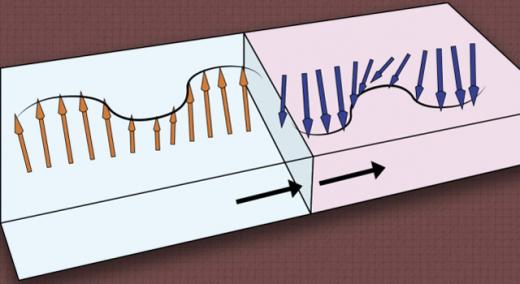
MIT researchers have devised a novel circuit design that enables precise control of computing with magnetic waves—with no electricity needed. The advance takes a step toward practical magnetic-based devices, which have the potential to compute far more efficiently than electronics.

ADVERTISEMENT

Classical computers rely on massive amounts of electricity for computing and data storage, and generate a lot of wasted heat. In search of more efficient alternatives, researchers have started designing magnetic-based “spintronic” devices, which use relatively little electricity and generate practically no heat.

Spintronic devices leverage the “spin wave”—a quantum property of electrons—in magnetic materials with a lattice structure. This approach involves modulating the spin wave properties to produce some measurable output that can be correlated to computation. Until now, modulating spin waves has required injected electrical currents using bulky components that can cause signal noise and effectively negate any inherent performance gains.

 …

Want to continue?
Log in or create a FREE account.
Enter your username or email address
Enter the password that accompanies your username.
By logging in you agree to receive communication from Quality Digest. Privacy Policy.
Create a FREE account
Forgot My Password
Top Stories
Your First 12 Months of ISO 9001:2026 Transition: An Auditor’s Perspective
Why Remote Work Isn’t Working
A Blueprint for Keeping Humans in Control of AI
A Passing Gauge R&R Doesn’t Mean the Measurement System Is Capable
Run It Past the Murder Board

Add new comment

Please login to comment.

© 2026 Quality Digest. Copyright on content held by Quality Digest or by individual authors. Contact Quality Digest for reprint information.
“Quality Digest" is a trademark owned by Quality Circle Institute Inc.

footer
  • Home
  • Print QD: 1995-2008
  • Print QD: 2008-2009
  • Videos
  • Privacy Policy
  • Write for us
footer second menu
  • Subscribe to Quality Digest
  • About Us
  • Contact Us