{domain:"www.qualitydigest.com",server:"169.47.211.87"} Skip to main content

        
User account menu
Main navigation
  • Topics
    • Customer Care
    • Regulated Industries
    • Research & Tech
    • Quality Improvement Tools
    • People Management
    • Metrology
    • Manufacturing
    • Roadshow
    • QMS & Standards
    • Statistical Methods
    • Resource Management
  • Videos/Webinars
    • All videos
    • Product Demos
    • Webinars
  • Advertise
    • Advertise
    • Submit B2B Press Release
    • Write for us
  • Metrology Hub
  • Training
  • Subscribe
  • Log in
Mobile Menu
  • Home
  • Topics
    • Customer Care
    • Regulated Industries
    • Research & Tech
    • Quality Improvement Tools
    • People Management
    • Metrology
    • Manufacturing
    • Roadshow
    • QMS & Standards
    • Statistical Methods
    • Supply Chain
    • Resource Management
  • Login / Subscribe
  • More...
    • All Features
    • All News
    • All Videos
    • Contact
    • Training

The Jet in Pneumatic Gauging: A Practical Viewpoint

Proper design and manufacture of jets is a key part of gauging performance

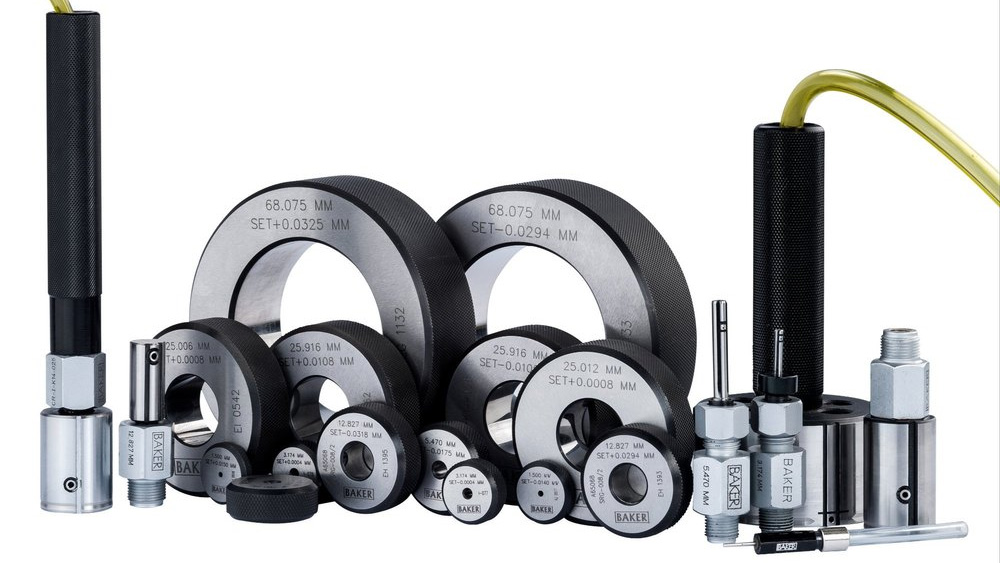
Examples of air plug gauges from Baker.

Anil More

ADCON Consulting

Mon, 12/09/2024 - 12:03
  • Comment
  • RSS

Social Sharing block

  • Print
Body

The jet in pneumatic dimensional (or air) gauging is the mechanical part of the sensing probe—air plug gauge, air ring gauge, air caliper gauge—through which compressed air is directed onto the part under measurement.

ADVERTISEMENT

In its simplest form, we have two jets working in tandem facing in opposite directions (180°) to each other. Two are required to maintain a balance and to direct the air so that it impinges equally on the part surface. The back pressure created between the sensor and the part surface tells us whether the surface is farther away or nearer than required, i.e., whether the part is within its tolerance in comparison to a master part measured on the same equipment. The jets need to be central to the diameter. This is achieved by the jets’ placement in the body, which acts as guide. The central position is important to the accuracy of the gauge.

 …

Want to continue?
Log in or create a FREE account.
Enter your username or email address
Enter the password that accompanies your username.
By logging in you agree to receive communication from Quality Digest. Privacy Policy.
Create a FREE account
Forgot My Password
Top Stories
What FDA Warning Letters Reveal About Records, Spreadsheets, and AI
The Art of Forecasting: Part 1
Avoiding the 7 Deadly Killers of Projects
ISO 9001:2026 Ethics and Quality Culture
ISO 9001:2026 Is Here

Add new comment

Please login to comment.

© 2026 Quality Digest. Copyright on content held by Quality Digest or by individual authors. Contact Quality Digest for reprint information.
“Quality Digest" is a trademark owned by Quality Circle Institute Inc.

footer
  • Home
  • Print QD: 1995-2008
  • Print QD: 2008-2009
  • Videos
  • Privacy Policy
  • Write for us
footer second menu
  • Subscribe to Quality Digest
  • About Us
  • Contact Us