{domain:"www.qualitydigest.com",server:"169.47.211.87"} Skip to main content

        
User account menu
Main navigation
  • Topics
    • Customer Care
    • Regulated Industries
    • Research & Tech
    • Quality Improvement Tools
    • People Management
    • Metrology
    • Manufacturing
    • Roadshow
    • QMS & Standards
    • Statistical Methods
    • Resource Management
  • Videos/Webinars
    • All videos
    • Product Demos
    • Webinars
  • Advertise
    • Advertise
    • Submit B2B Press Release
    • Write for us
  • Metrology Hub
  • Training
  • Subscribe
  • Log in
Mobile Menu
  • Home
  • Topics
    • Customer Care
    • Regulated Industries
    • Research & Tech
    • Quality Improvement Tools
    • People Management
    • Metrology
    • Manufacturing
    • Roadshow
    • QMS & Standards
    • Statistical Methods
    • Supply Chain
    • Resource Management
  • Login / Subscribe
  • More...
    • All Features
    • All News
    • All Videos
    • Training

Lean Is Not an Acronym

Never assume you’re as good as you can be

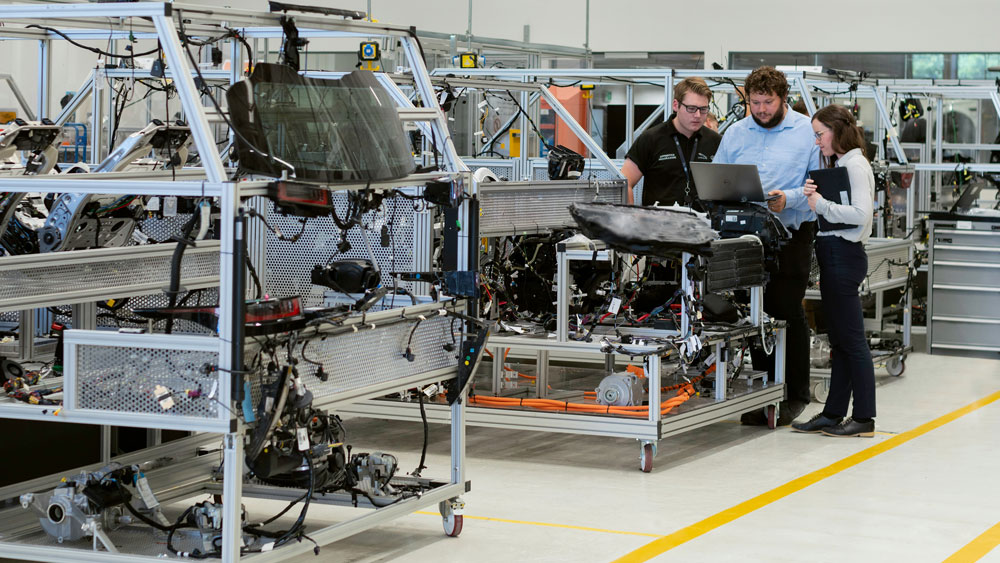
ThisisEngineering / Unsplash

Ken Eme
Bio

PIVOT Management Consultants

Thu, 01/08/2026 - 12:03
  • Comment
  • RSS

Social Sharing block

  • Print
Body

When I first became involved in lean (continuous improvement), I was the VP of operations at a privately held company in the Midwest. It was 2003, and as a newly promoted senior executive I was eager to find a strategy that could make a real difference in our operations.

ADVERTISEMENT

I quickly realized that lean might be the key to improving results across the board.

What is lean?

Lean isn’t an acronym. It was a term coined by John Krafcik in 1988 and later expanded by James Womack and Daniel Jones in 1996 to describe the Toyota Production System. In their seminal book Lean Thinking (Free Press, 2003), Womack and Jones codified lean into these key principles:
• Value—the transformation of materials or information, done correctly the first time and that the customer is willing to pay for
• Value stream—the processes by which the “value” moves “toward” the customer
• Flow—the continuous movement of the value along the stream with few or no stoppages
• Pull—the value is pulled by the customer’s demand, not pushed to them via other means
• Perfection—the actions to continuously look for and implement ways to improve the system

Here’s an acronym that can serve as a mnemonic to help you remember the eight wastes that a lean transformation can reduce or eliminate—DOWNTIME, as in:
D—defects
O—overproduction
W—waiting
N—nonused talent
T—transportation
I—inventory
M—motion
E—excess processing

Lean is about optimizing value while minimizing wastes, not about cutting employees or resources. While many of us may have forgotten it, lean still should have a prominent place in our thoughts and strategies going forward.

A bold decision to try lean

To get buy-in from my peers and my team—mostly former colleagues—I knew I had to show them lean in action. I decided to split the team into two groups. One group visited the Toyota plant in Georgetown, Kentucky, to see lean principles at work firsthand. The other attended an Institute of Industrial Engineers conference to hear case studies about successful lean implementations. My boss (the CEO) and I went to both events. I also purchased a copy of Lean Thinking for both teams to help them further understand the intent of what I was proposing. (If you haven’t read it, I highly recommend it.)

The experience was eye-opening for everyone involved. By the time we returned, I had secured enough support to pilot lean as a strategy for improving our operations.

This decision wasn’t made lightly. The company was family-owned, nearly 100 years old, and highly successful. It was conservative by nature, and change wasn’t always welcome. But if we wanted to stay competitive, we needed to embrace change.

The lean journey: From learning to doing

I recognized that I didn’t have all the answers; I needed guidance on how to execute this strategy. After interviewing several consulting partners, we chose a path that aligned with our goals. The business model was simple but powerful: The consultants didn’t just want to implement lean for us—they wanted to teach us how to do it ourselves.

We selected a value stream that was complex enough to employ several lean tools. The process was vertically integrated, with batch and flow operations, assembly, and late-point differentiation. We started with a value-stream mapping event that set the stage for a series of kaizen events aimed at transforming the operation.

Examples of the focused kaizen events included:
• Demand segmentation
• Standard work
• 5-S
• TPM (total productive maintenance)
• Changeover time reduction, also known as SMED (single minute exchange of dies)
• Kanban implementation and postponement

Each event was one week long and focused on that topic of improvement.

One event stands out vividly in my memory. As part of the event, we needed to physically move and decouple the painting operation from the rest of the process. This would allow us to reduce the waste of transportation and improve the flow of the value stream.

The challenge wasn’t just logistical; it was legal. The painting operation was “environmentally permitted” to be where it was, and we initially believed that moving it would take weeks, if not months. But we pushed forward, found a way to make it happen legally, and moved the operation in just a few days.

That breakthrough shifted the team’s mindset. They saw that lean wasn’t about being constrained by “how things have always been done.” With that mentality change, we gained significant momentum. KPIs improved across the board, and the value stream we had chosen became a shining example of lean’s potential.

Lean isn’t an acronym

As our transformation progressed, I started getting a lot of questions from employees and leaders: “What does lean stand for?” There was a common misconception that lean was an acronym, and people were eager to decode it.

I’ve often heard people mistakenly say that lean means fewer employees, as in:
• L—less
• E—employees
• A—are
• N—needed

Although it’s true that a lean transformation can lead to job shifts or reductions, that’s not its essence. In my experience, if you cut people just to reduce head count, the gains from lean won’t be sustainable. The key to success in lean is to empower people, not to lay them off.

In every lean implementation I’ve overseen, I’ve been committed to one core principle: No one will lose their job as a result of a kaizen event.

How have I kept that promise? Through business growth, reassignment, retraining, or voluntary attrition. As long as employees trust the lean process, they can thrive—and so can the organization.

Lean is about people, not layoffs. If I were forced to turn lean into an acronym, I’d offer this one:
• L—leverage
• E—everyone’s
• A—actual
• N—nonutilized talent

That idea isn’t far from reality. During a different transformation, for example, an operator approached us with a proposal to reorganize a staging area to reduce changeover time—something no engineer had noticed. Her idea cut setup time by nearly 40%. More importantly, it changed the narrative. Lean wasn’t something “being done” to employees; it was something they were doing and driving. That shift in ownership unlocked even greater improvements.

Lean succeeds when people and their creativity are at the center of the effort.

Final thoughts

A successful leader may wonder why they should embark on a lean journey if they haven’t already done so. My only advice would be this: I’m certain there’s a lot of nonvalue-added waste you can eliminate to make your operation even better than you ever thought it could be. Don’t assume you’re as good as you can be. You can always be better.

A lean transformation is a journey, not a destination. It requires humility, curiosity, and a willingness to question long-held assumptions. But when you do it right, lean unleashes potential that was always there—within people, processes, and culture.

If this perspective resonates and you’d like to continue the conversation, please leave a comment below.

Comments

Submitted by Jay Arthur (not verified) on Thu, 01/08/2026 - 09:52

Speed is the Healing App

Eliminating delays accelerates results and reduces defects, mistakes and errors. In service industries such as healthcare, diagramming a process, identifying unnecessary delays and redesigning the process can be done in a few hours and implemented immediately.

Speed is the healing app.

  • Reply

Submitted by P@ (not verified) on Thu, 01/08/2026 - 10:28

LEAN works

I started a lean journey nearly  13 years ago with a LEAN project called follow the Money, and over time has resulted in a revenue increase over 167 million dollars since the starting point (25% growth).

  • Reply

Add new comment

The content of this field is kept private and will not be shown publicly.
About text formats
Image CAPTCHA
Enter the characters shown in the image.

© 2025 Quality Digest. Copyright on content held by Quality Digest or by individual authors. Contact Quality Digest for reprint information.
“Quality Digest" is a trademark owned by Quality Circle Institute Inc.

footer
  • Home
  • Print QD: 1995-2008
  • Print QD: 2008-2009
  • Videos
  • Privacy Policy
  • Write for us
footer second menu
  • Subscribe to Quality Digest
  • About Us