{domain:"www.qualitydigest.com",server:"169.47.211.87"} Skip to main content

        
User account menu
Main navigation
  • Topics
    • Customer Care
    • Regulated Industries
    • Research & Tech
    • Quality Improvement Tools
    • People Management
    • Metrology
    • Manufacturing
    • Roadshow
    • QMS & Standards
    • Statistical Methods
    • Resource Management
  • Videos/Webinars
    • All videos
    • Product Demos
    • Webinars
  • Advertise
    • Advertise
    • Submit B2B Press Release
    • Write for us
  • Metrology Hub
  • Training
  • Subscribe
  • Log in
Mobile Menu
  • Home
  • Topics
    • Customer Care
    • Regulated Industries
    • Research & Tech
    • Quality Improvement Tools
    • People Management
    • Metrology
    • Manufacturing
    • Roadshow
    • QMS & Standards
    • Statistical Methods
    • Supply Chain
    • Resource Management
  • Login / Subscribe
  • More...
    • All Features
    • All News
    • All Videos
    • Contact
    • Training

Handing the Surgeon’s Scalpel to a Robot

After decades of merely assisting doctors, are sophisticated machines ready to take charge?

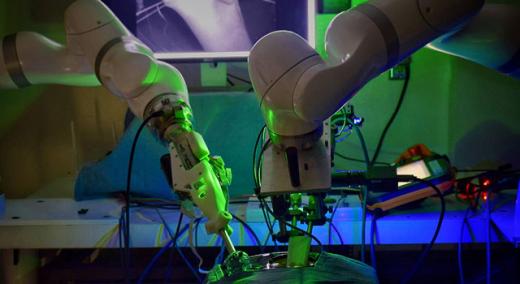
Courtesy of Axel Krieger and Jin Yang

James Gaines
Knowable Magazine
Tue, 10/25/2022 - 12:03
  • Comment
  • RSS

Social Sharing block

  • Print
Body

In 2004, the United States’ Defense Advanced Research Projects Agency (DARPA) dangled a $1 million prize for any group that could design an autonomous car that could drive itself through 142 miles of rough terrain from Barstow, California, to Primm, Nevada. Thirteen years later, the U.S. Department of Defense announced another award—not for a robot car this time, but for autonomous robotic doctors.

ADVERTISEMENT

Robots have been found in the operating suite since the 1980s for things like holding a patient’s limbs in place, and later for laparoscopic surgery, during which surgeons can use remote-controlled robot arms to operate on the human body through tiny holes instead of huge cuts. But for the most part, these robots have been, in essence, just very fancy versions of the scalpels and forceps surgeons have used for centuries—incredibly sophisticated, granted, and capable of operating with incredible precision, but still tools in the surgeon’s hands.

 …

Want to continue?
Log in or create a FREE account.
Enter your username or email address
Enter the password that accompanies your username.
By logging in you agree to receive communication from Quality Digest. Privacy Policy.
Create a FREE account
Forgot My Password
Top Stories
Beyond the Statistics: Implementing the New VDA AIAG SPC Manual
Multivariate Charts
All Whys Are Not The Same
Flying Blind: What Your Quality Data Miss Every Shift
Book Preview
The Psychology of AI Adoption at Work

Add new comment

Please login to comment.

© 2026 Quality Digest. Copyright on content held by Quality Digest or by individual authors. Contact Quality Digest for reprint information.
“Quality Digest" is a trademark owned by Quality Circle Institute Inc.

footer
  • Home
  • Print QD: 1995-2008
  • Print QD: 2008-2009
  • Videos
  • Privacy Policy
  • Write for us
footer second menu
  • Subscribe to Quality Digest
  • About Us
  • Contact Us