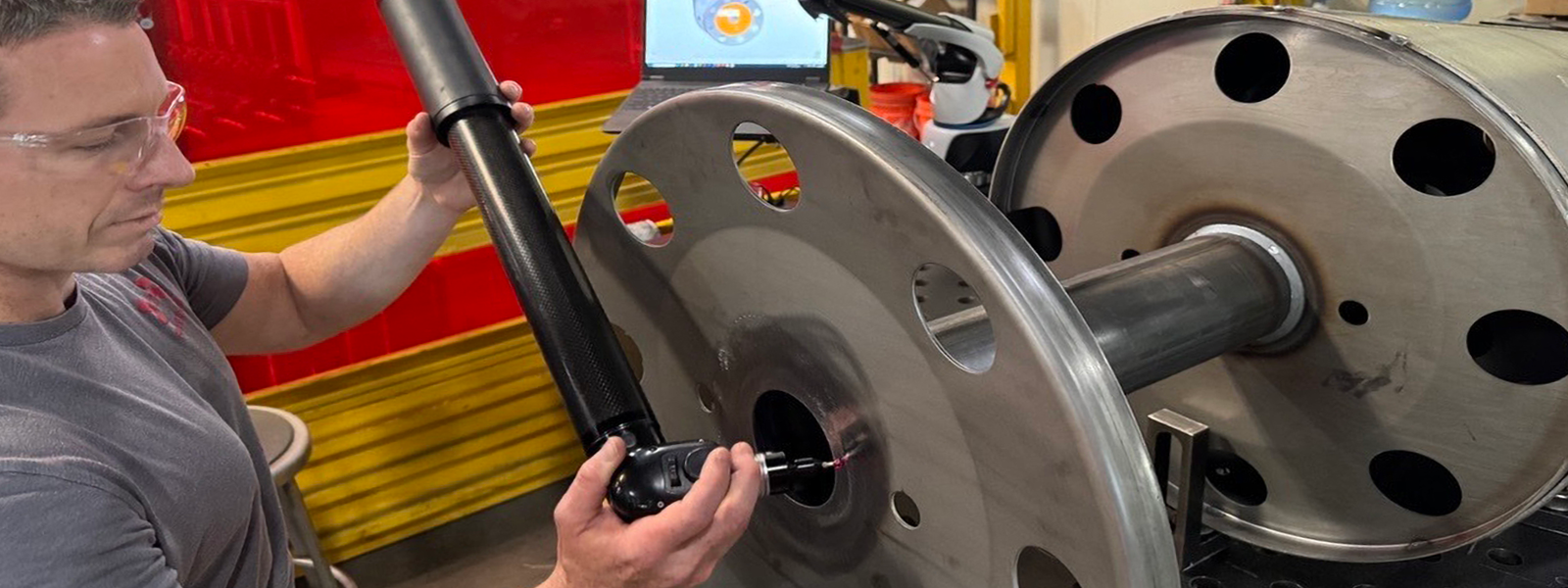
Portable Manual Metrology in an Increasingly Automated World
There’s a lot of talk about automation these days, not just in manufacturing circles but also the news in general.
This illustration featuring earthquake simulation data from the San Francisco Bay Area shows how seismic energy is shaped and directed by local geology, and how buildings and infrastructure respond to intense ground shaking.
Simulations still can’t predict precisely when an earthquake will happen. Still, with the incredible processing power of modern exascale supercomputers, they can now predict how they will happen and how much damage they will likely cause.
David Deisenroth, a mechanical engineer at NIST, researches ways to improve metal 3D printing.
Even if you’ve never heard of “light caustics,” you’ve probably seen them. They’re the ethereal patterns of light that coat the bottoms of swimming pools and break up the shadows of glass.
A Rhagovelia water strider with its fans open in the water.
A new study explains how tiny water bugs use fan-like propellers to zip across streams at speeds up to 120 body lengths per second. The researchers then created a similar fan structure and used it to propel and maneuver an insect-sized robot.
Guangwen Zhou, a SUNY distinguished professor at the Thomas J. Watson College of Engineering and Applied Science and deputy director of Binghamton University's Materials Science and Engineering program, is co-author on a new study in Nature that could lead to greener and faster metal production.
Most metals found in nature are actually in their oxide forms.
Everybody wants to have good measurements. To this end, many recommend a regular schedule of recalibration. While this sounds reasonable, it can actually degrade the quality of the measurements.
C hallenges abound for today’s manufacturers. Labor shortages and rising labor costs require innovative solutions to maintain productivity with fewer staff. Inflation continues to exert pressure on raw material costs, squeezing margins.
NIST researcher Kamran Sayrafian developed a computational model of the lungs with different levels of excess fluid. The long-term goal is to develop a device that could alert the patient or medical provider when it detects pulmonary edema in the user’s lungs.
A few years ago, I heard on the news that many people were being hospitalized with a condition of excess fluid in the lungs, called pulmonary edema.
A technician at Karbonius Composites cuts a carbon-fiber part.
Karbonius Composites specializes in manufacturing precision molds and composite components across various sectors, including automotive restoration and high-performance customization.
A student at the University of Perugia 3D scanning an implant with Artec Micro II.
The dental industry is seeing a surge in 3D printing, with the technology enabling a growing number of dentists to rapidly create custom implants in clinics around the world.
© 2025 Quality Digest. Copyright on content held by Quality Digest or by individual authors. Contact Quality Digest for reprint information.
“Quality Digest" is a trademark owned by Quality Circle Institute Inc.