{domain:"www.qualitydigest.com",server:"169.47.211.87"} Skip to main content

        
User account menu
Main navigation
  • Topics
    • Customer Care
    • Regulated Industries
    • Research & Tech
    • Quality Improvement Tools
    • People Management
    • Metrology
    • Manufacturing
    • Roadshow
    • QMS & Standards
    • Statistical Methods
    • Resource Management
  • Videos/Webinars
    • All videos
    • Product Demos
    • Webinars
  • Advertise
    • Advertise
    • Submit B2B Press Release
    • Write for us
  • Metrology Hub
  • Training
  • Subscribe
  • Log in
Mobile Menu
  • Home
  • Topics
    • Customer Care
    • Regulated Industries
    • Research & Tech
    • Quality Improvement Tools
    • People Management
    • Metrology
    • Manufacturing
    • Roadshow
    • QMS & Standards
    • Statistical Methods
    • Supply Chain
    • Resource Management
  • Login / Subscribe
  • More...
    • All Features
    • All News
    • All Videos
    • Contact
    • Training

Gallium: The Liquid Metal That Could Transform Soft Electronics

Bend it. Stretch it. Use it to conduct electricity.

Adobe Stock

Kurt Kleiner
Knowable Magazine
Wed, 05/25/2022 - 12:03
  • Comment
  • RSS

Social Sharing block

  • Print
Body

Every time you sit down with your phone in your back pocket, you’re reminded of a fundamental truth: Human bodies are soft and flexible. Electronics aren’t.

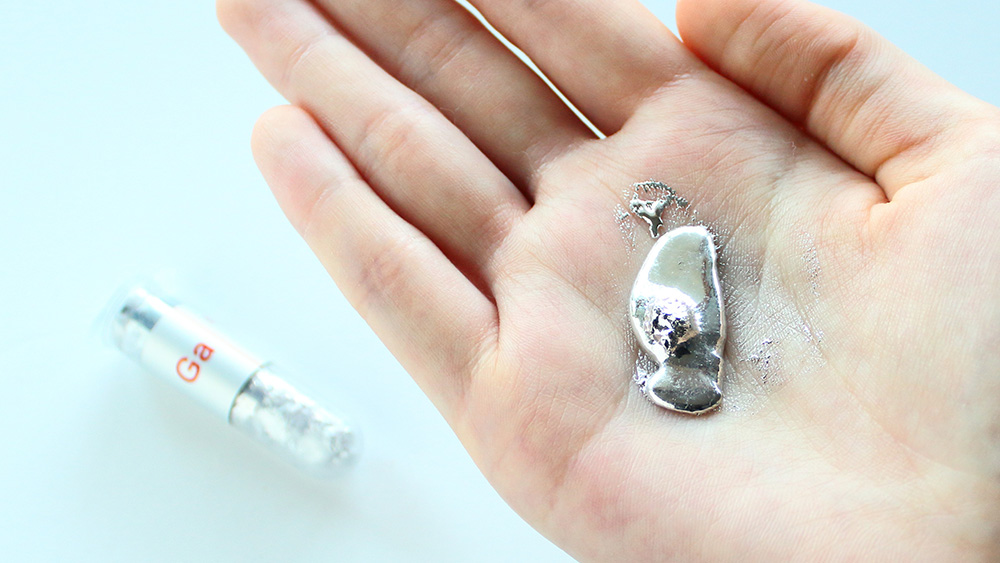
But soon there may be devices that can stretch, bend, and even repair themselves when they’re damaged. By harnessing the unusual properties of a liquid metal called gallium, materials scientists aim to create a new generation of flexible devices for virtual reality interfaces, medical monitors, motion-sensing devices, and more.

ADVERTISEMENT

The goal is to take the functionality of electronics and make them softer, says Michael Dickey, a chemical engineer at North Carolina State University. “I mean, the body and other natural systems have figured out how to do it. So surely, we can do it.”

Bendable electronics can also be made with conventional metals. But solid metal can fatigue and break, and the more that’s added to a soft material, the more inflexible the material becomes. Liquid metals don’t have that problem, Dickey says: They can be bent, stretched, and twisted with little or no damage.

 …

Want to continue?
Log in or create a FREE account.
Enter your username or email address
Enter the password that accompanies your username.
By logging in you agree to receive communication from Quality Digest. Privacy Policy.
Create a FREE account
Forgot My Password
Top Stories
Beyond the Statistics: Implementing the New VDA AIAG SPC Manual
All Whys Are Not The Same
Flying Blind: What Your Quality Data Miss Every Shift
Book Preview
The Psychology of AI Adoption at Work
Momentum Technologies Achieves Record Purity Milestones for Rare Earths

Add new comment

Please login to comment.

© 2026 Quality Digest. Copyright on content held by Quality Digest or by individual authors. Contact Quality Digest for reprint information.
“Quality Digest" is a trademark owned by Quality Circle Institute Inc.

footer
  • Home
  • Print QD: 1995-2008
  • Print QD: 2008-2009
  • Videos
  • Privacy Policy
  • Write for us
footer second menu
  • Subscribe to Quality Digest
  • About Us
  • Contact Us