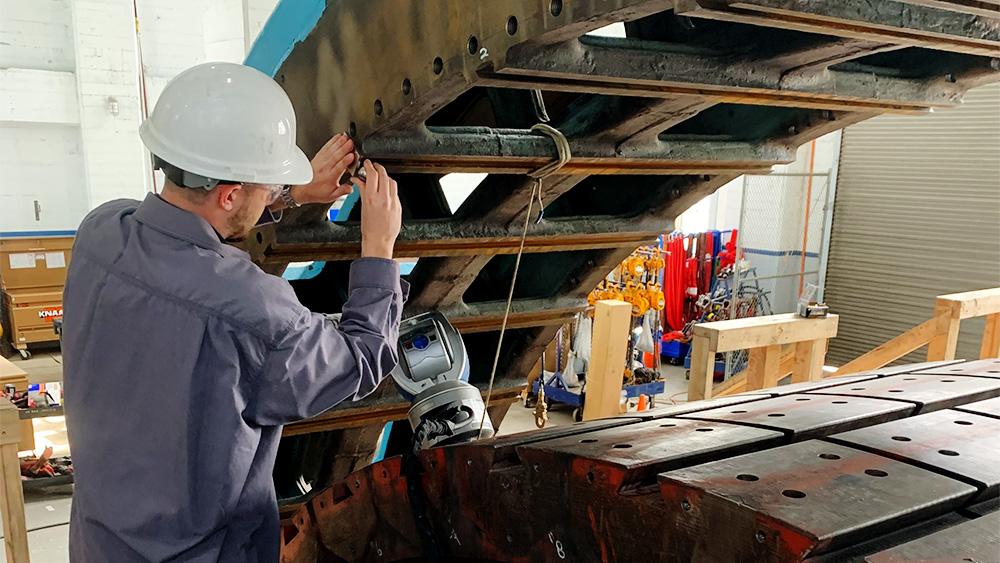
Buffalo Metrology
Hydroelectric generators are used to generate power in many parts of the United States. One of their interesting details is that despite how massive they are—a typical 5–20 MW generator can measure 8–12 ft in diameter and weigh about 50 tons—they are built to extremely demanding tolerances.
|
ADVERTISEMENT |
My company, BMI, was contracted to install new keybars in a hydroelectric generator stator frame. The stator frame houses the stator core that sits inside the generator. The keybars act as structural components to ensure the massive iron core is kept within the roundness tolerance.
Keybar manufacturing tolerances are tight, at this particular installation about 0.005 in. radius over the 24 in. keybar length. During installation, a series of fixtures are needed to hold the keybars in place and allow adjustment in and out, side to side, and to control twist during assembly so the stator’s inside diameter is held to a tolerance of +/– 0.01 in. over the 8–12 ft diameter.

Overall top-end view of hydroelectric generator. Stator frame is red. Keybars are the gray vertical pieces.
In addition to the dimensional challenges, the working environment requires that all fixturing be adaptable to field conditions where access, alignment consistency, and repeatability are often limited. Furthermore, because the work site is highly regulated and in a remote area for generating power, as the service provider we need to know we have the correct dimensions while we’re onsite to understand how to best join the keybar set to the generator’s stator core.
Because of all of these constraints, multiple fixture-machining iterations would be too time consuming. So, bringing modern technology to 100-year-old hydro generator building practices, our hydro division manager decided to try 3D printing prototype fixtures instead of machining them.
BMI’s approach
![]() Fixtures holding the keybar and stator frame in place |
Our field engineer first designed the two-part modular fixture components based on the onsite understanding of what was needed. The designs were reviewed collaboratively between engineering and field technicians to ensure usability and installation feasibility. The fixture components were then exported to a remote Bambu 3D printer.
The use of a Bambu H2D 3D printer allowed:
• High-resolution prints capable of maintaining tight tolerances
• Durable materials suitable for light-duty functional testing
• Consistent repeatability in multiple components
Although the printed parts weren’t intended for final structural use, they provided critical insight into how the final steel components would perform under installation conditions.
![]() 3D-printed fixture (green) for testing on stator core |
Upon completion, the 3D-printed parts were overnighted across the country to the generator site, hand tapped, and installed to complete proof of concept as seen here.
This rapid turnaround enabled immediate validation of:
• Fitment within the stator geometry
• Adjustability range of the fixture
• Repeatable alignment under installation conditions
• Ease of use for installation technicians
The ability to physically test these components in real-world conditions significantly reduced uncertainty before moving into final production.
Following field validation, the prototype components were inspected and measured to confirm that they met the critical tolerance requirements.
![]() Machined fixture components |
The last step in the process was to work with our CNC machining vendor to complete the expedited parts from steel. The validated additive design served as the “nominal model,” ensuring that the machined components required minimal rework or redesign.
Start to finish, from 3D print to machined parts, was less than one week.
This accelerated workflow eliminated multiple traditional design-review-manufacturing cycles and reduced overall project risk.
Final outcome
This proof of concept allowed our engineering staff to work with lead-level technicians to create a practical hydroelectric solution for joining keybars to the stator frame.
The project demonstrated how additive manufacturing can be effectively integrated into heavy industrial repair processes, enabling:
• Faster turnaround times
• Improved collaboration across teams
• Greater confidence in final product performance
Ultimately, the solution provided a repeatable and scalable method for addressing similar retrofit and repair challenges throughout aging hydroelectric infrastructure.
Additive manufacturing allowed our team to attempt a new technique in an age-old process. We hope this case study inspires others to try new engineering techniques in traditional manufacturing processes.


Add new comment