{domain:"www.qualitydigest.com",server:"169.47.211.87"} Skip to main content

        
User account menu
Main navigation
  • Topics
    • Customer Care
    • Regulated Industries
    • Research & Tech
    • Quality Improvement Tools
    • People Management
    • Metrology
    • Manufacturing
    • Roadshow
    • QMS & Standards
    • Statistical Methods
    • Resource Management
  • Videos/Webinars
    • All videos
    • Product Demos
    • Webinars
  • Advertise
    • Advertise
    • Submit B2B Press Release
    • Write for us
  • Metrology Hub
  • Training
  • Subscribe
  • Log in
Mobile Menu
  • Home
  • Topics
    • Customer Care
    • Regulated Industries
    • Research & Tech
    • Quality Improvement Tools
    • People Management
    • Metrology
    • Manufacturing
    • Roadshow
    • QMS & Standards
    • Statistical Methods
    • Supply Chain
    • Resource Management
  • Login / Subscribe
  • More...
    • All Features
    • All News
    • All Videos
    • Training

AI and the Rest of Us

Why keep humans in the loop?

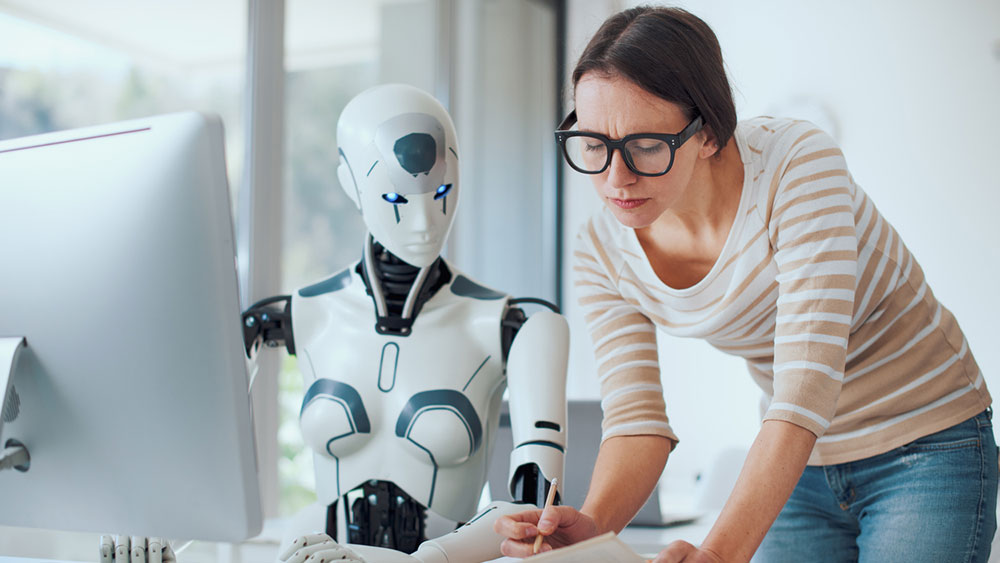
demaerre/iStock

Mark Hembree
Bio
Thu, 05/28/2026 - 12:02
  • Comment
  • RSS

Social Sharing block

  • Print
Body

Artificial intelligence is accelerating even as I write this. (And yes, this is me writing.) If anyone tells you they know how this is going to turn out, you should move on to the next expert. No one knows how this is going to turn out.

ADVERTISEMENT

Leaders in the AI field certainly expect it to become ubiquitous. The New York Times columnist Ezra Klein, in an article with the (somewhat) comforting title “Why the A.I. Job Apocalypse (Probably) Won’t Happen,” cited a March Quinnipiac poll finding 70% percent of Americans think that AI will lead to fewer job opportunities for human beings, up from 56% a year ago.

Dario Amodei, chief executive of Anthropic, estimates that half of all entry-level white collar jobs will dissolve within the next five years, Klein notes, and he quotes Mustafa Suleyman, chief executive of Microsoft AI, saying most white-collar work will “be fully automated by an AI within the next 12 to 18 months.”

Klein concludes that our essential need and desire for human connection is what will save us from AI’s most dire threats. I hope he’s right about that. I’m still worried.

Expert or not, like almost everybody else I do have opinions about AI. Chief among them is that human involvement is crucial. Like high-voltage wires running through your place of business, AI should have some sort of insulation wrapped around it to prevent it from shocking people or burning the place down.

Play ball!

When I look for analogy I often turn to baseball, a rich source. In fact, baseball is what got me thinking more deeply about why, along with the innovations AI can spawn, we need to keep humans around.

This is the first year of the “ABS” (automated balls and strikes) system in Major League Baseball. Some call it a robot umpire. Here’s how Google’s AI (see?) summed up MLB’s new system: “Beginning with the 2026 MLB season, the Automated Ball-Strike (ABS) Challenge System (powered by T-Mobile 5G) allows teams to appeal home plate umpire ball/strike calls. Each team gets two challenges per game, keeping them if successful. Players (batter, pitcher, or catcher) must signal a challenge immediately via a helmet/cap tap.”

So, if a catcher or batter disagrees with the home plate umpire he can invoke the ABS system, which can perceive pitch location within a fraction of an inch.

Baseball’s strike zone has evolved over time, but generally a strike has to be over the plate at a height between the batter’s shoulders and knees. How does ABS account for differences in height? According to MLB, “All position players in spring training camps have their heights measured by a team of independent testers conducting manual measurements and by representatives from a research institute using biomechanical analysis to confirm the manual measurements and safeguard against potential manipulation. Players are measured standing straight up without cleats.”

Call me a curmudgeon, but I’m still not completely sold. How are player data entered into the system? Consider that a shorter player has a smaller strike zone; is Aaron Judge listed at his full 6 ft 7 in.? Could potential variances in testing and traceability lead to what folks in the quality business call drift?

Furthermore: A few years ago I was at a game and stepped out to a beer garden connected to the stadium. There were TV screens showing the game, but I would hear the crowd react to something a few seconds before it appeared in the video feed. To no one in particular I said, “Why the delay?”

Nearby, a fellow promptly answered, “Gambling.”

Maybe. As they have for more than a century, people bet on all sorts of things before or during a baseball game—now more than ever, and online, faster than ever. An onsite delay may discourage betting on the premises as the video comes after the fact. Network broadcasts have a built-in delay, but is that the case with the onsite feed? It may be that it’s intended to disrupt the timing of bets. But on the other hand—or I should say, in the other hand—everyone has a phone. The crack of the bat or a swing and a miss happen in real time. After that, who knows?

Another longtime baseball tradition is cheating. From spitballs and doctored baseballs to planting an observer in the scoreboard where he could see the pitches the catcher was calling and relay them to the batter, people have devised various ways to “game” the game.

Those efforts are ongoing. Baseball comes up with fixes, and cheaters find ways to circumvent them. Presumably the ABS technology is ahead of bad actors. But technology’s current rate of change suggests that may not always be the case.

Here’s my point: Ultimately, it’s the presence of human umpires that renders various cheating systems unreliable. Humans in the chain are an essential element in keeping things honest. In matters of judgment, they’re much harder to hack.

So, aside from hand-wringing and a growing sense of dread, what’s next? What can be done? Here, I take solace from experts.

Always invite humans to your AI party

To belabor the baseball analogy, when you’re tossing a ball around and a throw goes over your head, you might spot someone near where it landed and call out, “A little help?”

That’s what I’ve done here, and a couple of Quality Digest regulars were kind enough to pick up the ball and toss back some examples of the need for human involvement.

Gleb Tsipursky, named “The Office Whisperer” by The New York Times, and CEO of the future-of-work consultancy Disaster Avoidance Experts, responded, “Here are three simple ways to think about where to insert a human into an AI workflow.

“In a marketing or communications workflow, AI can draft initial blog posts or social media copy. But a human must review the content for brand voice, factual accuracy, and emotional resonance before it’s published.

“While AI chatbots can handle routine inquiries, any complex or emotionally sensitive issue should be automatically flagged for a human agent to step in, ensuring the ‘human touch’ remains where it’s most needed.

“In fields like financial analysis or logistics, AI can process vast amounts of data to provide recommendations (like optimized schedules or risk assessments). But a human expert makes the final call, using their judgment to account for nuances the AI might miss.”

On my view that humans are harder to hack, Akhilesh Gulati, founder of PIVOT Management Consultants, wrote, “This is not because humans are perfect, but because they are unpredictable in different ways than machines, especially when we think of adversarial situations. Sharpening this context, we can break it down thus:

“With AI we get precision, speed, output, efficiency, scale. With humans we get ability to handle ambiguity, detect adversity, follow and enforce norms, make decisions, and understand consequences.”

Gulati elaborated on examples of keeping us humans around.

“Healthcare diagnosis systems: We’ve read about AI models that detect cancer, strokes, or anomalies from imaging, with superhuman pattern recognition. Still, humans (radiologists, physicians) are the clinical decision makers and arbiters, not just reviewers. While an AI model might flag a lesion, it is the human who decides.

“Autonomous vehicles: After recently subscribing to Tesla’s full self-driving app (FSD), we discovered that while the AI system could detect other vehicles, road boundaries, traffic signals, etc., at speed, it required driver supervision (hands-on) and did not quite serve our safety requirements. For example, if the driver passes out while driving—as happened recently in Mississippi on a school bus, with students stepping in to stop the bus—it’s the humans who handle the unknown unknowns!

“Financial trading and risk systems: At a conference I attended back in January, they had a panel discussion with senior executives from different disciplines (accounting, finance, operations, HR). One example cited by a director of finance was rather simple. He said it would normally take his staff at least a couple of weeks to review all reports, which would then be sent to him for decisions or action to be taken. With AI, they were able to turn that around overnight and get it back to him for his decision/direction on how to proceed. Thus, a human remained part of the control structure.”

I don’t dispute that AI can be enormously useful in making short work of massive time-consuming projects. But Gulati and I agree on this general premise: He wrote, “Your ‘high-voltage wire’ metaphor works especially well because it implies both power and risk. The insulation doesn’t remove the power, it makes it usable. That sounds like the right framing for AI.”

So, we humans must be the insulation wrapped around these hot wires of AI. No need to go very far to look for what can save us from an AI apocalypse.

We’re it.

Postscript: Quality Digest editors spurn any manuscript in which we detect AI generation. How do we check that? We use AI! Analyzing my article for AI elements, Anthropic’s Claude responded, “This is a columnist in full—opinionated, digressive, and unmistakably alive.” The next time I write a book I want that for a blurb on the back cover.

Add new comment

The content of this field is kept private and will not be shown publicly.
About text formats
Image CAPTCHA
Enter the characters shown in the image.

© 2026 Quality Digest. Copyright on content held by Quality Digest or by individual authors. Contact Quality Digest for reprint information.
“Quality Digest" is a trademark owned by Quality Circle Institute Inc.

footer
  • Home
  • Print QD: 1995-2008
  • Print QD: 2008-2009
  • Videos
  • Privacy Policy
  • Write for us
footer second menu
  • Subscribe to Quality Digest
  • About Us