Pottery is a metaphorical gold mine for archaeologists. Well-preserved ceramics offer a rare glimpse into the lives of past societies, their cultures, traditions, and how they expressed status. When analyzing such finds, stamps and inscriptions are often key.
|
ADVERTISEMENT |
This is certainly the case for Dries Daems and Jitte Waagen, digital archaeologists at Vrije Universiteit Amsterdam and the University of Amsterdam, who have been working on analyzing Hellenistic mold-made relief bowls. These ceramics, which were popular around 200–100 BCE, featured distinctive patterns. But they consisted of varying combinations and were made using a variety of different stamps, which allowed for a potentially infinite number of decorative patterns. This also made them quite tricky to identify.
That’s why Waagen and his 4D Research Lab team have come up with a fresh approach. When new fragments were discovered at Türkmen-Karahöyük, an excavation site in modern-day Turkey, directed by James Osborne (University of Chicago) and Michele Massa (Bilkent University Ankara), they decided to ditch traditional methods, analyzing patterns with 3D scanning instead—while also using a technique usually reserved for terrestrial mapping to identify if individual pieces matched.
Spider II: Perfect for artifact digitization
Traditionally, archaeological finds are manually sketched and analyzed with measuring tools. But modern technologies are gradually gaining traction. Increasignly, photogrammetry is being used to generate specimen 3D models from captured photos and videos. This has its own drawbacks: It can be time-consuming and difficult to set up the perfect capture conditions.
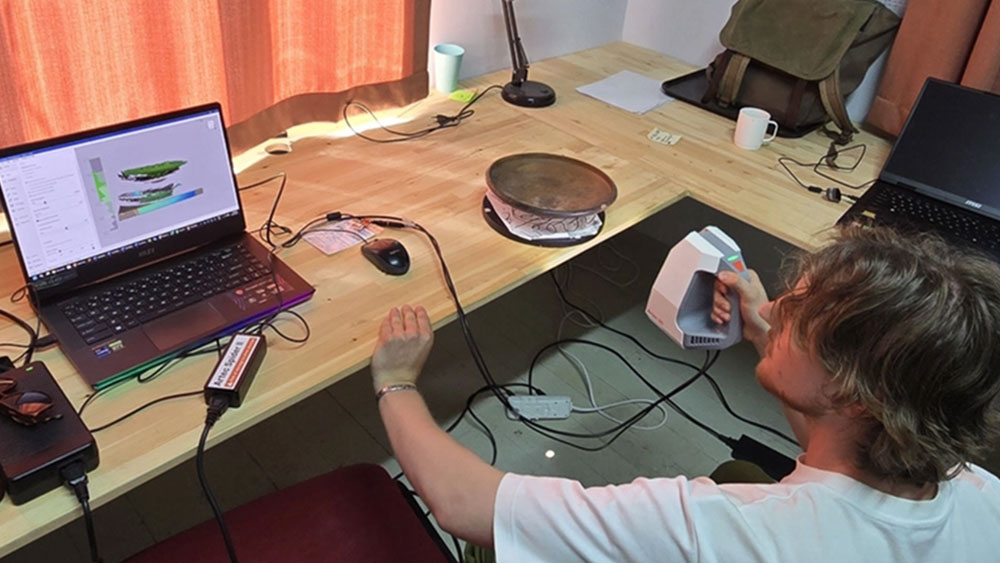
To get around these issues, Waagen opted to digitize fragments with Artec Spider II, an ultrahigh-resolution 3D scanner provided by Artec Ambassador 4C. In their latest project, his team wanted to see if a sample featuring an eagle matched up with another found elsewhere.

Hellenistic pottery shards discovered at the Turkish excavation site. Images courtesy of Dries Daems, Vrije Universiteit Amsterdam
They thought about using the 5-micron accuracy Artec Micro II, but instead opted for the flexibility and high-fidelity data capture of Spider II. Thanks to the real-time feedback offered by Artec Studio, it was immediately obvious they’d made the right choice. The blue light-powered handheld picked up everything from dents to tiny molded features with remarkable efficacy.
“Artec 3D scanning really allows for unprecedented detail,’ says Waagen. “You can also do photogrammetry, of course, but that will take much more time in this context. “We’ve developed a workflow for Spider II, where we can scan 18–22 objects per day. For someone who processes pottery manually, that’s relatively little for undecorated pottery. But if you compare it to other techniques, you can see far more subtle marks, right down to fingerprints in individual pieces.”
Innovating with GIS surface mapping
Data were captured and processed in Artec Studio, where initial inspection could be carried out using the software’s X-Ray visualization mode. But in-depth analysis would require the team to work out which marks had been left behind by a stamp and which had been caused by wear over time. Practically, this could only be achieved by “flattening” and “matching” the models.

3D models of Hellenistic pottery shards in Artec Studio. Images courtesy of Jitte Waagen, University of Amsterdam
Positioning was done in Blender so the models could be exactly overlaid and compared, after which the relative distances between generated point clouds were compared in Cloud Compare. They then used these data to generate a “digital surface” elevation model in Agisoft Metashape.
Using a geographical information system (GIS), models were later overlaid as if they were terrestrial maps, allowing “changes in elevation” to be matched effectively. There was a slight difference in surface inclination, but the two shards generally shared the same design. Small details like an eagle’s feathers, beak, and claws matched exactly in terms of shape, orientation, and size—strongly suggesting that their mold featured the same motif.
Having matched these fragments, all but proving that they came from the same Hellenistic workshop, Waagen says his team are now working on automating such analysis with AI.
“We’ll probably need to simplify models,” he says. “But the idea is to extract morphological features from 3D models and feed that into a machine learning model. The end goal is to have a model capable of identifying when you capture another piece of pottery with the same stamp or morphology, and which period it’s from, or at least telling you what’s similar. This kind of project is already taking off. We have the chance to pioneer and develop AI best practices.”
‘Live excavations’ and other opportunities
Waagen’s research isn’t just centered on Hellenistic pottery. He has also worked on numerous other archaeological projects where Artec 3D scanning has proved to be a game changer.
As part of a project directed by Michael Blömer of the Universität Münster in the ancient city of Doliche, Spider II was used to capture a rare Roman Mithraeum (a temple dedicated to the Roman god Mithras). His team was able to digitize intricate inscriptions scrawled along the walls. 3D scans continue to facilitate the deciphering of these etchings, helping uncover meaning where it simply wasn’t possible before.

A Roman Mithraeum being 3D-scanned with Artec Spider II. Image courtesy of Jitte Waagen, University of Amsterdam.
Many of these initiatives allow for the use of a turntable customized for ease of alignment. But not all are so straightforward. As part of another dig at Tell Kurdu, directed by Rana Özbal (Koç University) and Fokke Gerritsen (Netherlands Institute in Turkey), Waagen encountered 8,000-year-old footprints that the Turkish government was reluctant to disturb. Artec 3D scanning allowed for capture onsite so finds could be documented without disruption.
It’s worth noting that the University of Amsterdam also has a fully wireless Artec Leo. According to Waagen, “Leo is great for larger objects,” and he “loves the portability” of the device.
In fact, the device is so fast and intuitive that he’s done live excavation with it—recording sites immediately as they’re uncovered. This kind of initiative shows how digital archaeology is bringing the old and new worlds together in the most exciting way possible.
This study took place within the context of the 3D-CERA-ML project, which focuses on integrating 3D models with machine-learning algorithms to aid archaeological classification and interpretation. It’s directed by Dries Daems, Vrije Universiteit Amsterdam, in collaboration with the 4D Research Lab, University of Amsterdam, coordinated by Jitte Waagen.
You can find out more about the 3D-CERA-ML project here.
Published March 20, 2026, by Artec 3D.

Add new comment