{domain:"www.qualitydigest.com",server:"169.47.211.87"} Skip to main content

        
User account menu
Main navigation
  • Topics
    • Customer Care
    • Regulated Industries
    • Research & Tech
    • Quality Improvement Tools
    • People Management
    • Metrology
    • Manufacturing
    • Roadshow
    • QMS & Standards
    • Statistical Methods
    • Resource Management
  • Videos/Webinars
    • All videos
    • Product Demos
    • Webinars
  • Advertise
    • Advertise
    • Submit B2B Press Release
    • Write for us
  • Metrology Hub
  • Training
  • Subscribe
  • Log in
Mobile Menu
  • Home
  • Topics
    • Customer Care
    • Regulated Industries
    • Research & Tech
    • Quality Improvement Tools
    • People Management
    • Metrology
    • Manufacturing
    • Roadshow
    • QMS & Standards
    • Statistical Methods
    • Supply Chain
    • Resource Management
  • Login / Subscribe
  • More...
    • All Features
    • All News
    • All Videos
    • Training

Streamlined, Efficient Aircraft Surface Assessment—From Scan to Report

Guided inspection offers faster, more-informed maintenance decisions for MROs and airlines

FARO

FARO
Bio

FARO

Wed, 04/15/2026 - 12:01
  • Comment
  • RSS

Social Sharing block

  • Print
Body

Aircraft are routinely exposed to damage from bird strikes, lightning strikes, hailstorms, collisions with ground support equipment, or debris on the runway.

ADVERTISEMENT

As fleets grow and skilled technicians become harder to find, airlines and maintenance, repair, and overhaul facilities (MROs) face mounting pressure to complete inspections faster without sacrificing accuracy. Yet traditional damage-mapping methods are time-consuming and prone to human error, leading to inconsistent or unreliable assessments. When inspections fall short, aircraft stay grounded. And every grounded aircraft is lost revenue.

With this reality in mind, FARO CREAFORM engineered the HandySCAN 3D EVO Series—an ergonomic, MRO-oriented solution designed to deliver accurate and reliable aircraft surface assessments by enabling aircraft technicians and structures engineers to perform more-streamlined and efficient inspections, from scanning all the way to reporting.

Challenge: Persistent limitations of traditional damage mapping 

Despite being widely used across the industry, traditional aircraft damage-mapping methods, such as the pit gauge and hand-drawn sketches, introduce chronic limitations that compromise both inspection speed and data accuracy. Because these techniques rely heavily on manual operation and human interpretation, measurement quality can be inherently inconsistent: Two technicians can produce different dent depths, lengths, or contours for the exact same impact.

Close-up of a plane whing with several dents caused by a hailstorm.

Manual measurements are also slow and labor-intensive. Each dent must be evaluated individually using multiple tools and repeated steps, which significantly extends inspection times, especially when access is difficult, or when multiple damage sites must be assessed across large fuselage or wing surfaces.

Beyond the measurement itself, documentation remains one of the most persistent bottlenecks. Data are frequently captured through handwritten notes, unscaled photos, or simplified sketches that provide limited spatial context. Complex damage, such as hail-strike clusters, blended dents, or deformations near structural features, further increases the risk of inaccurate assessments.

In short, when data quality is low, structure engineers often default to conservative decisions, resulting in extended aircraft downtime and, consequently, higher aircraft on ground (AOG) costs.

EVO series—Redefining aircraft surface-integrity assessment 

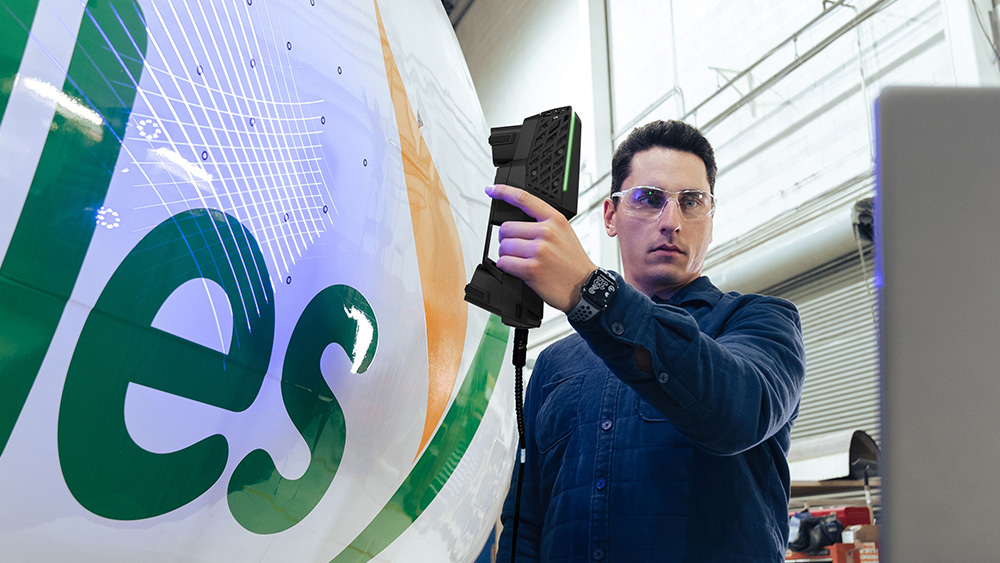
The HandySCAN 3D EVO Series is already making a strong impression throughout the industry with its embedded touchscreen display, built-in photo camera, laser pointer, and augmented-reality features. These technologies directly address the operational challenges faced by airlines and MROs by delivering highly accurate and repeatable measurements. With a simplified user interface, the EVO Series guides aircraft technicians through every step of data acquisition and photo capture while providing structures engineers with the clear, consistent information they need for confident report generation.

Technician on a mechanic creeper using the HandySCAN EVO Elite scanner to scan below a white, blue and red plane.

Guided inspection, from scan to report

Designed for aircraft technicians who may be new to 3D scanning, the Guided Inspection feature is seamlessly integrated into the EVO Series interface. It enables users to perform the complete inspection process—from data acquisition to report generation—directly on the scanner’s touchscreen with minimal steps and interaction required.

Scanning

The embedded display provides real-time visualization of the mesh data. Technicians can navigate all inspection functions directly from the 3D scanner and benefit from preconfigured parameters that streamline the inspection process. A built-in 12-MP camera enables onsite photo capture linked to specific damage locations, while the integrated laser pointer measures distances between dents and precisely targets areas for photo documentation.

Augmented reality analysis

Integrated augmented reality (AR) gives technicians immediate, in-context visibility of their analysis, enhancing inspection quality and accelerating data validation. With the Analysis Onsite feature (AR combined with the live camera feed), dent color maps and contour outlines are overlaid directly onto the aircraft’s damaged surface, ensuring a more reliable assessment before moving on to reporting.

Reporting

All photos and AR-enhanced visuals captured with the EVO Series can be automatically integrated into the predefined report templates, eliminating manual data transfer and saving significant postprocessing time. By producing structured, image-rich PDF reports without manual input, it enhances inspection compliance and ensures consistent, error-free documentation.

An example of a report displaying colormaps, data points, and pictures taken with the EVO Series.

Simplifying the path from damage characterization to reporting 

For MROs and airlines, the EVO Series brings clarity, consistency, and speed to dent assessment—three elements that traditional methods often struggle to deliver. By removing human interpretation, the 3D scanner ensures repeatable measurements, reducing the confusion and miscommunication that typically arise during manual inspections. The advanced AR tools further simplify damage characterization and documentation by visualizing and analyzing dents directly on the aircraft surface.

Technicians also benefit from a more-fluid and intuitive process. Dents can be selected with a simple laser pointer, and all essential information is displayed on the embedded screen, eliminating constant back-and-forth with a computer. This streamlined process accelerates inspection, supports more accurate reporting, and reinforces traceability—replacing pen marks and visual estimation with reliable, human-independent results.

Because the interface is preconfigured and easy to learn, technicians with limited experience or training can achieve consistent results. This helps MROs and airlines maintain high inspection quality even when staffing levels or expertise vary.

In short, the EVO Series is purpose-built for aircraft surface assessment. It delivers more-accurate and reliable aircraft surface assessments, minimizes human variability, and ultimately supports faster, more-informed maintenance decisions for both MROs and airlines.

Add new comment

The content of this field is kept private and will not be shown publicly.
About text formats
Image CAPTCHA
Enter the characters shown in the image.

© 2026 Quality Digest. Copyright on content held by Quality Digest or by individual authors. Contact Quality Digest for reprint information.
“Quality Digest" is a trademark owned by Quality Circle Institute Inc.

footer
  • Home
  • Print QD: 1995-2008
  • Print QD: 2008-2009
  • Videos
  • Privacy Policy
  • Write for us
footer second menu
  • Subscribe to Quality Digest
  • About Us