{domain:"www.qualitydigest.com",server:"169.47.211.87"} Skip to main content

        
User account menu
Main navigation
  • Topics
    • Customer Care
    • Regulated Industries
    • Research & Tech
    • Quality Improvement Tools
    • People Management
    • Metrology
    • Manufacturing
    • Roadshow
    • QMS & Standards
    • Statistical Methods
    • Resource Management
  • Videos/Webinars
    • All videos
    • Product Demos
    • Webinars
  • Advertise
    • Advertise
    • Submit B2B Press Release
    • Write for us
  • Metrology Hub
  • Training
  • Subscribe
  • Log in
Mobile Menu
  • Home
  • Topics
    • Customer Care
    • Regulated Industries
    • Research & Tech
    • Quality Improvement Tools
    • People Management
    • Metrology
    • Manufacturing
    • Roadshow
    • QMS & Standards
    • Statistical Methods
    • Supply Chain
    • Resource Management
  • Login / Subscribe
  • More...
    • All Features
    • All News
    • All Videos
    • Training

More Unidentified Museum Objects

Basement-dwelling enigmas from NIST

Jason Stoughton
Bio
Thu, 08/30/2018 - 12:01
  • Comment
  • RSS

Social Sharing block

  • Print
Body

The underground storage shelves of the National Institute of Standards and Technology (NIST) Museum are filled with loads of charmingly weird objects accrued throughout more than a century of scientific work. However, the original purpose of quite a few of these objects is lost in time. They are mysteries. Mysteries wrapped in riddles wrapped in... a thin layer of dust.

ADVERTISEMENT

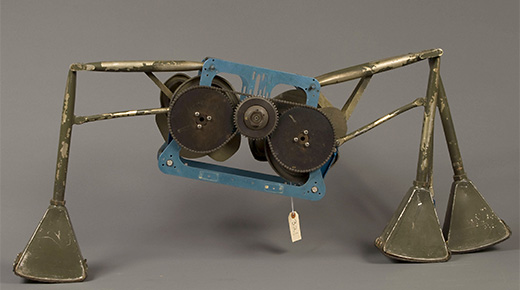
Welcome back to Unidentified Museum Objects, NIST’s ongoing quest to identify its basement-dwelling enigmas.

A railroad tale

The last installment elicited many responses. Read on for comments, along with a new batch of head-scratchers from the NIST Museum.

T. Jach writes:
“Item 0554 is clearly a frequency signal meter that is centered at 25 hertz. The indicator at the top is a series of reeds that have slightly different lengths. The reed that is in resonance with the input signal vibrates the most. The meter has a very narrow range, which would be consistent with using the indicators to regulate, for example, an alternator that operates at 25 hertz.”

 …

Want to continue?
Log in or create a FREE account.
Enter your username or email address
Enter the password that accompanies your username.
By logging in you agree to receive communication from Quality Digest. Privacy Policy.
Create a FREE account
Forgot My Password
You Might Like...
What's a 150-year Old Meat Chopper Have to do With America's Favorite Muscle Car?
How Remote Sensing and Aerial Imagery Can Improve Audit Accuracy
How to Get Your Employees to Love Your Brand
How DIY AI Unlocks Productivity and Flexibility
Which KPIs Prove Your Maintenance Plan Is Working?

Add new comment

Image CAPTCHA
Enter the characters shown in the image.
Please login to comment.

© 2026 Quality Digest. Copyright on content held by Quality Digest or by individual authors. Contact Quality Digest for reprint information.
“Quality Digest" is a trademark owned by Quality Circle Institute Inc.

footer
  • Home
  • Print QD: 1995-2008
  • Print QD: 2008-2009
  • Videos
  • Privacy Policy
  • Write for us
footer second menu
  • Subscribe to Quality Digest
  • About Us