{domain:"www.qualitydigest.com",server:"169.47.211.87"} Skip to main content

        
User account menu
Main navigation
  • Topics
    • Customer Care
    • Regulated Industries
    • Research & Tech
    • Quality Improvement Tools
    • People Management
    • Metrology
    • Manufacturing
    • Roadshow
    • QMS & Standards
    • Statistical Methods
    • Resource Management
  • Videos/Webinars
    • All videos
    • Product Demos
    • Webinars
  • Advertise
    • Advertise
    • Submit B2B Press Release
    • Write for us
  • Metrology Hub
  • Training
  • Subscribe
  • Log in
Mobile Menu
  • Home
  • Topics
    • Customer Care
    • Regulated Industries
    • Research & Tech
    • Quality Improvement Tools
    • People Management
    • Metrology
    • Manufacturing
    • Roadshow
    • QMS & Standards
    • Statistical Methods
    • Supply Chain
    • Resource Management
  • Login / Subscribe
  • More...
    • All Features
    • All News
    • All Videos
    • Contact
    • Training

Surprise! Weaker Bonds Can Make Polymers Stronger

New approach doesn’t alter other physical properties of the polymers

Anne Trafton
Tue, 07/18/2023 - 12:02
  • Comment
  • RSS

Social Sharing block

  • Print
Body

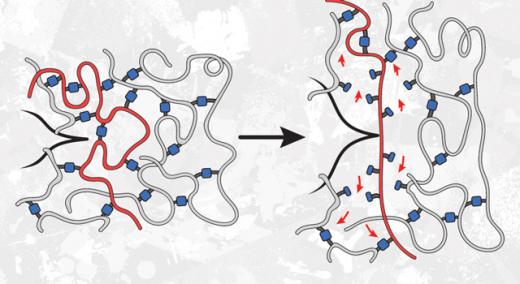
A team of chemists from MIT and Duke University has discovered a counterintuitive way to make polymers stronger: Introduce a few weaker bonds into the material.

ADVERTISEMENT

Working with a type of polymer known as polyacrylate elastomers, the researchers found that they could increase the materials’ resistance to tearing up to tenfold, simply by using a weaker type of cross-linker to join some of the polymer building blocks.

These rubber-like polymers are commonly used in car parts, and they are also often used as the “ink” for 3D-printed objects. The researchers are now exploring the possible expansion of this approach to other types of materials, such as rubber tires.

“If you could make a rubber tire 10 times more resistant to tearing, that could have a dramatic impact on the lifetime of the tire and on the amount of microplastic waste that breaks off,” says Jeremiah Johnson, a professor of chemistry at MIT and one of the senior authors of the study, which was recently published in Science.

 …

Want to continue?
Log in or create a FREE account.
Enter your username or email address
Enter the password that accompanies your username.
By logging in you agree to receive communication from Quality Digest. Privacy Policy.
Create a FREE account
Forgot My Password
Top Stories
Problem Solving and Continuous Improvement Are Not the Same
AI Job Growth Claims Outrun the Evidence
How Many Units Should Be in the Metric System?
The Newest in Octave Reliance QMS Offers Smart Features
5 Misconceptions About Generative AI in GxP Quality and Validation

Add new comment

Please login to comment.

© 2026 Quality Digest. Copyright on content held by Quality Digest or by individual authors. Contact Quality Digest for reprint information.
“Quality Digest" is a trademark owned by Quality Circle Institute Inc.

footer
  • Home
  • Print QD: 1995-2008
  • Print QD: 2008-2009
  • Videos
  • Privacy Policy
  • Write for us
footer second menu
  • Subscribe to Quality Digest
  • About Us
  • Contact Us