
{domain:"www.qualitydigest.com",server:"169.47.211.87"} Skip to main content

        
User account menu
Main navigation
  • Topics
    • Customer Care
    • Regulated Industries
    • Research & Tech
    • Quality Improvement Tools
    • People Management
    • Metrology
    • Manufacturing
    • Roadshow
    • QMS & Standards
    • Statistical Methods
    • Resource Management
  • Videos/Webinars
    • All videos
    • Product Demos
    • Webinars
  • Advertise
    • Advertise
    • Submit B2B Press Release
    • Write for us
  • Metrology Hub
  • Training
  • Subscribe
  • Log in
Mobile Menu
  • Home
  • Topics
    • Customer Care
    • Regulated Industries
    • Research & Tech
    • Quality Improvement Tools
    • People Management
    • Metrology
    • Manufacturing
    • Roadshow
    • QMS & Standards
    • Statistical Methods
    • Supply Chain
    • Resource Management
  • Login / Subscribe
  • More...
    • All Features
    • All News
    • All Videos
    • Contact
    • Training

The Persistent Unmarked Space

Inspired by the ideas in George Spencer-Brown’s Laws of Form and broader themes in cybernetics

Johan Rydberg / Unsplash

Harish Jose

Harish’s Notebook

Wed, 11/05/2025 - 12:02
  • Comment
  • RSS

Social Sharing block

  • Print
Body

In this article I want to explore an observation on how we make distinctions and what this reveals about the structure of our thinking. I’m inspired by the ideas in George Spencer-Brown’s Laws of Form and broader themes in cybernetics about how observers construct meaning.

ADVERTISEMENT

The starting point is simple. When we make a distinction, we create a boundary that separates what’s inside from what’s outside. Spencer-Brown formalized this with his notation of the mark, showing how any act of indication simultaneously creates both the indicated and the nonindicated. This is shown below:
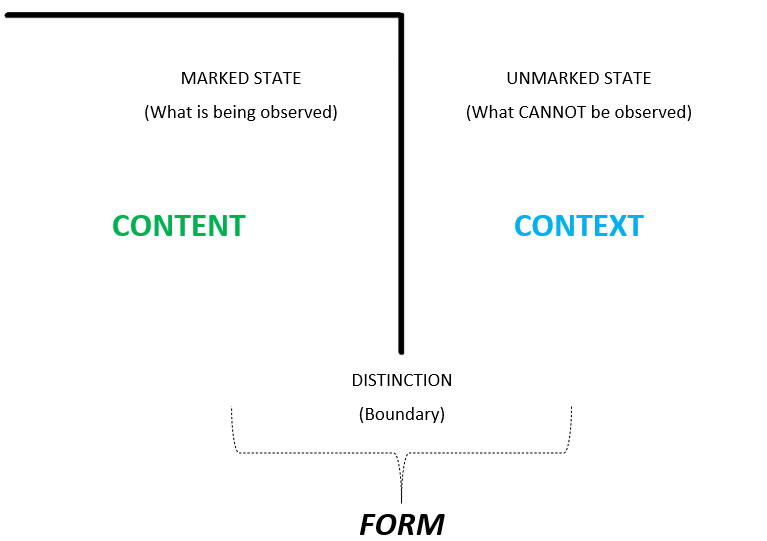
As we look closer, things get more interesting.

The basic operation of distinction-making

When I make one distinction to mark “A,” I create two states. There is A (the marked state) and not-A (the unmarked state). This seems straightforward enough. We can depict this as below:

(A) not-A

 …

Want to continue?
Log in or create a FREE account.
Enter your username or email address
Enter the password that accompanies your username.
By logging in you agree to receive communication from Quality Digest. Privacy Policy.
Create a FREE account
Forgot My Password
Top Stories
Problem Solving and Continuous Improvement Are Not the Same
‘Not relevant’ is no longer an answer on climate change
AI Job Growth Claims Outrun the Evidence
How Many Units Should Be in the Metric System?
Your Innovation Problem May Not Be an Innovation Problem

Add new comment

Please login to comment.

© 2026 Quality Digest. Copyright on content held by Quality Digest or by individual authors. Contact Quality Digest for reprint information.
“Quality Digest" is a trademark owned by Quality Circle Institute Inc.

footer
  • Home
  • Print QD: 1995-2008
  • Print QD: 2008-2009
  • Videos
  • Privacy Policy
  • Write for us
footer second menu
  • Subscribe to Quality Digest
  • About Us
  • Contact Us