{domain:"www.qualitydigest.com",server:"169.47.211.87"} Skip to main content

        
User account menu
Main navigation
  • Topics
    • Customer Care
    • Regulated Industries
    • Research & Tech
    • Quality Improvement Tools
    • People Management
    • Metrology
    • Manufacturing
    • Roadshow
    • QMS & Standards
    • Statistical Methods
    • Resource Management
  • Videos/Webinars
    • All videos
    • Product Demos
    • Webinars
  • Advertise
    • Advertise
    • Submit B2B Press Release
    • Write for us
  • Metrology Hub
  • Training
  • Subscribe
  • Log in
Mobile Menu
  • Home
  • Topics
    • Customer Care
    • Regulated Industries
    • Research & Tech
    • Quality Improvement Tools
    • People Management
    • Metrology
    • Manufacturing
    • Roadshow
    • QMS & Standards
    • Statistical Methods
    • Supply Chain
    • Resource Management
  • Login / Subscribe
  • More...
    • All Features
    • All News
    • All Videos
    • Contact
    • Training

Animal's ‘Swiss Army Knife’ Could Help Build Better Robots

How an elephant’s trunk manipulates air to eat and drink

Jason Maderer
Wed, 10/20/2021 - 12:01
  • Comment
  • RSS

Social Sharing block

  • Print
Body

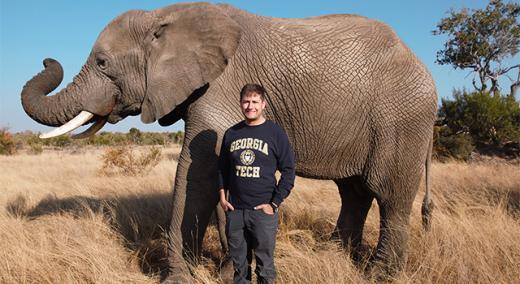
New research from the Georgia Institute of Technology finds that elephants dilate their nostrils in order to create more space in their trunks, allowing them to store up to 5.5 liters of water. They can also suck up three liters per second—a speed 50 times faster than a human sneeze (150 meters per second/330 mph).

ADVERTISEMENT

The Georgia Tech College of Engineering study sought to better understand the physics of how elephants use their trunks to move and manipulate air, water, food, and other objects. They also sought to learn if the mechanics could inspire the creation of more efficient robots that use air motion to hold and move things.

While octopus use jets of water to move, and archer fish shoot water above the surface to catch insects, the Georgia Tech researchers found that elephants are the only animals able to use suction on land and underwater.

The paper, “Suction feeding by elephants,” is published in the Journal of the Royal Society Interface.

 …

Want to continue?
Log in or create a FREE account.
Enter your username or email address
Enter the password that accompanies your username.
By logging in you agree to receive communication from Quality Digest. Privacy Policy.
Create a FREE account
Forgot My Password
Top Stories
What FDA Warning Letters Reveal About Records, Spreadsheets, and AI
The Art of Forecasting: Part 1
Avoiding the 7 Deadly Killers of Projects
ISO 9001:2026 Ethics and Quality Culture
ISO 9001:2026 Is Here

Add new comment

Please login to comment.

© 2026 Quality Digest. Copyright on content held by Quality Digest or by individual authors. Contact Quality Digest for reprint information.
“Quality Digest" is a trademark owned by Quality Circle Institute Inc.

footer
  • Home
  • Print QD: 1995-2008
  • Print QD: 2008-2009
  • Videos
  • Privacy Policy
  • Write for us
footer second menu
  • Subscribe to Quality Digest
  • About Us
  • Contact Us