{domain:"www.qualitydigest.com",server:"169.47.211.87"} Skip to main content

        
User account menu
Main navigation
  • Topics
    • Customer Care
    • Regulated Industries
    • Research & Tech
    • Quality Improvement Tools
    • People Management
    • Metrology
    • Manufacturing
    • Roadshow
    • QMS & Standards
    • Statistical Methods
    • Resource Management
  • Videos/Webinars
    • All videos
    • Product Demos
    • Webinars
  • Advertise
    • Advertise
    • Submit B2B Press Release
    • Write for us
  • Metrology Hub
  • Training
  • Subscribe
  • Log in
Mobile Menu
  • Home
  • Topics
    • Customer Care
    • Regulated Industries
    • Research & Tech
    • Quality Improvement Tools
    • People Management
    • Metrology
    • Manufacturing
    • Roadshow
    • QMS & Standards
    • Statistical Methods
    • Supply Chain
    • Resource Management
  • Login / Subscribe
  • More...
    • All Features
    • All News
    • All Videos
    • Training

Indonesian Powerhouse Accelerates Automotive Inspection With Artec Leo

Designing aftermarket parts and inspecting tooling molds better and faster

AppliCAD, PT Brilliant Jaya Inti

Paul Hanaphy
Bio

Artec 3D

Wed, 08/12/2026 - 12:01
  • Comment
  • RSS

Social Sharing block

  • Print
Body

Any automotive worker will tell you that inspection is vital to production quality. During initial assembly, raw materials and in-sourced parts are checked for compliance, molds are assessed for dimensional accuracy, and welds are examined to ensure integrity.

ADVERTISEMENT

The same can be said for aftermarket part manufacturing, where service providers offer to customize and repair clients’ cars on demand. Failure to properly measure an existing surface can lead to misfit parts that require adaptation or must be scrapped altogether. Speed is also essential, because automotive customization is a fiercely competitive marketplace.

Working from its headquarters in Bekasi, Indonesia, PT Brilliant Jaya Inti has found a way of accelerating this process and staying ahead of its competitors. Instead of disassembling the molds it uses to make aftermarket parts and measuring them with a static, inflexible CMM machine, the company now captures accurate 3D data with the faster, more versatile Artec Leo.

Taking things up a gear with Artec Leo

In a vast automotive industry, PT Brilliant Jaya Inti carved itself a niche in the world of interior and exterior aftermarket parts and accessories. The company primarily inspects tooling molds and fixtures to ensure accuracy and avoid issues during final product assembly.


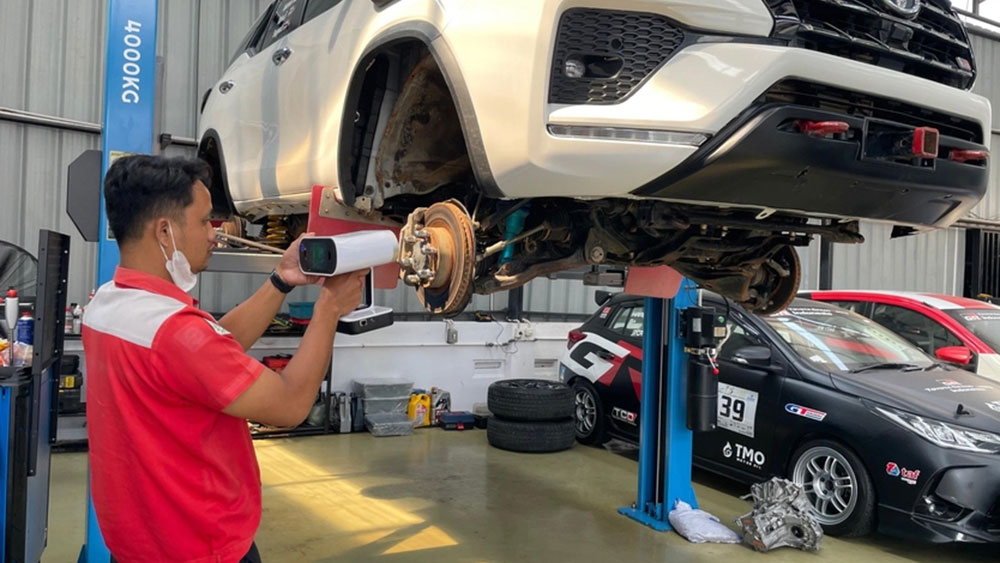
Measuring the underside of a wheel well with Artec Leo. Image courtesy of AppliCAD, PT Brilliant Jaya Inti

Until recently, PT Brilliant Jaya Inti found that parts like bumpers took a particularly long time to design and manufacture. That’s why the company reached out to Artec’s trusted reseller AppliCAD Indonesia, which helped it find the ideal technology to accelerate its workflow.

In the past, the company’s engineers had tried switching from CMMs to a target-dependent 3D scanner. When the team found this device cumbersome to use, AppliCAD offered to demo Artec’s Leo—an all-in-one 3D scanner with a built-in battery, display, and processor. It operates with no need for scanning targets. Less time is spent on preparation and cleanup, and capturing data faster also accelerates the company’s wider design workflow in a way that boosts customer satisfaction.

“The challenge is speed,” says Hardi Praptomo, head of research and development at PT Brilliant Jaya. “Before we acquired Artec Leo, our competitors couldn’t carry out these tasks as fast as us. Now they’re even further behind. Another challenge is capturing an OEM bumper at speed. This usually takes a long time, but with 3D scan data we can start on these projects earlier, accelerating our workflow.”

Ensuring accurate ‘checking fixtures’

The company’s workflow now revolves around Artec Studio. Using the industry-leading software, captured scan data are turned into 3D meshes, which can be analyzed or sent for manufacturing. Artec Studio comes with analysis tools like deviation mapping, which allows users to make scan-to-CAD comparisons and check whether parts will meet tolerances prior to production.


3D scanning a front grille with Artec Leo. Image courtesy of AppliCAD, PT Brilliant Jaya Inti

In the case of PT Brilliant Jaya Inti, it’s more useful to create checking fixtures, precision tools that act as a reference platform for detecting errors and ensuring perfect fit. Once tooling has been tested and used to make prototype parts, these go through trials until they meet quality standards before undergoing a part-fitting evaluation during the final manufacturing stage.

“This approach has huge potential for the mold industry,” says Praptomo. “Using a CMM machine means disassembling a mold, measuring a few points, then reassembling it—this isn’t easy. Artec 3D scanning allows us to measure on the spot, which is more efficient and applicable to any mold size. 3D scans are also more representative and easier to understand, as they provide capture context and aren’t restricted to point-by-point measurement.”

Not just for automotive analysis

Beyond inspection, PT Brilliant Jaya Inti also uses Artec Leo for reverse engineering. Rather than attempting to replace a tried-and-tested clay modeling workflow, 3D scans are used as a reference—e.g., clay models and real bumpers can be scanned and used for product design.


Artec Leo is highly maneuverable, allowing users to scan anywhere without cables. Image courtesy of AppliCAD, PT Brilliant Jaya Inti

That’s not to say that 3D data can’t be exported directly to design software for modeling. When captured with high geometric accuracy and resolution, they’re more than sufficient for the job. It’s just that in this case, PT Brilliant Jaya Inti found a unique way of combining technologies old and new to slash inspection lead times and bring products to customers at a much faster rate.

For now, the company remains focused on automotive interiors and exteriors, but eventually it would also like to work more directly with OEMs. The groundwork has already been laid elsewhere in automotive as virtual design, simulation, and 3D printing take hold. Now, in the hands of PT Brilliant Jaya Inti, 3D technology is ready to revolutionize the industry in Indonesia as well.

Published June 8, 2026, by Artec 3D.

Add new comment

The content of this field is kept private and will not be shown publicly.
About text formats
Image CAPTCHA
Enter the characters shown in the image.

© 2026 Quality Digest. Copyright on content held by Quality Digest or by individual authors. Contact Quality Digest for reprint information.
“Quality Digest" is a trademark owned by Quality Circle Institute Inc.

footer
  • Home
  • Print QD: 1995-2008
  • Print QD: 2008-2009
  • Videos
  • Privacy Policy
  • Write for us
footer second menu
  • Subscribe to Quality Digest
  • About Us