Social Sharing block

(GageList: Spring, TX) -- GageList, the cloud-based calibration management platform, has launched Clarity AI, making GageList the first calibration management platform to read incoming calibration certificates with AI and draft the gauge records for human review. Clarity was previewed at the NCSLI Workshop and Symposium and officially launched last summer in a live webinar.
|
ADVERTISEMENT |
Every quality program has this bottleneck: When a gauge returns from calibration, the certificate arrives as a PDF, and someone types its contents into the system by hand—the gauge, the dates, the readings, the certificate number. When GageList asked its launch-webinar audience how many external certificates their teams receive each month, the answers ranged from 15 to well over 200, every one of them entered manually.
“It’s careful, repetitive work, and it’s easy to get a digit wrong on a due date without anyone noticing,” says GageList’s creator, Doug Wheeler. “Whether your team handles 20 certificates a month or 2,000, that adds up to real hours, and real risk. That’s the problem we built Clarity to solve.”
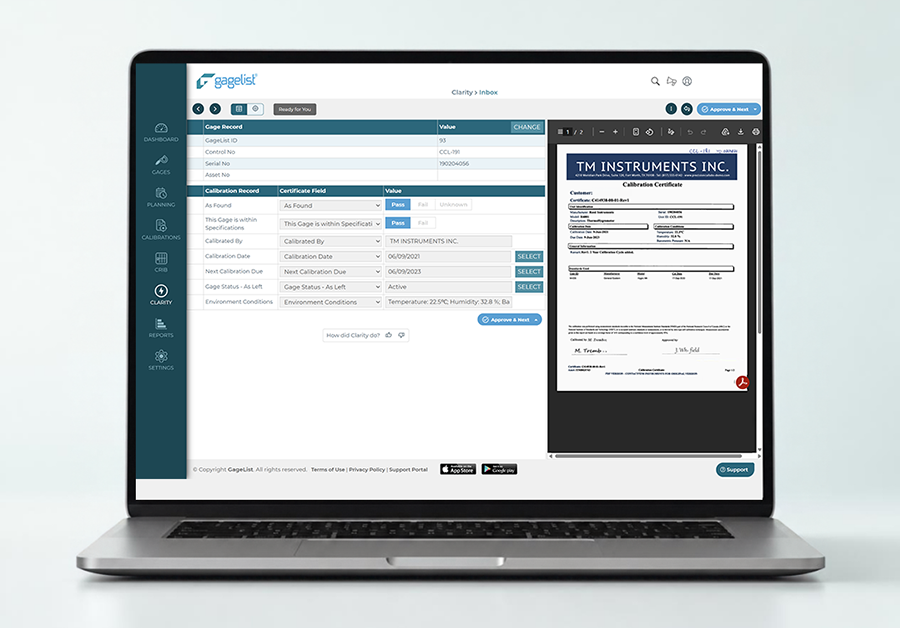
With Clarity, calibration labs email certificates directly to a private, white-listed inbox, or users upload them in bulk. Clarity reads each certificate, matches it to the correct gauge, and stages a draft record. A team member reviews the extracted data beside the original document, edits anything, and approves. One approval creates the record, updates due dates, and attaches the certificate with a full audit trail. In internal testing on a sample of 643 real-world calibration certificates, Clarity cut certificate processing time from 8–10 minutes to seconds per certificate, an estimated reduction of up to 98%.
Clarity handles certificates as PDF, JPEG, or PNG files, from any lab, in almost any layout or language, including fully handwritten documents, mixed handwritten-and-printed pages, and multipage certificates. It’s smart about context, too: It distinguishes a gauge’s own due date from the due dates of the calibration standards listed on the same page, a detail that routinely hinders manual data entry.
The feature is configurable per account. Users choose which fields to extract and can tune the AI’s prompts to their own requirements, including combining multiple data points such as temperature, humidity, and pressure, into a single custom field.
Data protection is built into the design. Clarity runs in a closed, private environment on Microsoft Azure AI: Certificate data are processed privately, never used to train AI models, and never shared with outside parties. GageList is independently audited to SOC 2 Type II.
“The most important safeguard is the simplest one,” Wheeler says. “The AI assists. It doesn’t decide. Every record is reviewed and approved by a person before it becomes part of your quality system.”
Ahead on the road map: direct API intake from calibration labs, support for the emerging digital calibration certificate (DCC) standard, and a future capability where Clarity evaluates certificates against ISO/IEC 17025 and user-defined criteria, flagging missing content or out-of-range results before an auditor finds them.
Clarity AI is included in GageList’s Plus, Pro, Max, and Multisite plans, with 100 pages of certificate processing per month; additional usage is priced on consumption.
Learn more about Clarity here.
Add new comment