{domain:"www.qualitydigest.com",server:"169.47.211.87"} Skip to main content

        
User account menu
Main navigation
  • Topics
    • Customer Care
    • Regulated Industries
    • Research & Tech
    • Quality Improvement Tools
    • People Management
    • Metrology
    • Manufacturing
    • Roadshow
    • QMS & Standards
    • Statistical Methods
    • Resource Management
  • Videos/Webinars
    • All videos
    • Product Demos
    • Webinars
  • Advertise
    • Advertise
    • Submit B2B Press Release
    • Write for us
  • Metrology Hub
  • Training
  • Subscribe
  • Log in
Mobile Menu
  • Home
  • Topics
    • Customer Care
    • Regulated Industries
    • Research & Tech
    • Quality Improvement Tools
    • People Management
    • Metrology
    • Manufacturing
    • Roadshow
    • QMS & Standards
    • Statistical Methods
    • Supply Chain
    • Resource Management
  • Login / Subscribe
  • More...
    • All Features
    • All News
    • All Videos
    • Training

5 Weirdly Nonstandard Things About the Metric System

And why isn’t there a base unit devoted to rotation?

BIPM/NIST

Ben P. Stein
Bio
Tue, 04/28/2026 - 12:03
  • Comment
  • RSS

Social Sharing block

  • Print
Body

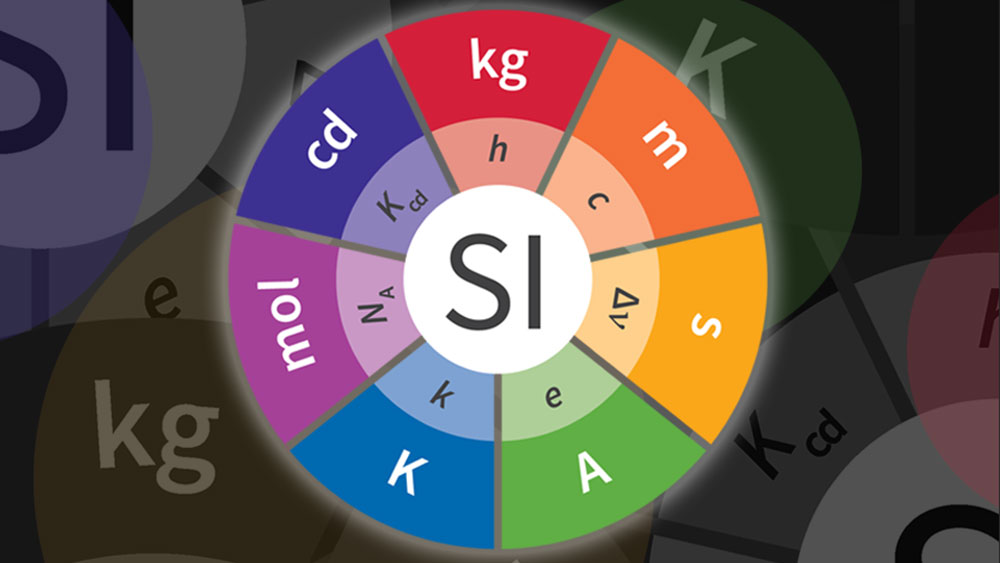
The modern metric system—known as the International System of Units, or SI—is a model of consistency and logic. But in some cases, the logic seems to break down.

ADVERTISEMENT

In this article, we’ll explore some of these quirks and why they (mostly) make sense at the end of the day (or approximately 86,400 seconds, as we might say at NIST).

1. Why is the kilogram (1,000 grams) a basic unit of measurement instead of just the gram?

In the metric system, we express quantities using individual units, such as length in meters and time in seconds. But the unit of mass is a kilogram—1,000 grams (kilo = thousand).

Why isn’t the gram itself a base unit in the SI? Well, for starters, it was once hard to make objects that were exactly one gram. Kilograms, which are equal to about 2.2 pounds, were much easier to make accurately and more useful in day-to-day trade.

 …

Want to continue?
Log in or create a FREE account.
Enter your username or email address
Enter the password that accompanies your username.
By logging in you agree to receive communication from Quality Digest. Privacy Policy.
Create a FREE account
Forgot My Password

Comments

Submitted by dangermoney on Wed, 04/29/2026 - 09:17

Huge blind spot here

The radian is a derived SI unit. It is the ratio of the arc subtended by an angle to the radius of the circle whose arc it is, having units of metre/metre, which makes it dimensionless. 

I don't understand how you can have an article arguing that the radian should be a base unit without discussing at all how it is actually treated in the SI. The author makes it out like there is some big blind spot to be solved here without even acknowledging why scientists tend not to see it as a problem. 

  • Reply

Add new comment

Image CAPTCHA
Enter the characters shown in the image.
Please login to comment.

© 2026 Quality Digest. Copyright on content held by Quality Digest or by individual authors. Contact Quality Digest for reprint information.
“Quality Digest" is a trademark owned by Quality Circle Institute Inc.

footer
  • Home
  • Print QD: 1995-2008
  • Print QD: 2008-2009
  • Videos
  • Privacy Policy
  • Write for us
footer second menu
  • Subscribe to Quality Digest
  • About Us