Social Sharing block

Many of modern astronomy’s achievements can be traced back to relatively unknown women who painstakingly cataloged the stars in the early 1900s.
|
ADVERTISEMENT |
Called the Harvard Computers (because they performed calculations), these women combed through thousands of photographic plates of stars and cataloged them. That’s like being given massive stacks of photo albums and having to manually find and identify every picture of a particular person.
While learning about stars and the cosmos is endlessly fascinating, staring at those plates must have been very tedious work.
But more than 100 years later, the field of astronomy is where it is today in part because of the influence of these trailblazing women, including Henrietta Swan Leavitt.
The Harvard Computers
The Harvard Computers consisted of about 80 women who worked at the Harvard Observatory. Its director, Edward Charles Pickering, hired them to catalog and analyze early photographs of stars.
Some of the women made groundbreaking discoveries in science. Annie Jump Cannon, for example, created a system for cataloging stars that’s still used today.
Here’s how their work was described in a 2020 article published by the National Trust for Historic Preservation:
“One woman would stand and analyze photographs taken by a telescope. These pictures were kept in glass plates, and each image captured thousands of stars. As the standing woman counted each dot, each star, aloud, a sitting co-worker would take notes to record the data. During their time at the observatory, the Harvard Computers manually classified hundreds of thousands of stars, mapping the sky for generations of future astronomers.”
For their contributions, the women were paid between 25 and 50 cents per hour. Twenty-five cents in 1914 is about $8 in today’s money. Men who did the same work were paid $1 per hour (or about $32 today).
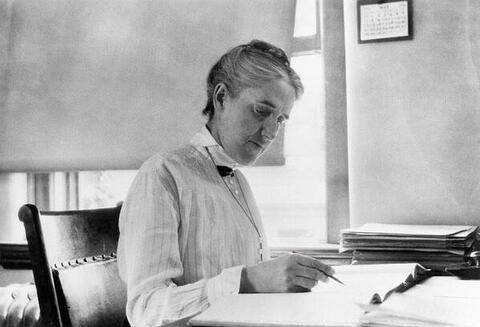 The field of astronomy is where it is today in part because of the influence of trailblazing women, including Henrietta Swan Leavitt. Credit: AIP Emilio Segrè Visual Archives, Shapley Collection
Measuring the stars
Leavitt’s major contribution to astronomy was helping the field understand variable stars. These are stars whose brightness changes over time.
She discovered a category of stars that have a predictable relationship between their brightness and the time it takes for their brightness cycle to occur, known as a period of variation. More luminous stars have longer periods, and intrinsically fainter stars have shorter periods. This is called the Cepheid period-luminosity relationship.
This exciting result meant astronomers could now estimate distances to other galaxies from observations of their Cepheid variables. Because the stars she examined are in the same galaxy, they must be about the same distance from Earth. So by comparing the measured brightness of the Cepheids in a distant galaxy to those in our Milky Way galaxy, astronomers can calculate the distance.
Leavitt developed a graph to chart the Cepheid period-luminosity relationship that astronomers still use today. This methodology helps researchers understand the relative distances between galaxies and our galaxy, the Milky Way.
Today, we’re not limited to the photographic wavelengths Leavitt and her fellow Harvard Computers used a century ago. Astronomers now use many other wavelengths and tools to measure astronomical distances. But the basic scientific principles are the same.
Leavitt’s work—and that of other pioneering astronomers—made mine possible.
A sky full of (standard) stars
Like many other tools, astronomers’ instruments must be calibrated to make sure they’re working properly. When we calibrate measurement tools here on Earth, we compare their results to a very precisely measured standard. Peanut butter manufacturers, for example, test their methods and equipment against our famous standard reference peanut butter.
We can’t bring a star into a laboratory to calibrate a telescope. So, astronomers calibrate their equipment using the most stable, predictable stars in the sky. You can’t use a star that’s constantly changing its brightness, or your calibrations will be off. Luckily, many stars are steady and perfect for calibrating tools.
I’ve always admired Leavitt and her dedication to the field. Today, at NIST, I make seemingly mundane but important measurements that could help astronomers measure the cosmos.
Astronomers want to measure the brightness of those “predictable” stars at different wavelengths very precisely and accurately. The goal is to be 99% sure that measurements are accurate. To put it another way, we want to have only about 1% doubt after measurements are taken. We call this uncertainty.
Why do we do this? Well, it’s useful for astronomy. But one important way our research is used is to help astronomers better understand a particular object in the cosmos, which can help pinpoint why our universe is expanding. This object is a type of exploding star called a Type Ia supernova.
We know that the universe is expanding and that its expansion is accelerating, but we don’t know much about why. Studying many thousands of Type Ia supernovae carefully can help astronomers answer key questions about the universe and what’s happening to it. After 30 years, we’re getting closer to an answer. But we’re not quite there yet.
NIST contributes to this important scientific effort by helping ensure the accuracy of the telescopes astronomers use to study supernovae. For example, NIST calibrates detectors and other instruments used to measure the light from celestial sources detected by telescopes. In this way, we help astronomers to better understand the history of our universe and the properties of stars.
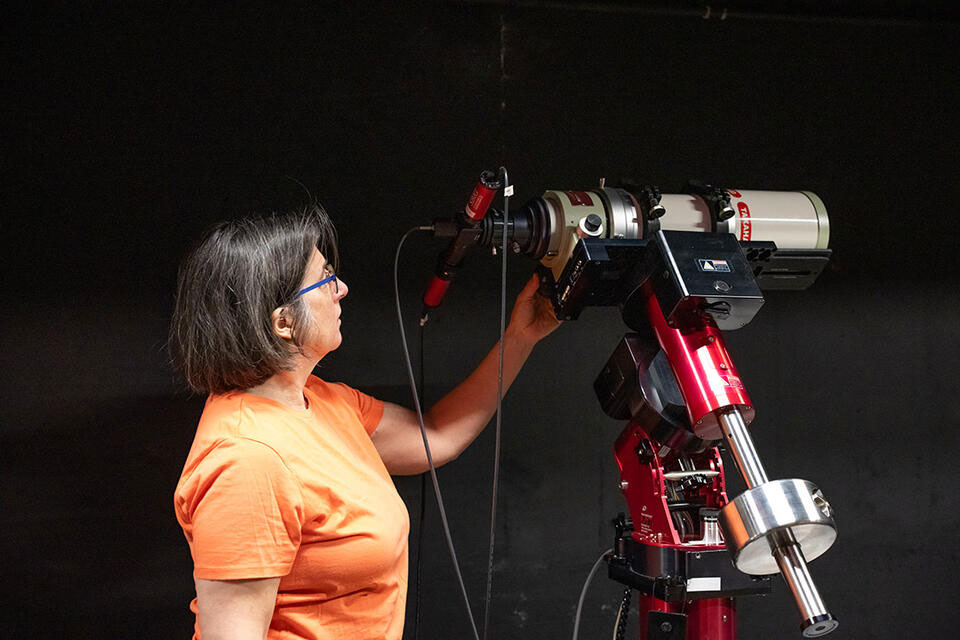 NIST researcher Susana Deustua works on a telescope. Credit: M. King/NIST
Pushing the limits of measurement
One of the things I love about my job is pushing the limits of how well we can measure something. I always want to know why we can’t get this uncertainty to, say, 0.1%? Why are we limited to the level of accuracy we currently have, and what can we do to push that accuracy even further?
Working at NIST has really changed my perspective on the fundamental limits of measurement. I’ve come to appreciate the importance of understanding the contributions that go into every measurement—including the uncertainty value.
In doing this research, I’ve realized the physical limit to how accurate we can be with these measurements. But we at NIST and in the astronomy community are generally determined to get as close to that physical limit as we possibly can. We do this because so many deep questions about our universe depend on it.
While my typical workday is certainly not like Leavitt’s and the Harvard Computers’, any role in science can be tedious sometimes, even today.
But the best part of being a scientist is when you can put all those data together and start looking for patterns. That’s where the magic happens. And that’s what motivates me, just as I imagine it did for Leavitt and her colleagues.
I look forward to pushing the limits of measurement as far as our expertise and technological advances will allow so we can all learn more about our stars and the universe.
Published March 25, 2026, in NIST’s Taking Measure blog.
Add new comment