
Social Sharing block

Walk into any machine shop today and you’ll hear about the same pressure points: tighter deadlines, rising part complexity, a stubborn skills shortage, and customers expecting “digital-ready” suppliers that can turn work around without delay. It’s no surprise then that artificial intelligence has become the industry’s newest beacon of hope.
|
ADVERTISEMENT |
But the reality on the shop floor is very different from the narrative in the headlines. While AI is advancing fast, and CAM automation is improving every month, most manufacturers find that the biggest barriers to progress aren’t algorithms at all. They’re the foundations: data quality, consistency, and the everyday structures that support programming.
Nowhere is this more visible, or more solvable, than in the cutting-tool library.
Often dismissed as an administrative chore or a background utility inside a CAM system, the tool library has quietly become one of the most strategically important assets in a digital machining environment. For many shops, it’s the single most important step that can be taken to prepare for automation and AI-assisted machining.
The disconnect between AI promise and shop-floor reality
The idea of “AI programming your parts for you” captures the imagination. But seasoned programmers know that machining is about nuance: the way a specific cutter behaves in aerospace aluminum, the holder extension needed to reach a deep feature, the stepovers that keep a tool stable on a particular machine.
These decisions aren’t stored in a CAD model. They live in people’s heads, notebooks, spreadsheets, and legacy NC files. Every shop has its own way of working, and in many cases, programmers have theirs.
So when shops attempt to adopt machine-learning-driven automation without first organizing and standardizing their tool and cutting data, the results are inevitably limited. The automation looks impressive in a demo, then struggles to match the subtlety of real-world best practice. In instances like this, the technology isn’t the problem. The data are.
What a modern cutting-tool library really does
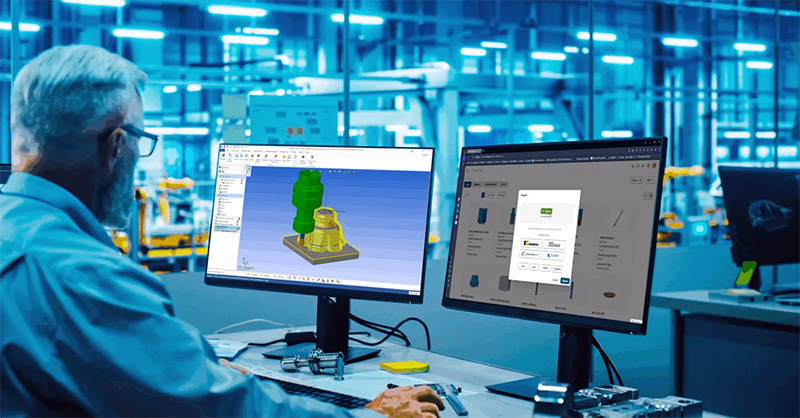
Modern machining demands more than a list of tools. A cutting-tool library today is a structured, connected, cloud-enabled system that brings order, clarity, and accuracy to one of the most fundamental parts of machining.
A next-generation tool library:
Centralizes and standardizes tool data—Every programmer on every shift uses the same verified definitions, not local copies or outdated variants.
Stores fully defined 2D/3D tool and holder assemblies—Simulation and collision checking rely on precise digital twins of the cutting system. The tool library provides them once, for everyone.
Pulls data directly from tooling manufacturers—Instead of typing dimensions or feeds and speeds by hand, modern libraries import ISO 13399-compliant data directly from suppliers. This saves time, reduces errors, and improves consistency.
Captures shop-specific cutting knowledge—The real intelligence, the parameters that work on your machines, in your materials, under your conditions, become part of your digital tool data rather than living in someone’s memory.
Connects programming, simulation, and future automation—When the same tool definition flows through the entire digital thread, everything from CAM to NC verification becomes faster, more reliable, and more consistent.
In short, the tool library is the place where tribal knowledge becomes durable knowledge within an asset the business owns, not an individual.
Why the tool library is the foundation of AI-assisted machining
AI systems, particularly those driven by machine learning, depend entirely on the quality of the data they consume. A learning system improves by recognizing patterns. But it can only see patterns when the information it receives is clean, structured, and consistent.
If a 10 mm end mill appears in five different forms across five programmers’ systems, the AI sees five tools, not one.
When tolerances are handwritten in a notebook instead of stored digitally, the AI never learns why a particular feature needs a different strategy.
If feeds and speeds vary wildly because they were copied from old NC files, the AI can’t understand what “good” looks like.
By contrast, when a tool library provides clean, standardized, richly defined tool data, the AI has something meaningful to learn from. It understands relationships between tools, materials, tolerances, and outcomes, and can replicate the same decision-making logic a senior programmer would apply.
This is why so many shops trying to “jump straight to AI” find themselves circling back to tooling data. Without a structured foundation, the automation simply doesn’t have enough to work with.
An accessible first step for any shop
What makes the cutting-tool library such a powerful entry point into automation is the simplicity and low risk. Unlike full AI-driven programming, a tool library doesn’t require sharing customer CAD data or adopting new workflows overnight. It fits neatly alongside existing CAM processes, delivering value immediately.
For shops wary of cloud workflows or governed by export controls, it’s also a safe move: Tooling data are rarely sensitive, and a cloud-connected library can be used without sending part geometry anywhere.
For smaller machine shops—the backbone of global precision engineering—it represents a rare win: a technology that boosts productivity without demanding major capital investment, staff retraining, or changes to customer contracts.
Protecting knowledge in a shrinking skills pool
One of the most urgent challenges in manufacturing today is the loss of expertise. Skilled programmers and machinists are retiring, and younger engineers are entering a world where automation is expected but experience is scarce. A tool library helps bridge that gap.
By embedding cutting data, tool behavior, and shop-specific know-how into a shared system, experienced staff effectively multiply their value. Junior programmers start from proven parameters instead of guesswork. The ramp-up curve shortens. Consistency improves. And the shop becomes less vulnerable to turnover. This isn’t just operationally beneficial; it’s strategically essential for long-term competitiveness.
Where to start: Practical steps for building a strong tooling foundation
Shops looking to strengthen their digital capabilities can take simple steps.
Audit your tooling data
Understand where tool definitions live today and how many duplicates exist.
Choose a modern, connected tool library
Look for support for ISO 13399 data, 3D assemblies, and integration with your CAM platform.
Start with a pilot cell or product family
Standardize tool definitions and cutting data in one area first, then expand.
Capture every improvement
When programmers optimize a toolpath or tweak a parameter, ensure it becomes part of the shared library.
Let the tool library become the source of truth
Make it the first place programmers go, not the last.
The quiet backbone of an AI-ready machine shop
For all the excitement about AI, automation, and digital machining, the truth is simple: No technology succeeds without the right foundations.
A tooling data library is one of those foundations: quietly transformative, often underestimated, but absolutely essential. It reduces programming time, improves quality, strengthens simulation, accelerates onboarding, and unlocks the full potential of AI-powered CAM when a shop is ready to take that step.
If the future of manufacturing belongs to those who can combine human expertise with digital automation, then the journey starts in the most practical place of all: Your tools. Your data. Your tool library.
Published Dec. 12, 2025, in the Hexagon blog.
Add new comment