{domain:"www.qualitydigest.com",server:"169.47.211.87"} Skip to main content

        
User account menu
Main navigation
  • Topics
    • Customer Care
    • Regulated Industries
    • Research & Tech
    • Quality Improvement Tools
    • People Management
    • Metrology
    • Manufacturing
    • Roadshow
    • QMS & Standards
    • Statistical Methods
    • Resource Management
  • Videos/Webinars
    • All videos
    • Product Demos
    • Webinars
  • Advertise
    • Advertise
    • Submit B2B Press Release
    • Write for us
  • Metrology Hub
  • Training
  • Subscribe
  • Log in
Mobile Menu
  • Home
  • Topics
    • Customer Care
    • Regulated Industries
    • Research & Tech
    • Quality Improvement Tools
    • People Management
    • Metrology
    • Manufacturing
    • Roadshow
    • QMS & Standards
    • Statistical Methods
    • Supply Chain
    • Resource Management
  • Login / Subscribe
  • More...
    • All Features
    • All News
    • All Videos
    • Training

What Is Organic Modeling?

Understanding key concepts, tools, and techniques in organic 3D design

Hexagon

Kevin Atkins
Bio

Geomagic

Tue, 02/17/2026 - 12:02
  • Comment
  • RSS

Social Sharing block

  • Print
Body

Whether you’ve sketched an idea in a notebook or a basic drawing program, it’s not until you begin creating the 3D model that a product really comes to life. If that product features sharp edges or smooth surfaces, you’re operating in the realm of standard CAD modeling. But if it has fluid forms, textures, or is based on biomorphic structures, we’re probably talking about organic modeling.

ADVERTISEMENT

The meaning of organic varies considerably depending on whom you ask. Different people highlight different aspects.

Understanding organic modeling

If the concept is completely new to you, the best way to learn about it is through examples.

Consider the two products in this photo from Nissan’s Technical Center. The sumo wrestlers and the car are both examples of organic modeling, but the techniques, skills, and results differ greatly.

The car is smooth and refined. You can design it once and produce it in the thousands. On the other hand, the sumo sculpture is a product you design once, make once—or in very limited quantities—and never again.

What makes them distinct? It’s the design techniques.

The car is modeled in your standard CAD software. Engineers use this technology to design mechanical objects—ranging from simple brackets to complex vehicles like this one.

The sumo sculpture must be created with sculpting tools that you don’t usually find in CAD. It would be difficult to design products that aren’t made of mechanical forms in traditional CAD systems. While many techniques have been developed over the years to help CAD create objects with a “sculpted look,” skillful designers and considerable time and effort are still required to make that work.

Mechanical to organic spectrum

Many products we purchase are neither purely organic nor purely CAD, but a mixture of both forms. A good way of thinking about design is as a spectrum of forms ranging from organic to mechanical. Each product can be placed somewhere between the two ends of that spectrum—they have some elements of CAD and some organic.

CAD and organic modeling software aren’t mutually exclusive, either. When you find that designing organic features in CAD starts to feel like an uphill battle, you have to ask yourself: Is there a different type of 3D modeling software that’s better suited for this task? If you’re planning to manufacture a product with organic features, and you’re going to make it in high volume but your CAD system can’t handle it, you need organic modeling software.

The software should have both sculpting and CAD tools. Most products made for manufacturing are a mixture of organic and mechanical forms. For example, toys will have a shell that’s shaped like something organic, such as the toy below, but its inner mechanism will require the precision of CAD. When we talk about the CAD-organic spectrum, this is what we’re referring to.

A real-world example

Let’s go back to our initial example, the sumo wrestlers and the car. The wrestlers are very organic, but the car has many mechanical elements. That’s why the car is a better fit for CAD software than organic modeling software.

On the other hand, certain devices are predominantly mechanical but still require organic modeling software. If you want to make an iPhone case, you’ll add textures. The easiest way to do it is in organic modeling software.

The same goes for toy cars. You can model the basic mechanical system in CAD, but the expressive elements of a character must be sculpted. That’s easiest to do in organic modeling software.

We also need to consider the ultimate use of the model. A model that’s intended to be a real product, no matter where it lies on the spectrum, needs to be engineered for function, strength, and manufacturability, whereas a model that will only be used in the digital realm, e.g., for animation, only needs to look like a real product.

4 key elements of organic modeling for product design

These examples show that there are four key elements that define organic modeling.

1. Used in projects where CAD doesn’t cut it. Organic modeling is the design of shapes (two dimensions) and forms (three dimensions) that can’t be easily defined by dimensions and modeled by usual CAD operations such as extrusions, revolutions, blends, sweeps, NURBS/Bezier surfacing, or Booleans. When you envisage your product, ask whether it’s possible to sketch it, extrude it, revolve it, and end up with the design you want. If not, then you’re in the realm of organic modeling.

2. A way of design thinking. Organic modeling is an approach to design in which the proportions and the emotions the object evokes are paramount.

3. Creative exploration. Organic modeling gives you the freedom to engage in a process of design exploration. While every design software has its own structured approach to creating a model, traditional CAD systems are often more rigid. This can get in the way of the fun of figuring things out as you go. In contrast, organic modeling software uses less restrictive methods. You can start with a rough idea of an object or character and easily change it as your design evolves. That kind of freedom is harder to achieve in CAD, where you need to define precise dimensions and features from the start. The software hinders the design process itself.

4. Modeling physical products. Organic modeling software helps create products for the physical word, not just digital. There are many organic design systems that can make a product that looks great on the screen, but there’s no way to manufacture that model or use real-world dimensions to define features.

Organic modeling products

Let’s see what types of products we can use organic modeling for.

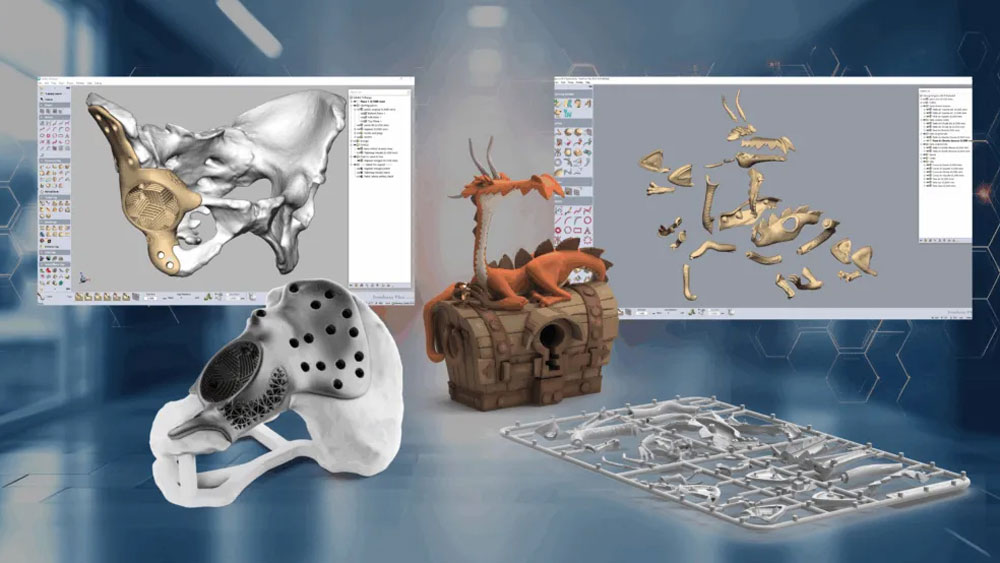
A big area is toys. Human- or animal-like figurines need to be sculpted and broken up into pieces that will be mass-produced using plastic injection molding. Both of these steps—organic design and preparing it for manufacturing—take place in organic modeling software using a combination of sculpting tools and CAD operations.

In the healthcare industry, we use organic modeling to design anything from medical teaching models to patient-specific hip replacement implants, cranial plates, orbital implants, or cutting guides. Because we design medical devices to fit the unique shape of a person’s body, CAD won’t work for this application.

This is why the prosthetics and orthotics industry went all-in on organic modeling. A prosthesis is only going to be comfortable if the socket fits the patient well. You can only achieve this with organic modeling.

Industrial design has adopted this modeling technique rapidly, too. Today we use it to make everything from jewelry to shoes, razors, lunch boxes, dollhouses, and bottles with unique sculpted or textured elements.

Choosing the right software

Now that you understand the ins and outs of organic modeling, you should feel more confident about choosing the right software.

You need flexibility in the modeling process. Your product is expressive and not defined by primitives—and you need to make it manufacturable? Even if you have a CAD system with some special technique for designing organic shapes, it’s just going to be too clunky. Organic modeling software is the way to go.

If you want a comprehensive tool kit for organic modeling, explore Geomagic Freeform. It brings together sculpting and indispensable CAD operations, enabling you to create virtually anything, whether it’s a medical device, a toy, shoes, or a baking mold.

Published Sept. 18, 2025, by Hexagon.

Add new comment

The content of this field is kept private and will not be shown publicly.
About text formats
Image CAPTCHA
Enter the characters shown in the image.

© 2026 Quality Digest. Copyright on content held by Quality Digest or by individual authors. Contact Quality Digest for reprint information.
“Quality Digest" is a trademark owned by Quality Circle Institute Inc.

footer
  • Home
  • Print QD: 1995-2008
  • Print QD: 2008-2009
  • Videos
  • Privacy Policy
  • Write for us
footer second menu
  • Subscribe to Quality Digest
  • About Us