Courtesy of NUS
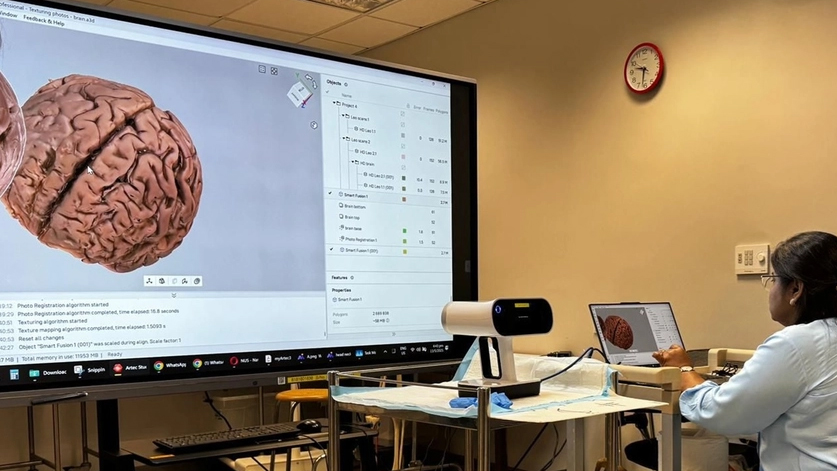
Artec Leo and 3D anatomical model of a brain in Artec Studio
Social Sharing block

In the medical field, 3D technology is fast becoming indispensable. Whether used for educating patients ahead of surgeries or teaching students how to do these operations, anatomy models, both 3D printed and digital, offer an ideal solution for visualization ahead of time.
|
ADVERTISEMENT |
One of the main challenges behind digitizing human anatomy is accuracy. Our insides are full of complex systems and microscopic details that are difficult to capture. Blood vessels, for example, form in narrow, intricate networks vulnerable to motion artifacts during digitization.
Then there’s the question of technology integration. In theory, anatomy modeling sounds like a great interactive way of educating patients and students. But going from a captured model to usable 3D print, VR, or AR data can be tricky. File size is another issue: 3D scanning is an excellent tool for intricate object capture, but detailed models can be too heavy for VR to run.
…
Add new comment