Image courtesy of the researchers
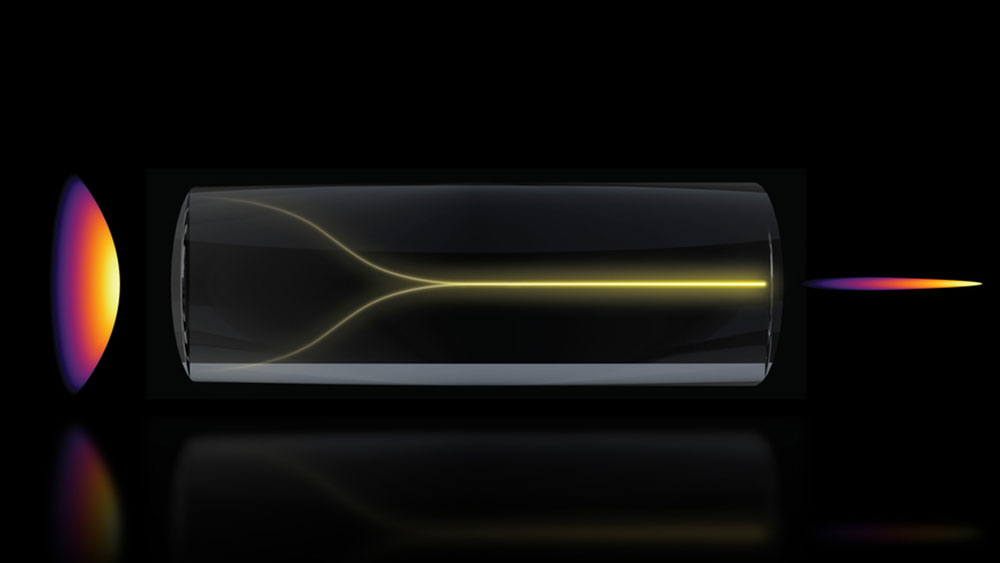
Under the right conditions, a chaotic mess of laser light can spontaneously self-organize into a highly focused “pencil beam.” This schematic shows the pencil-beam formation mechanism. Image courtesy of the researchers
Social Sharing block

(MIT: Cambridge, MA) -- MIT researchers discovered a paradoxical phenomenon in optical physics that could enable a new bioimaging method that’s faster and higher-resolution than existing technology.
|
ADVERTISEMENT |
They discovered that, under the right conditions, a chaotic mess of laser light can spontaneously self-organize into a highly focused “pencil beam.”
Using this self-organized pencil beam, the researchers captured 3D images of the human blood-brain barrier 25 times faster than the gold-standard method while maintaining comparable resolution.
By showing individual cells absorbing drugs in real time, this technology could help scientists test whether new drugs for neurodegenerative disease like Alzheimer’s or ALS reach their targets in the brain with greater speed and resolution.
Concentrations of red dye begin to appear across the network veins.
…
Add new comment