
Social Sharing block

Audit week has a way of revealing gaps that stay invisible during normal operations. Your methods are sound, and your data look clean. Then the assessor asks for the calibration certificate on the torque wrench used last Tuesday, and someone heads off to find it.
|
ADVERTISEMENT |
That small gap, a record that exists somewhere but not where it should be, is what good planning prevents. ISO/IEC 17025 is broader than most people expect. Its requirements touch almost everything a lab does, from the competence of staff to the wording on a final report.
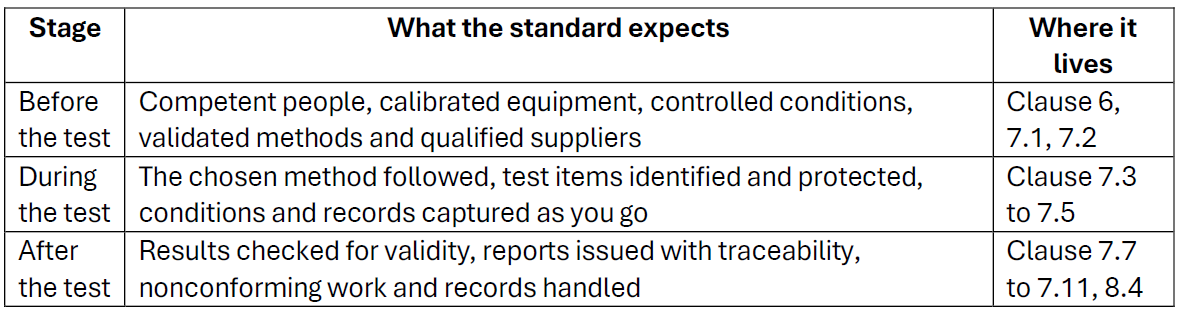
The standard groups its requirements into resources, the testing process, and the management system that holds them together. You can plan for all three at once by anchoring them to the thing that your lab actually produces: a test result. Each result has a before, a during, and an after, and ISO 17025 has something to say about each. Plan around that, and accreditation tends to look after itself. Here is the same picture, mapped to the standard.
Before the test: Get the lab ready
If the inputs to a task are incomplete, the output can only be as reliable as what went into it.
People come first. Each method needs someone competent and authorized to run it, with the education, training, and experience behind that authorization on file. An accredited lab calibrates the equipment so its readings trace back to the national measurement standards. Hold the environmental conditions the method calls for and log them. Validate the method for its intended use, or verify it if it’s a published standard method. Last, evaluate and approve the suppliers behind your calibration, reference materials, and proficiency testing, and keep the evidence.
The piece labs most often forget to plan is authorization. A simple competence matrix that maps people to the methods they are signed off for, reviewed on a set cadence, catches a lapsed sign-off before an assessor does. While you’re at it, write the short list of people, equipment, conditions, and inputs each method depends on. That list doubles as a readiness check and the backbone of your resource plan.
During the test: Capture as you go
Once testing starts, the standard cares about control and evidence. Follow the validated method and record any permitted deviation, rather than quietly working around it. Test items need clear identification and protection from the moment they arrive, so there’s no doubt later about what was tested or whether its condition changed in your care.
The part that decides how an audit feels is technical records. Clause 7.5 wants enough detail to repeat the test and check the result: the method and equipment used, the conditions at the time, the raw observations, the person who ran it, and the date. Capture those records at the bench as the work happens. Anything reconstructed from memory a week later tends to have holes that an assessor will find.
After the test: Prove it and report it
When the result is in, three things matter: The result is valid, the report is clear, and the record survives.
Validity is the quiet engine of Clause 7.7. Plan the checks that tell you the measurement system is still behaving: control samples, intermediate checks on equipment between calibrations, retests, and participation in proficiency testing or interlaboratory comparison. These also catch the equipment that comes back from calibration out of tolerance, which can call earlier results into question and trigger a review of what already shipped.
Reporting has its own rules in Clause 7.8. A report must identify the method, the items, the results and their units, the dates and any statement of conformity with its decision rule, and uncertainty where relevant. Plan a report template that carries these by default so nothing depends on whoever happens to write it.
When something does go wrong, nonconforming work and corrective action under Clause 7.10 and 8.7 expect a planned response: Contain it, judge the effect on results, fix the cause, and check that the fix actually worked. Behind all of it, control of records in Clause 8.4 keeps the evidence legible and retrievable for as long as you said it would be.
Where a connected platform earns its place
Running one test through readiness, execution, and reporting is manageable on spreadsheets. Multiply that by dozens of active tests, several labs, and a year of staff changes, and the manual version starts to leak. Authorizations lapse unnoticed. Calibration dates pass. The technical record for one test ends up in a different place from its report.
This is the problem a test life-cycle management platform is meant to solve, and it’s where TITAN focuses. Those three stages live in one system, each tied to the test it belongs to. A calibration coming due is flagged against the schedule before it stops a test. The competence behind a result, the conditions on the day, and the equipment used stay linked to that result. Reports come out audit-ready with the traceability already in place. When the assessor asks for last Tuesday’s certificate, it’s a click away.
The payoff is in the effort saved. Staying on the right side of the standard becomes routine, test after test.
A practical place to start
You don’t need new software to begin. A handful of moves covers the life cycle:
1. For each method on your scope, list the people, equipment, conditions, and inputs it requires. This is your readiness check in draft.
2. Build a competence matrix linking each person to the methods they are authorized for, with the date of last review.
3. Put every measuring device in one register with its calibration status, due date, and owner, and set reminders ahead of expiry.
4. Set a standard technical-record format that captures method, equipment, conditions, raw data, and operator at the bench.
5. Create a report template that already carries every required field, including decision rules where you state conformity.
6. Write the response for nonconforming work and out-of-tolerance equipment before you need it, including the check that the fix worked.
7. Review the whole picture against your upcoming schedule each quarter so capacity and calibration clashes become evident with time to fix them.
As the number of tests grows, a platform such as TITAN keeps the life cycle joined up without the manual upkeep. Until then, the steps above hold the line.
The payoff
Resource planning under ISO 17025 isn’t glamorous, and broader planning across the test life cycle is no different. The reward is quiet. An assessor asks for the calibration certificate on last Tuesday’s torque wrench, and it’s there, current and traceable, beside the name of the authorized operator and the conditions logged that day. The report reads the same whoever wrote it. The corrective action from last quarter shows a cause that was fixed and a fix that was checked.
ISO 17025 is one idea repeated across the life cycle: A result deserves the same care as everything that went into making it. Plan for the before, the during, and the after, and the audit stops being an event you brace for.
Add new comment