{domain:"www.qualitydigest.com",server:"169.47.211.87"} Skip to main content

        
User account menu
Main navigation
  • Topics
    • Customer Care
    • Regulated Industries
    • Research & Tech
    • Quality Improvement Tools
    • People Management
    • Metrology
    • Manufacturing
    • Roadshow
    • QMS & Standards
    • Statistical Methods
    • Resource Management
  • Videos/Webinars
    • All videos
    • Product Demos
    • Webinars
  • Advertise
    • Advertise
    • Submit B2B Press Release
    • Write for us
  • Metrology Hub
  • Training
  • Subscribe
  • Log in
Mobile Menu
  • Home
  • Topics
    • Customer Care
    • Regulated Industries
    • Research & Tech
    • Quality Improvement Tools
    • People Management
    • Metrology
    • Manufacturing
    • Roadshow
    • QMS & Standards
    • Statistical Methods
    • Supply Chain
    • Resource Management
  • Login / Subscribe
  • More...
    • All Features
    • All News
    • All Videos
    • Training

Maximizing Air Gauge Capability for Small Holes

Air gauging can be used to measure very small through-holes down to 0.1 mm via a new approach

Mahr

George Schuetz
Bio

Mahr Inc.

Thu, 04/23/2026 - 12:02
  • Comment
  • RSS

Social Sharing block

  • Print
Body

There are numerous parts that make use of very small holes in various industries (or in your shop). A dozen examples could be listed, but the most common include aerosol cans, needles for delivering fluids and medicines, fuel-injection nozzles, and simple fixed restrictors used to control liquid or airflows. 

ADVERTISEMENT

Typically, holes for these types of applications range from 0.1 mm–1 mm in diameter. Some of these small holes aren’t that important. But when it comes to delivering fuel or coatings, the size of the hole may increase or decrease fuel efficiency, or determine the quality of the paint job on your part. And if the delivered product is medicine, hole size might have life-or-death consequences.

Many methods exist to inspect small holes. Some applications are served well by microscopes and optical comparators, although neither is well suited to high-volume production applications, and both are limited in the part configurations they can accept. For example, if the hole is deep within the part, or the hole is the length of a shaft like a hypodermic needle, measuring microscopes probably won’t work. By the same token, go/no-go gauging with precision wires is also practical only for very low-volume tasks.

So how does one measure these very small holes that control flow?

Air gauging may be a choice to consider. Conventional air gauging for measuring inside diameters is typically limited to a minimum size of about 0.060 in./1.52 mm; below that, it becomes difficult to machine air passages in the plug tooling and accommodate the precision orifices or jets. But air gauging is among the most flexible of inspection methods, and with a simple change of approach, it can be used to measure very small through-holes down to 0.1 mm.

Most air gauges measure backpressure that builds up in the system when the tooling is placed close to a workpiece. In the case of bore gauging, a smaller bore means closer proximity of the part surface to the jets. This results in higher air pressure, which the gauge comparator converts into a dimensional value.

Some air gauges measure the rate of flow through the system rather than backpressure: As tool-to-workpiece proximity decreases, flow also decreases. The flow principle can be effectively applied to measure very small through-holes, even on air gauges that were designed to operate on the backpressure principle. Rather than installing tooling at the end of the air line, the workpiece itself is connected to the line. Smaller bores restrict the flow of air more than larger ones. Thus, the workpiece essentially becomes its own gauge tooling. This approach works on all common types of backpressure gauges—single-leg gauges requiring dual setting masters, as well as differential-type gauges, which typically use just one master.

Airflow is proportional to the bore’s cross-sectional area, but area varies with the square of diameter. Gauge response in this setup, therefore, is nonlinear. Nevertheless, this rarely causes problems, because the range of variation to be inspected is usually very small, and the gauge is typically set to both upper and lower limits using dual masters or qualified parts. Thus, a specially modified bench air gauge amplifier or pneumatic column gauge can be dedicated to measuring this small range.

However, the ideal gauge for the user has as much flexibility built into the system as possible. What this means is the ideal solution is to be able to measure anything within the 0.1 mm–1 mm range and thus eliminate the short-range dedicated system. To do this, there is the small equation we mentioned previously: Airflow is proportional to the bore’s cross-sectional area, but area varies with the square of diameter. Thus, if a long-range system is required, linearization is a must. Using two masters over the full range of the hole diameters would not provide the performance required. And there is one more issue. Most pneumatic sensors can’t be set up to handle the long range needed and still maintain the resolution and performance required.

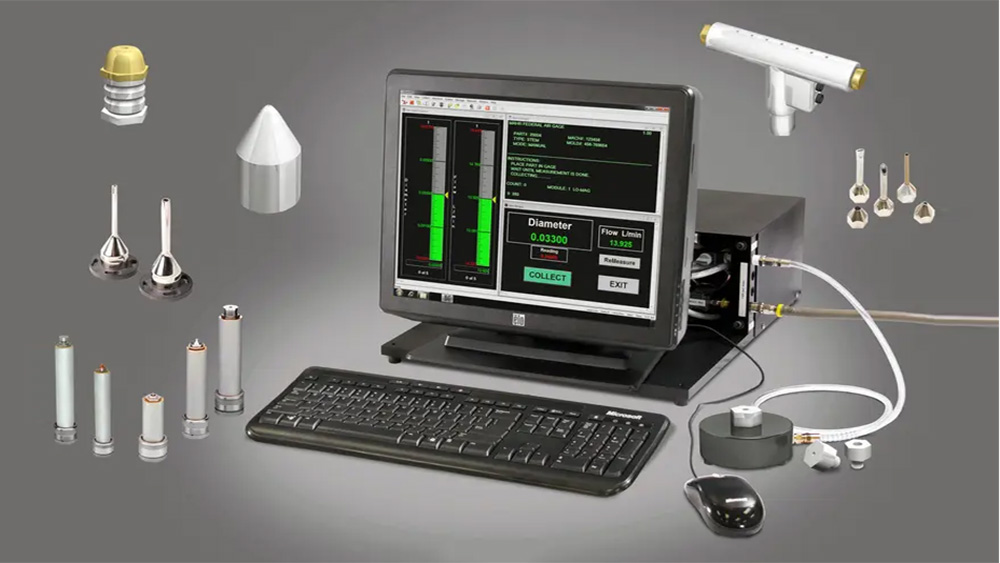
With the use of a gauging computer in conjunction with a series of pneumatic transducers, each tuned for its own small range, the computer can sense where the sample part is falling in terms of flow with the proper pneumatic transducer and use that one for the hole measurement. Also, because each transducer has been linearized to correct for the squaring of flow for the size change, hole sizes can be measured to an accuracy of better than 7.6 µm.

With a linearized and multiple pneumatic transducer system, the operator can simply place any part onto the gauge, and it will provide the hole diameter and the flow rate based on the pressure used in the system.

In discussing air gauging in past columns, we’ve often emphasized its flexibility. With it, one can measure a wide range of dimensional characteristics, including inside and outside diameters, feature location, thickness, height, and clearance/interference. Air can also be used to measure geometric characteristics such as roundness, squareness, flatness, parallelism, twist, and concentricity. And we’ve seen how air gauges can measure very deep bores, blind holes, and counterbores.

 The use of air gauging to inspect very small through-holes is yet another example of the tremendous adaptability of this relatively simple but very cost-effective technology.

Add new comment

The content of this field is kept private and will not be shown publicly.
About text formats
Image CAPTCHA
Enter the characters shown in the image.

© 2026 Quality Digest. Copyright on content held by Quality Digest or by individual authors. Contact Quality Digest for reprint information.
“Quality Digest" is a trademark owned by Quality Circle Institute Inc.

footer
  • Home
  • Print QD: 1995-2008
  • Print QD: 2008-2009
  • Videos
  • Privacy Policy
  • Write for us
footer second menu
  • Subscribe to Quality Digest
  • About Us