{domain:"www.qualitydigest.com",server:"169.47.211.87"} Skip to main content

        
User account menu
Main navigation
  • Topics
    • Customer Care
    • FDA Compliance
    • Healthcare
    • Innovation
    • Lean
    • Management
    • Metrology
    • Operations
    • Risk Management
    • Roadshow
    • Six Sigma
    • Standards
    • Statistics
    • Supply Chain
    • Sustainability
    • Training
  • Videos/Webinars
    • All videos
    • Product Demos
    • Webinars
  • Advertise
    • Advertise
    • Submit B2B Press Release
    • Write for us
  • Metrology Hub
  • Training
  • Subscribe
  • Log in
Mobile Menu
  • Home
  • Topics
    • 3D Metrology-CMSC
    • Customer Care
    • FDA Compliance
    • Healthcare
    • Innovation
    • Lean
    • Management
    • Metrology
    • Operations
    • Risk Management
    • Roadshow
    • Six Sigma
    • Standards
    • Statistics
    • Supply Chain
    • Sustainability
    • Training
  • Login / Subscribe
  • More...
    • All Features
    • All News
    • All Videos
    • Training

Automating the Indicator Calibration Process

With modern vision systems, it’s possible to ‘read’ a dial, digital indicator, or comparator

Mahr

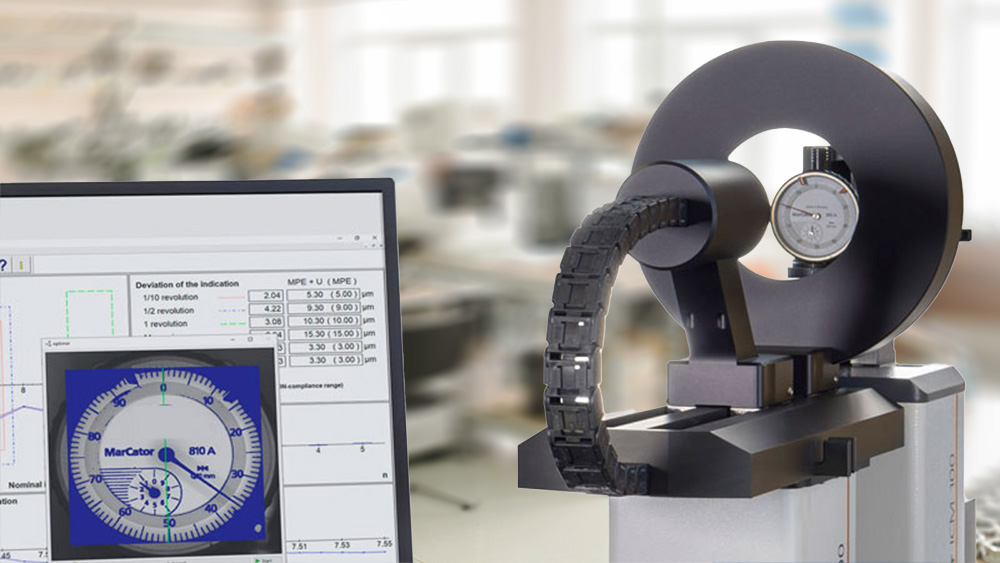
Systems exist that can “read” a dial indicator and capture its values.

George Schuetz
Bio

Mahr Inc.

Mon, 12/15/2025 - 12:03
  • Comment
  • RSS

Social Sharing block

  • Print
Body

All gauging equipment must be calibrated periodically to ensure it can perform the job for which it’s intended (i.e., measuring parts accurately).

ADVERTISEMENT

This is true for every hand tool or gauge used in a manufacturing environment that verifies the quality of parts produced—from calipers and micrometers to dial indicators and electronic amplifier systems that measure to submicrons. This has always been necessary for maintaining quality. But there are additional, external reasons to establish and maintain a regular program of gauge calibration—customer requirements. Companies now routinely demand that suppliers document their quality efforts from start to finish.

Some large companies with thousands of hand measuring tools, dial/digital indicators, and comparators can cost-justify hiring or training specialists in gauge calibration methods and supplying them with equipment and resources to perform virtually all calibration duties in-house. However, dial and digital indicator or comparator calibration can be a very time-consuming and operator-intensive process.

Most dial indicators are relatively short range but need to be checked at multiple points throughout their range to verify performance accuracy. Then, they need to be checked again in the reverse direction to verify hysteresis requirements. Historically, most dial-indicator calibrators have been built around a high-precision mechanical micrometer—in effect, turning the micrometer to a known point and then observing any deviation on the dial indicator. Even for a short-range indicator, the process will involve moving a mechanical dial calibrator by hand to 20 or more points along the indicator’s travel. This isn’t too difficult for a short-range indicator, but with a longer-range indicator, say 12.5, 25, 50, or even 100 mm of range, there are a lot of positions to go to and points to observe and record.

This can also take a significant amount of time and concentration for the user. Doing this for many indicators throughout the day is stressful for the operator, not only in hand positioning of the micrometer head to hundreds if not thousands of points, but also from the resulting eye strain from reading the micrometer head and indicator. The reading is also problematic because people will naturally (and unintentionally) reverse numbers or just misread. Alternatively, in the case of a dial indicator, not reading the indicator straight on causes a parallax effect and a misreading of the result.

To reduce operator stress and increase productivity, automated calibrators are available that, based on the indicator, will drive a precision spindle to the desired location. The operator can then read and record the deviations. These machines will significantly reduce the hand/arm strain caused by the constant rotational driving of the mic head. Time is still involved, and the operator must read and record the indicator’s values. This is a significant improvement, but more can be done.

The real improvement would be to eliminate the operator, install the indicator into the calibration tool, tell the gauge what indicator specs to measure for, and then let the gauge measure and certify the indicator without operator involvement. This allows the gauge technician to be productive while preparing the next indicator to be checked, signing the certifications, or even starting a different calibration process—all while the automated calibrator is working.

Today, with modern vision systems, it’s possible to “read” the dial or digital indicator or comparator. By reading, I can know what the indicator and dial is supposed to be, process an image to read the pointer relative to the grads, and interpolate this as a measurement. In the case of digital indicators, the digital dial is scanned by the system’s camera, the digits are analyzed or “read” by the controller, and the actual deviation between measurements is made.


Example of points required for checking an indicator.

Because of this automation with image processing, what was once a labor-intensive, manual, and error-prone calibration is now faster and reduces measurement errors and uncertainties while preventing potential stress and injuries to the user. With auto-recognition of the vision system, more test items with more data points will be recorded faster than conventional manual methods, which frees the operator to be productive during the automated measuring process.

Add new comment

The content of this field is kept private and will not be shown publicly.
About text formats
Image CAPTCHA
Enter the characters shown in the image.

© 2025 Quality Digest. Copyright on content held by Quality Digest or by individual authors. Contact Quality Digest for reprint information.
“Quality Digest" is a trademark owned by Quality Circle Institute Inc.

footer
  • Home
  • Print QD: 1995-2008
  • Print QD: 2008-2009
  • Videos
  • Privacy Policy
  • Write for us
footer second menu
  • Subscribe to Quality Digest
  • About Us