{domain:"www.qualitydigest.com",server:"169.47.211.87"} Skip to main content

        
User account menu
Main navigation
  • Topics
    • Customer Care
    • Regulated Industries
    • Research & Tech
    • Quality Improvement Tools
    • People Management
    • Metrology
    • Manufacturing
    • Roadshow
    • QMS & Standards
    • Statistical Methods
    • Resource Management
  • Videos/Webinars
    • All videos
    • Product Demos
    • Webinars
  • Advertise
    • Advertise
    • Submit B2B Press Release
    • Write for us
  • Metrology Hub
  • Training
  • Subscribe
  • Log in
Mobile Menu
  • Home
  • Topics
    • Customer Care
    • Regulated Industries
    • Research & Tech
    • Quality Improvement Tools
    • People Management
    • Metrology
    • Manufacturing
    • Roadshow
    • QMS & Standards
    • Statistical Methods
    • Supply Chain
    • Resource Management
  • Login / Subscribe
  • More...
    • All Features
    • All News
    • All Videos
    • Contact
    • Training

3-D Scanning and Processing Technologies Help Ensure Safety of NASA Shuttle Discovery

Belly-up scanning at space station creates 3-D model of tiles crucial to orbit reentry

Bob Cramblitt

Cramblitt & Company

Thu, 09/09/2010 - 09:07
  • Comment
  • RSS

Social Sharing block

  • Print
Body

When the NASA Discovery space shuttle launches in November, there will be dozens of upgrades and safety modifications, but one thing will remain unchanged from every mission during the last five years: 3-D scanning and processing will be used to help ensure the safe return of astronauts to Earth.

ADVERTISEMENT

As part of the Return to Flight initiative following the Columbia disaster in 2002, NASA implemented 3-D scanning and processing to detect, assess, and repair, if necessary, tile damage caused by foam particles dislodged from the shuttle and other flying debris.

Heat-resistant ceramic tiles that cover the underside of the shuttle Discovery are part of the thermal protection system that shields the orbiter and its astronauts from the 2,300°F-heat faced during re-entry into the Earth’s atmosphere.
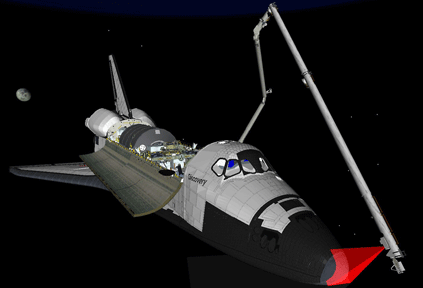
Simulation of the Neptec system scanning the Discovery shuttle. Image courtesy of Neptec.

 …

Want to continue?
Log in or create a FREE account.
Enter your username or email address
Enter the password that accompanies your username.
By logging in you agree to receive communication from Quality Digest. Privacy Policy.
Create a FREE account
Forgot My Password
Top Stories
AI May Be Making Your Quality Problem Worse
The 6 Best Quality Management Software Features That Simplify Your QMS
What I Discovered About Quality Concepts by Watching My Newborn Granddaughter
Why Products Still Fail RoHS, REACH, and POPs Compliance
The Hidden Cost of Poor Quality in Regulated Manufacturing

Add new comment

Please login to comment.

© 2026 Quality Digest. Copyright on content held by Quality Digest or by individual authors. Contact Quality Digest for reprint information.
“Quality Digest" is a trademark owned by Quality Circle Institute Inc.

footer
  • Home
  • Print QD: 1995-2008
  • Print QD: 2008-2009
  • Videos
  • Privacy Policy
  • Write for us
footer second menu
  • Subscribe to Quality Digest
  • About Us
  • Contact Us