{domain:"www.qualitydigest.com",server:"169.47.211.87"} Skip to main content

        
User account menu
Main navigation
  • Topics
    • Customer Care
    • Regulated Industries
    • Research & Tech
    • Quality Improvement Tools
    • People Management
    • Metrology
    • Manufacturing
    • Roadshow
    • QMS & Standards
    • Statistical Methods
    • Resource Management
  • Videos/Webinars
    • All videos
    • Product Demos
    • Webinars
  • Advertise
    • Advertise
    • Submit B2B Press Release
    • Write for us
  • Metrology Hub
  • Training
  • Subscribe
  • Log in
Mobile Menu
  • Home
  • Topics
    • Customer Care
    • Regulated Industries
    • Research & Tech
    • Quality Improvement Tools
    • People Management
    • Metrology
    • Manufacturing
    • Roadshow
    • QMS & Standards
    • Statistical Methods
    • Supply Chain
    • Resource Management
  • Login / Subscribe
  • More...
    • All Features
    • All News
    • All Videos
    • Training

How to Reverse Engineer Classic Car Parts

With 3D scanning and the right software, car restoration is more accessible than ever

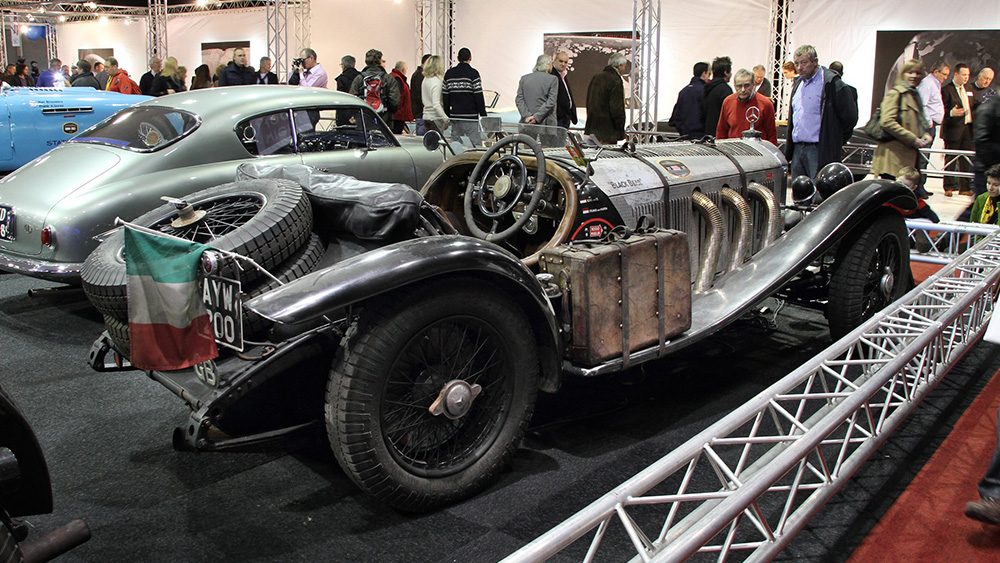
Georg Sander/Flickr

Gregory George
Bio

Hexagon Manufacturing Intelligence

Wed, 01/28/2026 - 12:03
  • Comment
  • RSS

Social Sharing block

  • Print
Body

Timeless design, meticulous craftsmanship, and connection to the past: There are many reasons why classic cars are enduringly popular. Reverse engineering has brought them within reach of more people than ever before. 3D scanners and 3D modeling software make it possible to remake parts at a fraction of previous costs. To help you understand how, here is an overview of the technologies needed to reverse engineer classic car parts.

ADVERTISEMENT

What is reverse engineering in automotive restoration? 

A lot goes into keeping a vintage vehicle up and running. You can’t simply order a replacement from a manufacturer, because original parts have gone out of production years, sometimes decades ago.

When parts break or wear out, most often you need to have a replacement manufactured from scratch. The older the vehicle, the more difficult it is to find a replacement, especially when the original manufacturer no longer exists.

The simplest approach is reverse engineering, using existing products to design and manufacture new ones. You measure the existing part, design a new one based on that information, tweak the broken areas, and have the part manufactured. It’s fast and relatively inexpensive.

Tools and technologies to reverse engineer classic cars 

Measurement tools

If you want to reverse engineer classic car parts, a critical step is gathering measurements. A wide range of tools is available for this—from the more traditional manual options to digital alternatives.

Basic hand tools include calipers, micrometers, gauges, rulers, and tape measures. These can be helpful for measuring very simple, noncrucial parts. The challenge comes when a greater level of accuracy is required, because design engineers now work in terms of microns

When you need to measure complex parts efficiently, you can use modern metrology devices. The best bet for this type of project is a portable 3D scanner. It gathers enough data points to serve as a basis for rebuilding parts, and it’s available at accessible price points.

Software

With all the measurements gathered, it’s time to build the 3D model. There are two types of software you can use for this.

The more traditional option is CAD. Professional car engineers and enthusiasts have been using it for years to rebuild parts. However, it has its drawbacks. A common issue is that it’s too slow at handling big files such as scanning data. Even with optional reverse engineering modules, CAD programs can be inefficient in editing scans.

The more efficient way is to get 3D reverse engineering software. It helps model accurately by automatically fitting sketch lines, arcs, and curves onto scanned parts. Thanks to tools that automate operations, such as 2D and 3D sketch, revolve, extrude, fillet, shell/thicken, and pipe, modeling is faster. Most importantly, you can check the accuracy of CAD models during reverse engineering without the need to export.

After finishing the 3D CAD model, designers send the part to fabrication. This could be milling, machining, or additive manufacturing.

A screenshot of a computer  AI-generated content may be incorrect.

Real-world example 

Reverse engineering is widely used in classic car preservation to replicate legacy parts or simply to create a digital record of the car for historical purposes.

The most prominent example can be found in Florida. Revs Institute is a museum dedicated to preserving and restoring historic automobiles from the early 1900s. The institution houses rare and valuable vehicles that represent excellence in automotive engineering and design.

To digitize its vast collection of cars, Revs uses reverse engineering. Scanning each vehicle and gathering millions of data points in the process, Revs uses those data to create CAD models in Geomagic Design X. The models are used for restoration, conservation, and preservation decisions.

The future of car restoration 

Over the last two decades, reverse engineering has become one of the most efficient methods for designing aftermarket automotive parts. Organizations working with classic cars are one of its main beneficiaries.

As more accessible 3D scanners have emerged on the market and the software options have diversified, the barrier to entry has become much lower. As a result, both car enthusiasts and major manufacturers of our time are leveraging it for car restoration.

Discover some of the most exciting projects in our white paper “Redesign, Remanufacture and Restoration: 3D Scanning in Aftermarket Automotive.”

Published Dec. 10, 2025, on the Hexagon blog.

Add new comment

The content of this field is kept private and will not be shown publicly.
About text formats
Image CAPTCHA
Enter the characters shown in the image.

© 2026 Quality Digest. Copyright on content held by Quality Digest or by individual authors. Contact Quality Digest for reprint information.
“Quality Digest" is a trademark owned by Quality Circle Institute Inc.

footer
  • Home
  • Print QD: 1995-2008
  • Print QD: 2008-2009
  • Videos
  • Privacy Policy
  • Write for us
footer second menu
  • Subscribe to Quality Digest
  • About Us