Komatsu
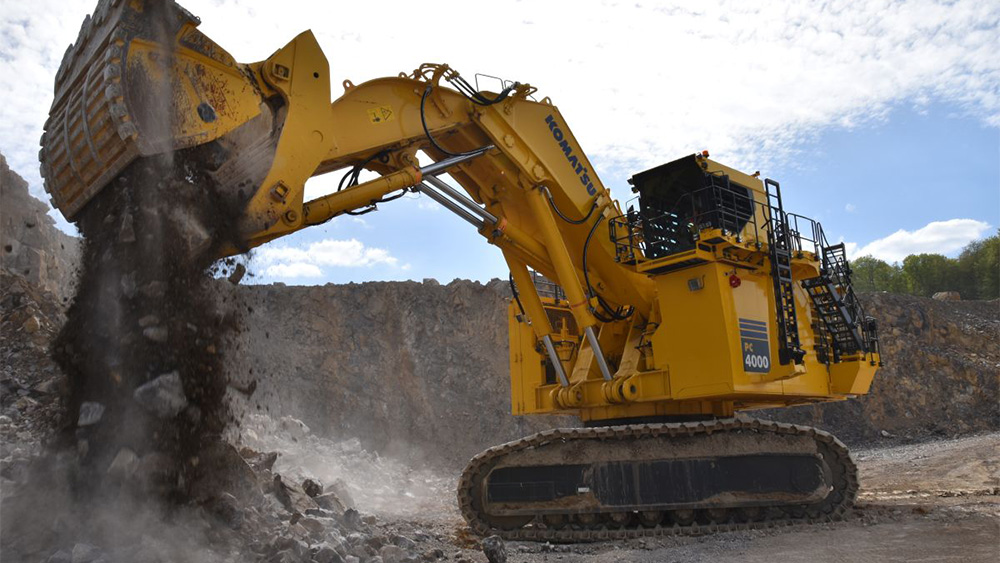
Ultralarge hydraulic excavators for international open-pit mining are the core specialty of Komatsu Germany GmbH—Mining Division. A subsidiary of Japan’s Komatsu Ltd., Komatsu Germany develops and manufactures six models of ultralarge hydraulic excavators in Düsseldorf in the 300–900 tonne class. Customer support, including service and spare parts, is also based onsite.
|
ADVERTISEMENT |
The company has delivered more than 1,200 ultralarge hydraulic excavators, some of which have been in use for more than 25 years and have logged more than 160,000 operating hours. The company holds itself to high standards, offering customers robust, reliable machines built to the highest standards of quality and manufacturing.
There is a clear trend in mining toward ever-larger equipment. Customers want to increase productivity, efficiency, and performance while improving operator comfort and safety.
Komatsu Germany develops solutions to meet these requirements. One such example is the first Komatsu PC9000 ultralarge hydraulic excavator, which was delivered to Canadian energy company Suncor early in 2025. At around 900 tonnes, this machine is currently the largest hydraulic excavator in the world.
Do the increasingly large steel components remain within tolerance?
The development of bigger hydraulic excavators brought new challenges for quality assurance at Komatsu Germany. One of these is measuring the steel components that have been manufactured. The measurement systems previously in use could not handle a measuring range as large as 15 m × 6 m × 6 m (L × W × H).
To avoid the risk of welded steel components exceeding the tolerance range and later requiring costly corrections, the team had to look for a new solution. The new system needed to be able to scan very large components in a short time while being as flexible and easy to operate as possible. This required compact dimensions, a lightweight setup, and minimal cabling. At the same time, the company did not want to compromise on accuracy and repeatability.

The steel structures of Komatsu Germany Mining Division’s ultralarge hydraulic excavators are designed for long service life, high load-bearing capacity, and resilience under extreme operating conditions. This requires high dimensional accuracy of the main components of the excavators, which are made of high-strength steel. These include the upper carriage, which supports the slewing ring, engine, hydraulic systems, and cab. The company uses a HandySCAN MAX|Elite from Creaform to measure the upper carriage directly during production.
Fast measurement using HandySCAN MAX|Elite and the Inspection Software module
![]() HandySCAN MAX|Elite |
The company compared various solutions and ultimately chose the portable 3D scanner HandySCAN MAX|Elite from Creaform, a decision reinforced by the Komatsu Group’s positive experience with Creaform measurement systems at numerous sites worldwide.
Creaform designed the HandySCAN 3D|MAX Series for fast scanning of large parts without compromising accuracy. The HandySCAN MAX|Elite offers point accuracy of 0.075 mm and volumetric accuracy of 0.075 mm + 0.010 mm/m. These levels of accuracy are maintained for parts ranging in size from 1–15 m. Although the scanner looks large because of the greater spacing between its cameras (which ensures impressive scan quality and accuracy), it remains highly ergonomic. Weighing only 1.2 kg, it enables the quality assurance staff at Komatsu Germany to scan large parts throughout the day without causing operator fatigue.
Rapid measurement directly in production
The decisive factor for the company was the size of the captured scan area and the high measurement speed it enabled. Quality assurance staff also find the HandySCAN MAX|Elite easy to operate, because this 3D scanner requires no complex setup and is immediately ready for use. All that’s needed is a laptop, a cable, and the 3D scanner, and measurements can begin immediately.
Its simplicity meant the HandySCAN MAX|Elite was seamlessly integrated into the company’s workflows from Day One. The quality assurance team required only three days of training on their own components; after that, they needed no further support from Creaform.
The hydraulic excavator manufacturer records the 3D scan data, verifies dimensional accuracy, and archives them for documentation.

At its Düsseldorf facility, Komatsu Germany produces ultralarge hydraulic excavators for international open‑pit mining.
The quality assurance team finds it very helpful that the HandySCAN MAX|Elite scanner supports three different levels of detail (scan resolutions), each optimized for point density, scanning speed, and file size. This makes it possible to capture less-detailed surfaces with lower accuracy, while higher accuracy is selected for bearing seats and similar features.
For example, the 3D scanner is used to measure the upper carriages of the PC3000 ultralarge hydraulic excavator. The upper carriage is essentially the “heart” of the excavator, controlling all movements. It rotates on the lower carriage and comprises the operator’s cab, engines, hydraulic systems, and boom mechanism. Mounted beneath the upper carriage is the roller slewing connection, which enables rotation between the upper and lower carriage through the swing drives. This means the steel components of the upper carriage must be manufactured with high precision. With the HandySCAN MAX|Elite, quality assurance can now verify dimensions directly in the steel construction facility, avoiding transport to a measuring room, and determine whether tolerances are met or rework is needed.
The quality assurance team also praises the HandySCAN MAX|Elite for supporting three different scan resolutions. This gives measurement technicians a considerable time advantage when working with large components.
The quality assurance staff is very satisfied with the 3D scanner: Effort and costs are far below those of other solutions that were considered. Komatsu Germany is now considering extending the use of 3D measurement technology to other areas. The company plans to use this technology to measuring products from other departments, while the production fixture construction team has also expressed interest in adopting it. The technology may also be used for components that exist only as 2D drawings, where scan data can be used to create a reference model.
Published Jan. 5, 2026, by Creaform.


Add new comment