Carlos Jones/ORNL, U.S. Dept. of Energy
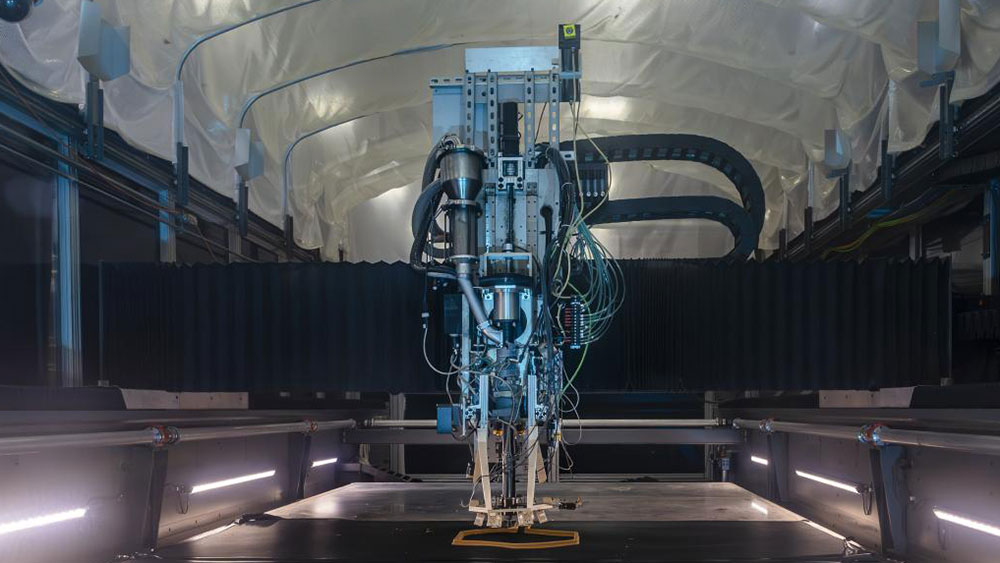
A test object is 3D-printed using a new system to monitor for errors and correct them automatically while manufacturing large items made from plastic composite.
Researchers at the U.S. Department of Energy’s (DOE) Oak Ridge National Laboratory (ORNL) have created a new tool that can catch and correct potential mistakes in real time while 3D-printing large plastic parts.
|
ADVERTISEMENT |
The automated system could help U.S. manufacturers produce large, custom parts with fewer defects, potentially reducing waste, lowering costs, and strengthening domestic competitiveness in additive manufacturing—including 3D printing.
Large-scale 3D printing directs heated plastic composite through a robotic nozzle, arranging layers to form parts such as walls for the building industry, or aircraft wings and car bumpers for the transportation sector. There are many printing variables that control whether layers are hot enough to stick together yet firm enough to hold their shape, a manufacturing balancing act that requires constant supervision.
ORNL researchers created a controller that supervises automatically, freeing workers to focus on more complex tasks. The controller system is equipped with sensors tracking the position of the robotic nozzle, the printing speed, and the temperature of the plastic being dispensed. The team augmented the sensor suite with low-cost thermal cameras mounted around the printing nozzle. These are used to monitor the temperature of the deposited plastic as it cools.

A ring of tiny thermal cameras points at the robotic nozzle depositing plastic composite during testing of the new ORNL platform for correcting 3D-printing errors using automation. Credit: Carlos Jones/ORNL, U.S. Dept. of Energy
Computer vision enhances real-time control of large-scale 3D printing
With computer vision, a type of artificial intelligence enabling a machine to interpret images, the ORNL-developed controller can identify the location and temperature of hot material within a live-streamed thermal image. If the controller spots a deviation from the target temperature, it adjusts the speed of the 3D printing process so each layer cools to the target temperature before the next one is added. This ensures the proper shape and binding between layers, reducing failed prints and wasted material.
“It is novel that our controller can sense what is happening and react in real time,” says Kris Villez, the project’s lead researcher, who partnered with University of Tennessee graduate student Chris O’Brien. “It controls the process almost like a human would by observing and nudging the setting until it reaches the desired outcome.”
To test this, the team first calibrated the control system and adjusted the tight crown of six thermal cameras on the robotic nozzle. The assembly resembles a column of metal tubes laced with colorful wires suspended inside a printer the size of a boxcar. Researchers prepared to monitor how reducing print speed would affect the temperature of the layers. As each layer of plastic was dispensed, the print bed—serving as the floor—lowered slightly to make room for each new layer.

Big-area 3D printers, like this one where experiments are conducted at ORNL, are so large that the print bed is also the floor. Credit: Alonda Hines/ORNL, U.S. Dept. of Energy
The machine printed a hexagon bigger than a truck tire to demonstrate the controller’s performance on a full-scale part. The job started with a low print speed to challenge the new controller. This resulted in material that was about 30% too cool when the next layer was applied. Detecting this, the controller automatically increased the print speed to maintain the best temperature for layers to fuse correctly, demonstrating real-time correction in action.
O’Brien said the tool can detect and correct temperature differences down to just few degrees, which is critical because temperature variations are a common cause of ruined parts.
Unlike some monitoring systems, ORNL’s controller doesn’t need retraining for every new design, which saves time and computing power while increasing flexibility. Villez said the tool is designed to work with any large-area composite printer, any type of plastic, and any shape.
This model used machine learning to create a virtual replica of the physical printing process—a digital twin—which allows risk-free experiments with new shapes and materials, Villez says.
Controller is next step in ORNL research to improve real-time 3D-printing error correction
ORNL is a global leader in advancing the accuracy, affordability, and scalability of additive manufacturing. This project built on a previous ORNL study with Purdue University and the University of Maine that showed the benefits of combining thermal images with a statistical model to improve fault detection in large-scale 3D printing. More recently, researchers at the University of Tennessee-Knoxville and ORNL proved this approach is capable of reliably catching print speeds as little as 15% different from the programmed settings.

ORNL’s Kris Villez adjusts thermal cameras incorporated into a big-area 3D printer before testing a new technology for error recognition and correction. Credit: Alonda Hines/ORNL, U.S. Dept. of Energy
While the earlier project automated fault recognition, the new system goes further by instantly correcting errors.
“There is a vast opportunity space to make these machines more intelligent and more responsive,” Villez says. “In the end, we’d love this to work like baking bread: You set the oven temperature, put in your dough, and return when the timer goes off to see if it’s done. You don’t have to monitor the oven temperature in real time throughout the baking.”

University of Tennessee graduate student Chris O’Brien sets up the 3D-printing apparatus at ORNL to test a new sensing and control technology for creating large objects with plastic composite. Credit: Alonda Hines/ORNL, U.S. Dept. of Energy
Automating the process could free skilled workers from constant monitoring. Villez says it would allow them to focus instead on fine-tuning the balance of speed, product shape, and strength. This renewed and expanded focus could open the door to broader use of large-scale 3D printing for products such as refrigerated shipping containers, molds for boat hulls, and walls of buildings.
Other researchers who contributed to the project include ORNL’s Katie Copenhaver and Alex Roschli, with funding from the DOE’s Advanced Materials and Manufacturing Technologies Office.
The University of Tennessee-Battelle manages ORNL for the DOE’s Office of Science, the single largest supporter of basic research in the physical sciences in the United States. For more information, visit energy.gov/science.
Published May 21, 2026, in Oak Ridge National Laboratory News.

Add new comment