4C Creative CAD CAM Consultants
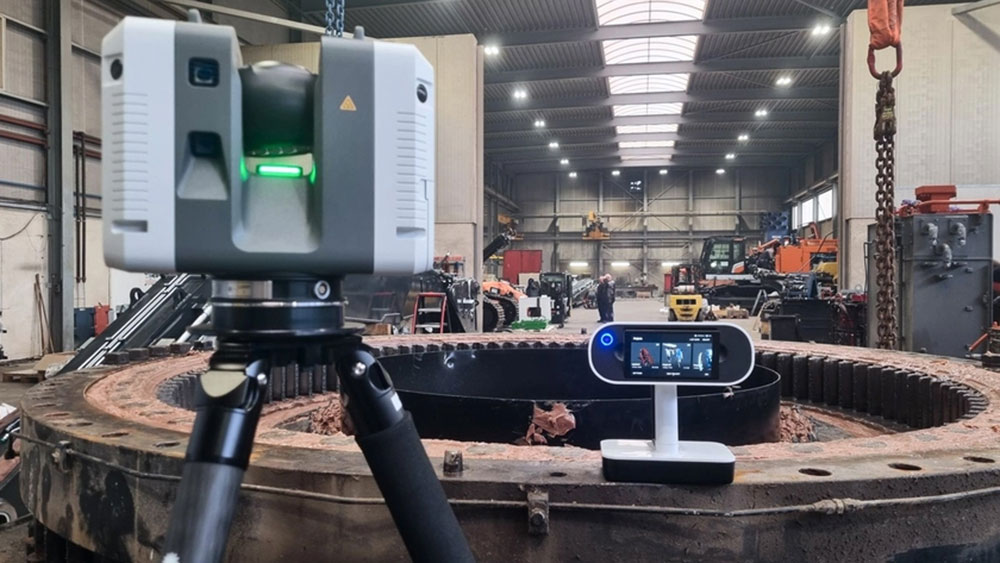
Artec Ray II (left) and Artec Leo at the customer’s workshop.
At the heart of every construction project around the world is a handful of vehicles doing all the heavy lifting. Whether it’s a digger, tractor, or crane, this machinery must be safe, efficient, and fit for purpose—and purpose can depend quite a lot on the project at hand.
|
ADVERTISEMENT |
It’s often possible to change tools mounted to the end of their hydraulic arms, making industrial equipment fairly adaptable. But in certain cases, where necessitated by obstacles, ground clearance, or environmental hazards, more extensive modifications are required.
That’s where Artec’s 4C Creative CAD CAM Consultants come in. During the last six to seven years, it has offered its services to an excavator in the Netherlands. 4C’s latest modification project saw it called out to digitize a 10-meter vehicle featuring a cabin with complex internals, an air filtration system, and a boom mounted to a rotating platform with Caterpillar tracks.

Artec Leo with an onscreen 3D scan of the vehicle’s Caterpillar tracks. Image courtesy of 4C Creative CAD CAM Consultants.
Traditionally, getting hold of CAD data for such a large, complex structure would require slow, methodical manual modeling. Introducing 3D scanning into the equation allowed 4C to capture the equipment in its current state for measurement later on. Better yet, pairing Artec Leo and Artec Ray II meant not having to compromise scale or accuracy, allowing for the best of both worlds.
Leo and Ray II: A match made for problem solving
With a built-in display, battery, and processor, Leo is usually more than capable of capturing large objects by itself. In this case, Ray II was brought in to supplement the device’s versatile scanning capabilities with long-range data capture. Mounted high above the rest of the vehicle, its hydraulic arm was especially difficult to reach with Leo—but it was no problem for Ray II.
Another challenge was capturing data underneath. Weighing several tons, the equipment sat just 80 cm above ground level, making it unsafe to scan from below. Removing Ray II’s tripod and positioning it on the floor proved to be the perfect solution. This allowed the vehicle’s underbelly to be quickly captured from all angles without any unnecessary risks.

Artec Ray II alongside the customer’s hydraulic arm. Image courtesy of 4C.
To meet customer requirements, 4C was also asked to capture the machine’s staircase. This is where Leo and Ray II excelled.
“The challenge here was capturing the geometry of the stairs and the handrails—you could easily lose tracking,” says company co-owner Rogier Rappard. “Using Leo, it also would’ve meant aligning a lot of scans. Instead, we captured with Ray II from the side. Then we used Leo to focus on scanning the most important parts with high resolution and accuracy.”
Merging different datasets in one click
In 3D scanning, the power is often in the software. This is especially true of Artec Studio, which includes the unique feature Smart Fusion. Not only does it combine point clouds from long- and short-range 3D scans—it uses the highest-resolution data available for peak results.
Those wanting to take full control over data processing can also align scans themselves. 4C aligned its scans based on geometric features and merged them using the software’s Sharp Fusion algorithm. Compared to other target-based workflows, Rappard says this is “much more efficient and less time-consuming” while still delivering an outstanding level of precision.
Click here to watch Boom by 3dscanservice on Sketchfab.
Scan decimation came in handy with this project. Capturing the entire vehicle with structured-light 3D scanning would have resulted in a huge file with about 50 GB of information. Decimating the final model to remove unneeded polygons reduced this figure to just 300 MB, making it much easier to send to third-party software for modification.
Artec Studio’s ability to share fully formed meshes also lends itself to intuitive file sharing. Zooming in on point clouds can cause distortion, making them tricky to measure. But Ray II point clouds can be sent directly as OBJs and STLs that are textured, polished, and ready to go. With these meshes, it’s easy to use CAD primitives for perpendicular measurement.
According to Rappard, Artec Studio’s built-in tools unlock a range of other applications as well, including feature extraction for design referencing. In this particular project, collected data turned out to be critical to strength analysis carried out via simulations designed to ensure modification durability.
Technology that leaves users ‘blown away’
From forensics to the defense industry, 4C continues to find new applications for Leo and Ray II, a unique proposition in 3D scanning. No other solution merges LiDAR and handheld structured-light 3D scans so seamlessly. New adopters are often left stunned by the results.
Rappard says, “Every time that I visit clients, Artec Studio makes it so easy to demonstrate pinpoint alignment. You just find similar geometry between two scans and align it. They are always asking: ‘Is it possible to combine scans? How does that work?’ When I show how simple it is, they’re always blown away about what’s possible with the technology.”

A 3D model of Caterpillar tracks captured with Artec Leo in Artec Studio. Image courtesy of 4C.
Having the versatility to digitize large items in any environment also has real-world benefits. In another project, 4C was charged with capturing factory machinery. Without 3D scanning, the factory would have had to cease production for two or three days so surfaces could be measured. Leo reduced overall downtime to just two hours, and adding Ray II makes this approach easy to scale.
Often, Leo and Ray II are deployable on their own. In the case of this vehicle, Leo could digitize the whole structure in high resolution. Ray II also captures large objects with ease. But together, they made it possible to generate a lightweight 3D model with accuracy where it matters. With this kind of versatility, it’s no wonder that the technology is taking off in industry and beyond.


Add new comment