Buffalo Metrology
Buffalo Metrology Inc. (BMI) was recently tasked with reverse engineering an 8 ft outside-diameter clarifier cover used in the mixing/agitation industry. The goal was to inspect the fracture on the tapered face of this component as part of a possible new cover fabrication.
|
ADVERTISEMENT |
Clarifier agitators are commonly used for groundwater treatment processes to act as a filter to remove impurities such as solids (sludge and scum) that settle in containers or float to the top of liquids. Due to continuous mechanical loading and rotational forces, the clarifier cover integrates several critical features, including bearing alignment surfaces and weld locations. BMI’s customer requested that this cover be inspected to fabricate the original bearing alignment and weld placements.
The primary objectives of the project were:
• Inspect and assess a visible fracture on the tapered surface of the cover
• Capture highly accurate dimensional data of the entire component
• Develop a complete 3D CAD model to support fabrication of a replacement unit
• Ensure all critical functional features were replicated with precision
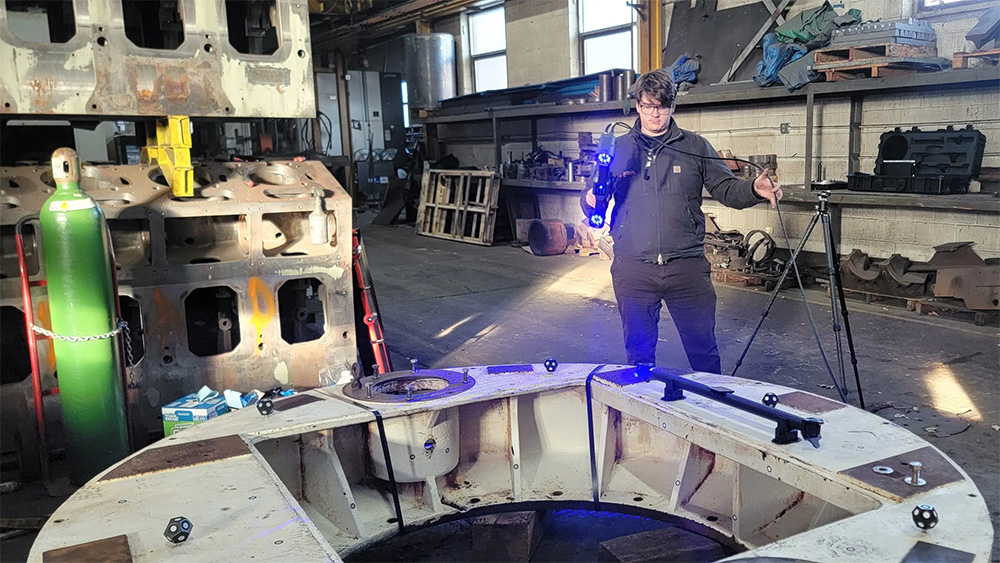
This inspection for reverse engineering was done in one day using a Shining 3D FreeScan Trak Nova. Multiple scan datasets were captured from different orientations to ensure complete surface coverage. This was followed by weeks of analysis from BMI’s engineering staff.

The repair
Visible in the picture above is a fracture along the top taper of the clarifier cover. Current metal-locking service (a cold repair process for cracked or fractured cast metal) is being performed to repair the component. Failure and load testing will need to take place following the metal locking repair. If the repair attempt is successful, a new unit won’t be needed. However, by reverse engineering concurrently with the repair, BMI has a head start should a new unit need to be fabricated.

3D data acquisition by FreeScan Trak Nova
Engineering and inspection
The clarifier cover was scanned with the FreeScan system at the top face, ID, OD, and bottom face. Resolutions of the captured data were at 0.1 mm and 0.2 mm with a metrology-grade accuracy of 0.02 mm (20 um). BMI was able to provide one day of onsite support to acquire a full polygonal model. The scan data were imported into PolyWorks, where the engineering team analyzed dimensional features, verified alignment surfaces, and identified all critical geometries needed for accurate reproduction. By combining several large scan files, the team ensured complete coverage and precise measurement of the component.

This image shows multiple 3D scans overlayed in PolyWorks to create one solid model for reverse engineering. The clarifier cover is being reverse engineered to gain information on dimensional data for new fabrication if required.
Reverse engineering process
With the completed scan data in place, Buffalo Metrology’s engineering team transformed the high-resolution 3D mesh into a fully detailed CAD model of the clarifier cover. Rather than simply copying the damaged part, the team extracted all critical dimensions from the scan and rebuilt the model. With nominal dimensions, the team will be able to create a manufacturing process to support the new fabrication of a clarifier cover, should it be needed. Manufacturing a new clarifier unit will most likely involve new material purchase, machining, and weldments included with the ID supports. Bearings would need to be press-fitted to the assembly.
The final results
The replacement clarifier cover will be fabricated from an industry-standard grade of carbon steel suitable for agitation applications. Material selection, structural considerations, and dimensional accuracy are all guided by the nominal model derived from the 3D scan data.
Buffalo Metrology will engineer a reinforced assembly based on the nominal model and the operational demands of the agitator system. The new design will incorporate welded center supports and structural enhancements to ensure the cover can withstand the significant loads generated during mixing operations.

Add new comment